


Book Review: Beyond Profit: How purpose-driven leadership can transform organisations and wellbeing
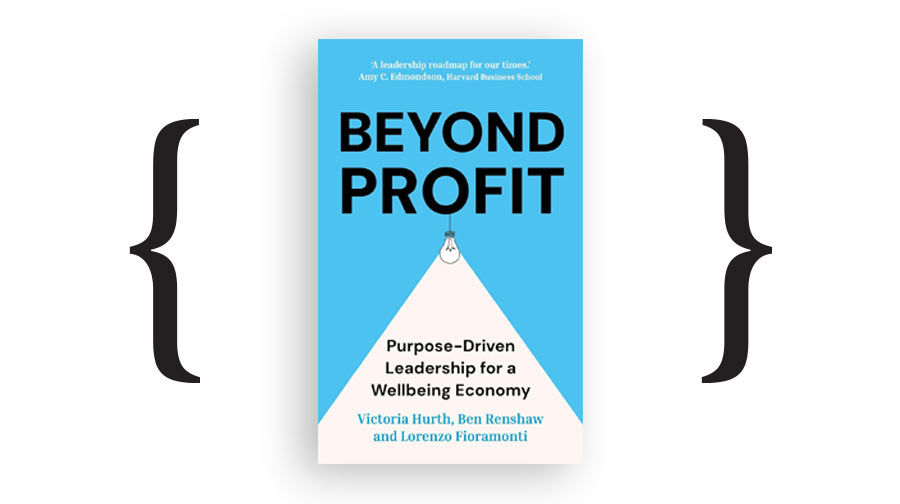
Beyond Profit: How purpose-driven leadership can transform organisations and wellbeing
By Dr Victoria Hurth, Ben Renshaw and Lorenzo Fioramonti
Amazon link
There’s a certain irony in the fact that, at the very moment the world feels increasingly fragmented, the most compelling ideas today are those that urge us to reconnect — to purpose, to people, to nature and to wellbeing. Beyond Profit belongs firmly in that camp.
I have known Dr Victoria Hurth for a number of years. We first met through a think-tank established by Ben Kellard of the Cambridge Institute for Sustainable Leadership. A gathering of practicing consultants and academics united by curiosity and a desire to challenge the status-quo, Victoria’s boundless energy was a driving force of the many debates we had about ‘all matters purpose’ during evening meetings and weekend retreats. It came as no surprise to me then, that she would later channel that energy into something that will genuinely make a difference. Her leading role in the vanguard of the of development of ISO 37011 (the forthcoming international standard that will define what purpose-driven governance looks like), and the publishing of Beyond Profit with Ben Renshaw and Lorenzo Fioramonti are testament to both her thinking and her remarkable determination.
Because of our relationship and the shared objectives that have shaped so many of our conversations over the years, I’ve set aside my usual review style and asked Victoria directly what five ideas she most wants readers to take away. Here’s my take on what she shared with me:
1. Purpose is contribution, not extraction
The first and perhaps the most foundational point is that organisations exist to contribute, not merely extract. Economies are supposed to produce long-term collective wellbeing; yet the way many companies operate achieves the opposite. Self-interest and survival are not innovation strategies. Nor are they adequate lenses for stewarding the scarce resources on which our future depends.
Moving beyond profit is not ideological; it is, in fact, totally rational.
2. A purpose-driven economy requires purpose-driven governance
If contribution is the goal, governance is the engine.
Governance determines:
- What an organisation exists to do
- The boundaries within which it must act
- The accountability mechanisms that keep it honest.
Shifting from business-as-usual to purpose-driven governance is not incremental, it’s transformative. It redefines performance. It shifts incentives. It opens the door to innovation that serves more than the balance sheet. And crucially, it recognises that a better future will not emerge by chance.
3. Leadership as courageous, human service
Leadership is a compassionate, courageous practice of service. The work of creating the conditions in which people can flourish and contribute to something better than the present. Fear, control and narrow financial incentives do not unleash creativity; they actually corrode it. A purpose-driven economy needs leaders who see humanity not as a drag on performance but as its primary asset.
4. The wellbeing economy where all stakeholders flourish is within reach — but only if we modernise governance
A wellbeing economy is not utopian. It is achievable, but only if the technical architecture of governance changes. The upcoming standard ISO 37011 to be published late next year, will provide exactly that blueprint.
5. If not this, then what?
If we do not intentionally redesign governance around purpose, then we are choosing the status quo — choosing extraction, fragmentation and harm.
The question, then, is disarmingly simple:
If not purpose-driven governance, what alternative can credibly deliver long-term wellbeing?
A clear, necessary contribution
Beyond Profit is not another corporate feel-good manual. It is a system-level argument delivered with clarity and moral seriousness. It challenges leaders to rethink not just their organisations but their assumptions about the economy itself.
By bringing together Victoria Hurth’s governance expertise, Ben Renshaw’s leadership insight and Lorenzo Fioramonti’s economic perspective, the book achieves something rare: It bridges disciplines without diluting their depth.
For leaders grappling with the demands of 2026 and beyond — technological disruption, social fragmentation, environmental constraints — this book offers both the intellectual framing and the practical orientation needed to steer in a more purposeful direction.


Beyond flat-packs: What IKEA’s arrival means for purpose-driven governance
IKEA shows that you can scale globally, serve meatballs and still lead with integrity.
First published in Chapter Zero New Zealand – 18 Nov 2025
In December, IKEA will finally open its first New Zealand store in Auckland. I’m old enough to remember the opening of IKEA’s first UK store in 1987 – but I don’t recall it generating quite this level of excitement. For many, IKEA’s arrival promises affordable Scandinavian design and meatballs. For me, it represents something deeper – the arrival of a company that has demonstrated over decades what can be achieved by challenging the status quo, leading with values and being single-mindedly purpose-driven.
Behind the blue-and-yellow logo stands Ingka Group, the largest IKEA franchisee and the operator of nearly all IKEA stores worldwide. While the IKEA trademark and concept are owned by Inter IKEA Systems B.V., Ingka Group is responsible for global retail operations, investment activities and the company’s world-leading approach to business governance. It’s a governance model that focuses people and sustainability around a widely understood core purpose and combines it with distributed accountability – and it works.
Ingka Group has shown that commercial success and positive societal impact are not opposing forces; its integration lies at the very heart of IKEA’s success. Its stated purpose – to create a better everyday life for the many people – is not a slogan but an organising idea. It shapes everything from how products are designed and priced to how materials are sourced, employees are treated, stores are powered and decisions are made in the boardroom.
Happily, Ingka is prepared to share and foster greater understanding of its success and the potential of being purpose-driven. First published in 2017, Ingka Group released its latest People & Planet Consumer Insights & Trends Report – a global study conducted with Canadian research partner GlobeScan – in October this year. Together their work tracks and captures the pulse of public expectations of business around the world. New Zealand directors should pay attention to the numbers. They might also pause to ask a simple question – why does a company that sells furniture publish such a report?
Despite the divisions fuelled by short-termist populist politicians, the squeeze of rising costs and the chaos of click-bait misinformation, something essential endures: people still care about one another, they fear for the climate, they dislike injustice and they long for a future – and a world – that is fair for everyone.
- 64% worry about climate change and almost half feel personally affected.
- 82% want companies to pay living wages and 36% say they boycott brands that fail to treat workers fairly.
- Seven in 10 consumers want clearer communication from businesses about the environmental and social impact of their products.
- Younger generations are leading, pioneering circular habits such as buying second-hand, renting and repairing.
This is not a consumer-trends report – it’s a governance signal and a wake-up call for boards. New Zealand stands at its own inflection point. Productivity is slipping, inequality is widening and, like elsewhere in the Western world, trust in both business and government is eroding. Yet there is also a deep-seated belief among Kiwis that we can, and should, do better – that values matter and that what unites us is far greater and more powerful than what divides us.
IKEA’s success offers three key lessons in the power of purpose as an organising idea – one that unites an entire enterprise, delivers measurable outcomes and drives long-term sustainable success:
- Make purpose the organising idea
Purpose only delivers when it sits at the heart of strategy and operations – not as an add-on or aspiration. From flat-pack logistics to renewable energy and circular design, IKEA has built its entire system around one clear idea. Everything else flows from that core purpose. - Align purpose with real-world value
The Ingka/GlobeScan report shows that saving money remains the top motivator for sustainable behaviour. IKEA’s genius lies in linking purpose with affordability – proving that what’s good for people and planet can also be good for profit. Boards that align purpose with everyday value creation turn ideals into enduring commercial success. - Govern for the long term
IKEA’s purpose endures because its governance model demands it. Ingka Group’s structure – a foundation with a long-term ownership mandate – protects purpose from short-term pressures and political fashion. Boards that design governance around purpose, not quarterly results, create the conditions for consistency, innovation and trust.
When the doors open in December, IKEA will undoubtedly attract large crowds eager to experience its mix of design, efficiency and Scandinavian charm. But the bigger story is what those crowds are recognising and rewarding through spending their hard-earned cash. Simply put, that is an approach to business superbly executed every day at scale, across the world by a company that has embedded purpose into the core of its governance, operations and culture – and prospered as a result.

Why do companies greenwash?
Why do companies greenwash?
Z Energy’s recent apology for misleading environmental claims poses a question: Why do companies keep greenwashing?
In 2022, Ampol owned Z Energy told New Zealanders it was “in the business of getting out of the petrol business.” It sounded like a radical step for the country’s biggest fuel importer — a bold signal that the company was changing course.
Three years later, after a costly legal dispute with Consumer NZ and environmental groups, Z Energy has admitted the truth: Its much-promoted biofuels plant wasn’t operating, its carbon-reduction claims excluded the emissions from the fuel it sells, and its messaging went “beyond aspirational.”
To its credit, the company has apologised. But the questions remain: Why do smart, well-resourced businesses keep saying one thing and doing another?
Z Energy is not an isolated case. Around the world, major brands have been caught in the same web. In the same sector, a quarter of a century ago, I saw firsthand the results of going “beyond reality” while working for the WPP branding agency that came up with BP’s now-infamous “Beyond Petroleum” rebrand. It’s a landmark example I’ve written and spoken about often over the years — a powerful core purpose and potential single organising idea that could have changed everything at BP and across the entire sector — if only Lord Browne, then CEO, had delivered on it.
Volkswagen’s “Clean Diesel” campaign promised low-emission performance but concealed deliberate manipulation of emissions tests is another case in point. H&M, Nestlé, Shell, HSBC, Kmart and others have all faced scrutiny for sustainability claims that overstated progress or obscured uncomfortable facts.
So why do they do it? Here are some reasons:
- To protect reputation – appearing progressive buys time and goodwill.
- To meet stakeholder pressure – investors, customers and employees expect and are much more vocal about, their expectations of business.
- To retain market relevance – being seen as sustainable, rather than being sustainable, has ironically become a survival strategy.
- To disguise inertia – rhetoric fills the gap where innovation and progress aren’t actually happening.
- To simplify complexity – clever marketing and creative advertising can tell a more compelling and engaging story than reality allows.
- Because of fragmented governance – the left hand (marketing) doesn’t know what the right hand (operations) is doing.
- Because leadership confuses communication with commitment – they believe saying it is the same as doing it.
- Because the system still rewards short-term profit – quarterly earnings trump long-term purpose.
- Because they lack a strategy for the future – senior leaders see change as risky and managing efficiencies as progress, missing out on the innovation that comes from grasping the future and contributing to it in ways that create new ideas, new value and sustained relevance for all stakeholders.
- Because they really don’t understand the power and potential of purpose — as a single organising idea that drives progress from the heart of business.
Most companies don’t set out to deceive. They simply haven’t re-engineered their businesses to deliver what their slogans promise. The result is an obvious credibility gap between what they say and what they do.
The hidden cost of that gap
The Z Energy case highlights the price of that gap.
The company spent hundreds of thousands of dollars in legal fees and lost months of leadership focus defending its own words. Far more damaging, though, is the erosion of trust.
Z’s chief executive, Lindis Jones, has walked a fine line between contrition and justification. He apologised “to the extent we caused any confusion,” but defended the campaign as “aspirational and provocative,” arguing it reflected the company’s intent to transition over time. It was, in effect, an apology for misunderstanding — not misrepresentation.
That distinction matters. Because when leaders stop short of full accountability, they signal that the problem is perception, not practice. The risk is that it entrenches the very behaviour the apology was meant to resolve.
When customers and communities discover that big environmental statements aren’t backed by real action, cynicism grows. The next time a company makes a genuine commitment, the public shrugs.
The collateral damage is borne by everyone — including the businesses trying to do the right thing.
The alternative: Walking the talk
There is another path, and we can see it in companies that have truly embedded purpose — organisations like Patagonia, Interface, Unilever and IKEA.
These businesses don’t just talk about sustainability; they integrate it into how they’re governed, how they invest and how they measure performance. They demonstrate that when purpose is treated strategically as a governance framework, not a slogan, it produces measurable benefits:
- Stronger stakeholder trust
- Greater innovation and resilience
- Higher employee engagement and retention
- Improved long-term performance
- Positive social and environmental impact
The irony is that if most companies actually did what their marketing departments claim, they would perform better — commercially as well as ethically.
The real issue is a failure of vision
Companies don’t greenwash because they’re evil. They greenwash because they lack a vision of the future.
Fixated on managing the status quo through lobbying politicians to protect short-term results, they are closed-minded to the possibilities of tomorrow — to the power and potential of new ideas to transform their businesses and ensure their long-term success.
Businesses such as Z Energy are emperors without clothes. They have jumped on the purpose bandwagon. They are not driven to make a positive difference to people and planet — but they are comfortable talking about it.
And that’s a great shame — and a lost opportunity. Because given their resources and influence, with a little courage these leading companies could do so much more than peddle purpose statements — they could live by them.
And that would benefit them and all of us as well.