



Beyond business: Why purpose’s moment is still ahead of us
Beyond business: Why purpose’s moment is still ahead of us
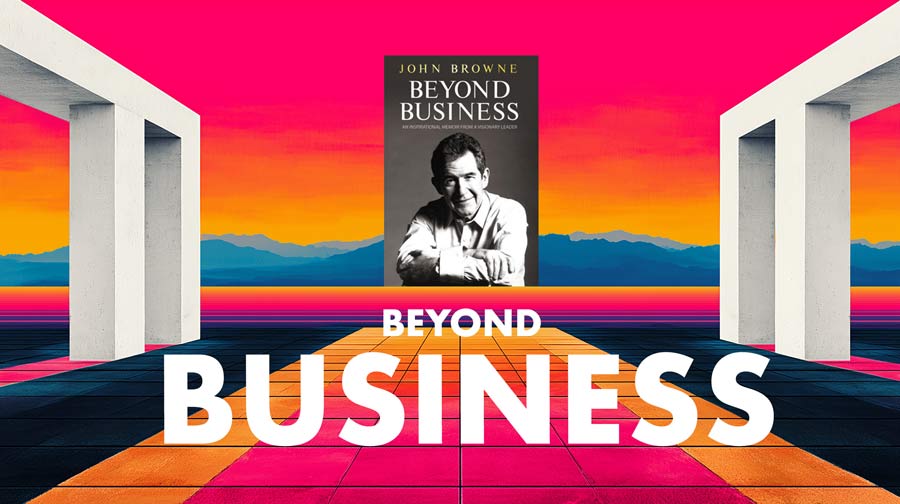
When Beyond Business was published back in 2010, it landed as a serious intervention in the debate about the role of business in society. Written by the former CEO of BP, John Browne, it argued that companies could no longer afford to see profit and responsibility as separate conversations. For Browne, sustainability, integrity and long-term value creation were no longer optional extras, they were becoming the central features of future business success.
I read the book through a particular lens. I worked at Enterprise IG, the global branding agency where BP’s infamous Beyond Petroleum ‘brand promise’ was coined at the turn of the century. That proximity made Browne’s arguments feel less theoretical, more immediate and I wrote about his ideas and challenges quite extensively in my first book, CORE. This was a brand promise not as a cosmetic idea, but as something new and different. It was a rallying call and a bold attempt to re-orient one of the world’s most powerful companies — and potentially an entire industry — around a shared sense of purpose fit for a future that would be better for all. Better for shareholders, better for employees, better for society and better for the planet.
It remains for me a lesson from history. Its failure was not down to a lack of vision, but ultimately, a lack of courage and leadership in the face of short-termist thinking and the self-centred agendas of those who stand in the way of progress and capitalise through business as usual by maintaining the status quo. A status quo incidentally, that often profits from creating problems for people and planet, rather than profiting from solving them.
Fifteen years later, much has changed. Purpose has moved from the margins to the mainstream. It is part of the corporate vernacular and almost every business claims to have a purpose. And yet, much has stayed stubbornly the same. The gap between intent and execution remains just as wide and purpose is still too often treated as brand narrative rather than operational discipline, positioning rather than governance. There is a big difference between having a purpose and being purpose-driven.
Re-reading Beyond Business today is therefore both instructive and uncomfortable. It reminds us how long these questions have been on the table and how slow and uneven our progress has been in answering them. But the lesson it offers us now is not to look back in anger at lost opportunities, but to look forward with resolve.
As we approach a new year and enter the second quarter of the 21st century, it feels like the right moment to lift our gaze. At the very beginning of the first quarter, Browne’s Beyond Petroleum appeared radical, imperfect, ahead of its time and was ultimately, an opportunity missed. Ensuring purpose is properly understood and implemented by today’s leaders will give the next quarter of the century the opportunity to deliver on the promise the first could only glimpse.
For those interested, my original review of Beyond Business can be found on the NG&A website.


Here comes the shift: Why 2026 marks the quiet arrival of purpose as discipline: Part 2
Part Two: Here comes the shift: Why 2026 marks the quiet arrival of purpose as discipline
History rarely announces its turning points. More often, they slip quietly into view, obvious only in hindsight. 2026 will be one of those moments. It is the year when purpose stops being a sentiment and begins to function as a system — when leaders discover that the question they’re being asked is no longer whether purpose matters, but whether they possess the plans and discipline to make it operational.
The forces reshaping 2025 are not dissipating; they are tightening. Markets remain volatile, geopolitical tensions have hardened into structural rivalries, climate impacts are accelerating and public trust in institutions continues to erode. Supply chains are more exposed, conflicts are redrawing alliances and economic conditions are more brittle than many care to admit. Against this backdrop, purpose is no longer a rhetorical accessory; it becomes a stabilising logic. A way for organisations to navigate complexity with coherence and avoid being pulled off course by the growing volatility of external shocks.
A shift in how businesses are governed is underway and purpose is quietly evolving into a proxy for capability. Words alone will no longer suffice. Investors, employees and citizens will increasingly judge leaders not on what they say about the benefits of a purposeful future, but by the consistency with which they align resources and reward decisions and behaviour that deliver it. Put simply, it will test whether leaders can articulate a unifying idea, link decisions to it and maintain that alignment under pressure.
This is why governance now moves to centre stage — because this is where purpose finally hardens into discipline. The arrival of ISO 37011 in late 2026 will provide the first global standard that treats purpose not as a slogan but as an organising principle. Its significance lies in its clarity: It articulates what many leaders have sensed yet struggled to codify — that purpose must shape the rules, incentives and architecture through which decisions are made. It gives boards and executives a shared vocabulary and, more importantly, a shared expectation.
With clearer standards, accountability follows. Organisations will increasingly be assessed on how purpose influences resource allocation, how it alters risk, how it shapes culture and how it governs outcomes. Vague claims and selective reporting will become harder to defend in a world weary of performative language. The distinction between sincere purpose and cosmetic purpose — between leadership and theatre — will sharpen.
The expectations placed on leaders themselves are shifting just as rapidly. People are not demanding perfection; they are demanding coherence. They want leaders who speak plainly about trade-offs, who acknowledge uncertainty without surrendering responsibility and who behave as if their decisions carry consequences beyond their own convenience. These expectations are neither ideological nor sentimental. They are a rational response to a world in which problems are interconnected and leadership conducted in isolation is no longer tenable.
Those who grasp this moment will have the chance to define more than organisational success. They will influence the operating logic of the next decade. Their authority will come not from their rhetoric but from the alignment of their systems. Their credibility will rest on the discipline with which they embed a unifying idea into the everyday machinery of decision-making.

Here comes the shift: How purpose is bridging the divide: Part 1
Part One: Here comes the shift: How purpose is bridging the divide
As 2025 comes to a close, I’m noticing something rare in a year marked by noise and division — alignment. Not perfect alignment, the world is far too messy for that, but a quiet, unmistakable coalescence around the idea that unity through shared purpose is no longer fringe, optional or idealistic. It is emerging instead as a realistic antidote to the destruction that division wreaks. Purpose, as a driver of future prosperity and human wellbeing, has crossed a threshold. The innovators have broken down the barriers, the early adopters have done their job and we are now unmistakably in early-majority territory.
And when the early majority moves, markets move.
This shift isn’t ideological. It’s structural and it’s being driven by five converging forces:
- Geopolitics, which have made fragility impossible to ignore.
- Socio-economics, where inequality and insecurity are reshaping beliefs and behaviours.
- Demographics, with younger workers, acutely aware of the world they’re inheriting, increasingly unwilling to collude with business-as-usual.
- The environment, where climate change, biodiversity loss and resource constraints are forcing ever more urgent thinking around risk, resilience and responsibility.=
- Technology, particularly AI, which is forcing organisations to define what makes them meaningfully human.
Together they form an irresistible tide. You can, of course, sit on the shore like King Canute and command the waves to stop rolling in. But, just like the waves, markets will continue to do what markets do and reward those who meet the needs, values and preferences of customers, employees and investors.
This is why the 2025 narrative coming from the business-as-usual ‘Canute Brigade’, that ESG or sustainability has somehow gone away, is so misplaced. ESG hasn’t gone away. The only thing that has changed is the language. And frankly, thank goodness for that, because we are finally talking about how purpose drives performance, catalyses innovation and creates long-term value, rather than being sidelined by deny–delay–distract tacticians with their ‘woke caricatures and ‘dig-baby-dig’ calls to invest in industries in decline, while, the world’s richest and arguably most successful businessman pointed out, “severely damaging industries of the future.”
Mr Musk isn’t wrong to identify the tension. Many nations, including Aotearoa New Zealand, still find themselves caught between two instincts:
- Dig, baby, dig — invest in what we know, even as it declines.
- Bet on the future — back the industries, capabilities and governance models that will define the next 10–20 years.
These are not abstract forces grinding away in the background. They are choices made by people, in rooms, around tables, weighing up risk, reward and reputation. Which is why the question of who sits at those tables and how they think about their role matters now.
In a recent interview, Barack Obama said something that captures the spirit of this moment. He reflected on sitting in rooms with “folks with fancy titles,” only to discover they were not superhuman after all. Some brilliant, some not, some admirable, some deeply questionable. In his words:
“Once you sit at these tables…you talk to them and you go…oh, they ain’t all that.”
That sentiment is at the heart of why purpose is spreading. People are finally realising that the work of building better organisations, and better societies, isn’t reserved for the anointed few. It belongs to all of us.
Qiulae Wong, The Opportunities Party’s recently anointed leader, summed up her CitizenVoice policy in strikingly human terms: Connect as people first rather than hiding behind screens, give those most affected by decisions a genuine role in shaping them and remember that community, not radical individualism, is ultimately what makes societies work.
What interests me is what this signals about expectations of governance from the point of view of a relatively young political party entering an arena dominated by traditional organisations, with traditional ideas for a traditionally minded ‘voting constituency’. This is not challenger-brand veneer. It is a pragmatic and thoughtful reaction to the status quo and a model of governance that reflects what society is increasingly demanding from all our organisations — participation, transparency, fairness and long-term thinking.
Part Two will explore what this means for leadership in 2026. The courage to choose the future over the past, the discipline to align governance with purpose and the role of ISO 37011 in separating those who are merely talking about change from those who are prepared to contribute and lead it.