




Walking the Purpose Talk Series: Innovation
Walking the purpose talk: A series exploring how leaders bring purpose to life by aligning what they do with what they say they stand for.
Innovation
Over the past decade, purpose has moved from the margins to the mainstream of business thinking. Many organisations now have a clearly articulated purpose, a statement that explains why they exist and what they seek to contribute beyond financial return.
Far fewer, however, are genuinely driven by one.
Being driven by purpose is not about intent or aspiration. It is about consequence. It shows up in what products and services an organisation chooses to sell, which markets it participates in, which revenues it is prepared to forgo, and which opportunities it actively pursues. When purpose is real, it constrains as much as it inspires.
In a genuinely purpose-driven organisation, purpose acts as the single organising idea of the enterprise. It sits at the core of strategy, not running in parallel with it, not competing with commercial priorities, but actively shaping them. It informs decisions across the whole system: sales and marketing, systems and processes, communications, products and services, innovation, people and culture, procurement, and leadership itself.
This is where many organisations struggle. Purpose is identified, sometimes eloquently, but the business continues to operate much as it did before. Strategy advances down one track; purpose runs alongside it on another. Over time, that separation creates inconsistency, confusion and accusations of hypocrisy labelled as purpose-washing.
This series of articles is written to prompt reflection for leaders navigating that terrain. Some will already have a stated purpose and be grappling with how to align the organisation around it. Others may sense that something more is required but are unsure where to begin. The intent here is not to prescribe the Single Organising Idea (SOI®) methodology, but to surface the questions leaders need to ask if purpose is to become operational rather than ornamental.
We are starting with innovation. Not because it is the first domain every organisation should address, but because it is one of the most revealing. Innovation is not just about the new ideas an organisation chooses to explore and invest in. It is also where intent meets investment, and where the gap between words and action becomes visible very quickly.
Seen this way, innovation becomes a discipline of focus rather than creativity alone. It exposes whether purpose is genuinely shaping priorities, or simply sitting in the background as an expression of good intent.
Innovation as a test of seriousness
Innovation is often treated as a signal of ambition, evidence that an organisation is looking forwards rather than backwards. But viewed through the lens of purpose, innovation reveals something more exacting — whether an organisation is prepared to act differently, not just think differently.
This is why innovation so often exposes the gap between what organisations say they are here to do and what they actually prioritise. It is one thing to articulate a purpose; it is quite another to allow that purpose to shape where time, talent and capital are deployed.
When purpose is genuinely at work, innovation priorities change. Leaders move beyond asking what could we do next? to what should we do next, and why? Initiatives are judged not only on commercial potential, but on coherence with the organisation’s core idea. The result is not less innovation, but more deliberate innovation.
A useful illustration can be seen in Patagonia®. Far from constraining growth, Patagonia’s environmental purpose has actively shaped the company’s innovation agenda, from product design and materials science to repair, resale and circular business models. Initiatives such as Worn Wear, supply-chain transparency and long-term product durability were not bolt-ons to a conventional growth strategy; they flowed directly from a clear point of view about what the company exists to do.
Importantly, this clarity has not diminished commercial performance. Patagonia has grown, not in spite of its purpose, but because its innovation efforts are coherent, differentiated and trusted. Purpose narrowed the field of possibility, and in doing so, strengthened both relevance and resilience.
Innovation is ultimately a leadership choice
For all the language of creativity and experimentation, innovation does not happen in a vacuum. It is shaped, consciously or otherwise, by leadership decisions, incentives, risk appetite and what the organisation chooses to reward or protect.
When purpose is peripheral, innovation defaults to familiar measures: speed, return, imitation. When purpose is central, those measures are supplemented by a more searching question: does this advance what we are here to do?
This does not replace commercial discipline; it refines it. Organisations that take purpose seriously do not innovate indiscriminately, they innovate coherently. They are clearer about the value they seek to create, and the value they are prepared to walk away from. Over time, that coherence compounds.
A revealing place to begin
Innovation is not the only domain that must align with purpose. Communications, systems, culture, leadership and measurement all matter, and each will surface different tensions. But innovation is a revealing place to begin because it forces intent into contact with reality.
It challenges leaders to move beyond aspiration and ask whether purpose is actively organising decisions, priorities and trade-offs, or merely accompanying them.
Purpose sets direction. Innovation reveals whether the organisation is actually moving.
In the next article, I’ll turn to another domain where this gap becomes visible very quickly — communications, and how misalignment there can undermine even the strongest intentions.

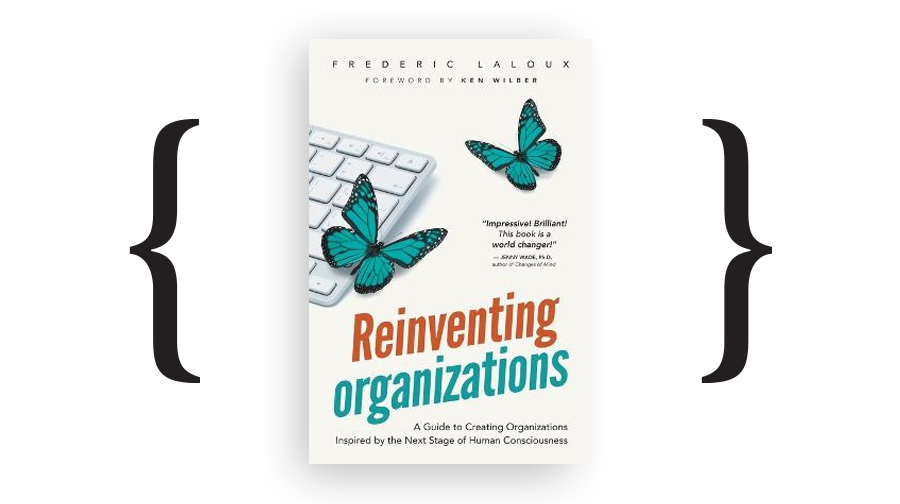
Book Review: Reinventing Organisations
Book Review: Reinventing Organisations
I didn’t simply read Reinventing Organizations when it was published back in 2014 — I devoured it. I pored over it, took it apart, tested its ideas against lived experience and returned to it repeatedly while shaping my own thinking and the development of my Single Organising Idea (SOI®) framework. Laloux’s work acted less as a template than as a provocation. To be completely open, I wanted to better it.
I didn’t. Reinventing Organizations is a work of tremendous insight and foresight. What I gained instead was clarity and direction. Where Laloux explored what a more human, evolutionary organisation could look like, my own work focused on how leaders make that intent real, and how purpose shapes strategy, governance, culture and day-to-day decision-making in practice.
One of the reasons Reinventing Organizations continues to resonate more than a decade after its publication is that the conditions Laloux was responding to have intensified rather than eased. As I noted in my last article, this reality makes 2026 feel less like a milestone and more like an inflection point, as purpose moves from the margins to the mainstream and old business ideas are replaced by ones relevant to today’s world.
What makes Laloux’s contribution distinctive is not simply his critique of traditional hierarchies, but his synthesis. Drawing on evolutionary psychology, systems thinking and real-world case studies, he described a new organisational logic; one oriented around purpose, wholeness and self-management.
Today, Laloux’s influence extends beyond organisations and into the civic and political realm. Fragmentation, institutional mistrust and cultural polarisation are no longer background noise. They are the defining conditions shaping much of our world today. In response, the search underway is not for better rhetoric, but for systems capable of tackling 21st century challenges without collapsing into division.
We can see this dynamic emerging in the Teal movement in Australia. While diverse in form and policy, what unites many of these candidates is not ideology so much as orientation. A rejection of party tribalism in favour of integrity, long-term thinking and a more adult relationship with complexity. In the hands of the Teals, Laloux’s ideas become less about left or right and more about developmental maturity, and the promotion of systems that can hold competing truths without defaulting to zero-sum outcomes.
Similar signals can be observed within New Zealand’s Opportunity Party. Again, the emphasis is subtle but significant: Evidence over rhetoric, long-term outcomes over short-term advantage, and a willingness to challenge entrenched assumptions about how value is created and shared. These traits echo the same evolutionary logic Laloux described in teal organisations seeking to move beyond rigid hierarchies and binary debates.
What is striking is that these societal signals are emerging at the same time as purpose is beginning to be formalised at the level of governance. The development of ISO 37011, the forthcoming international standard on purpose-driven governance, marks an important inflection point. Where Reinventing Organizations helped legitimise a new way of thinking about organisations, ISO 37011 signals the moment when purpose begins to function as a discipline.
Seen together, these threads tell a coherent story. Laloux articulated the why and the what. He explained, with clarity, why existing models were failing and what a more human, evolutionary alternative might look like. Movements such as the Teals and Opportunity reflect the demand side of that shift, and the growing appetite for institutions capable of acting with integrity, coherence and foresight in an increasingly divided world.
Reinventing Organizations is available at leading bookstores and online retailers.

Opportunity Knocks: From Purpose Promise to Purpose Practice
Opportunity Knocks: From Purpose Promise to Purpose Practice
Aotearoa New Zealand has always punched above its weight when it is united by something more than short-term advantage. Our best chapters, whether in social progress, enterprise, innovation or community resilience have enhanced and enriched our reputation abroad and delivered pride at home when we’ve acted as if we were responsible for far more than just ourselves. For me, this is the very essence of what sets us apart, what defines this extraordinary country and what defines those who call ourselves Kiwis.
Now imagine a near future in which the essence of that approach helps us navigate the chaos of today’s world. An approach that embraces, and enables, the birth of a new world out of the old one. An approach that challenges outdated, self-serving practices that benefit a few and catalyses new ideas that benefit everyone.
Imagine a business sector where every enterprise treats employees as stakeholders in the real sense. Investing in capability, wellbeing and belonging because it improves performance and strengthens society. Imagine supply chains designed for resilience and trust, not just cost. Imagine organisations measuring success through a wider lens that results in both commercial strength and societal wellbeing.
Imagine what that would do to our confidence, our productivity, our innovation, our social cohesion and our standing in the world. A small country, at the edge of the map, quietly pioneering and establishing a more coherent model of capitalism. One that is competitive, inventive and fit for everyone, today and tomorrow.
This is not utopian. It is simply what happens when new ideas are made possible by a purpose that is not limited to a clever line captured in a slick slogan, but sits at the core of the systems we organise ourselves around. Helping us daily shape decisions, guide trade-offs and align what we reward with what we claim to value.
2026 is not ‘just another year’. It arrives in an era where disorientating geopolitical and social-economic turbulence powered by dizzying technological advances are testing every leader and every institution. The old world is not coming back and the new one is arriving faster than many expected.
The question is no longer whether your organisation has a purpose statement that sounds relevant in this new world. It is whether your business is actually driven by a core purpose that will help you navigate this era and emerge stronger and better from it. Because that’s the real gap in the era we now live in. An era where almost every organisation has learned the language of purpose but far fewer have built the machinery and discipline capable of delivering it in real terms. Purpose has been widely adopted as communications but not yet as capability.
That distinction is about to matter more. With the emerging international guidance standard ISO 37011 on the horizon, the expectation will increasingly shift from purpose as promise to purpose as practice, and from what is stated to what can be actually demonstrated. In other words, purpose will become less of a vibe and more of a test. One that is visible in governance, clear in strategy, consistent in incentives and measurable in outcomes.
If purpose is going to drive business advantage and not just organisational virtue it must be treated as a discipline. That means it must be designed into how decisions are made, how performance is evaluated, what leaders are rewarded for and how progress is measured over time. It must live in the operating system of an enterprise not just in the brand management department.
Many people read and shared my articles last year and I’m truly grateful for your support and especially to those who sent thoughtful messages and challenges.
I’ve taken that feedback seriously and my intention is to focus my first few articles this year on how leaders embed purpose once they’ve identified and defined it. How they align governance, strategy, culture, measurement and avoid the drift that quietly turns good intent into reputational risk.
If Aotearoa is going to get back to punching above its weight in the world that is being born around us, we will need more than good values and great storytelling. We will need organisations public, private and social that are prepared to grasp the future. Not organisations nostalgically looking backwards but ones with a clear road-map and a pre-determined destination that will deliver long-term value for people, country, organisations and planet.
That’s the opportunity of 2026.