



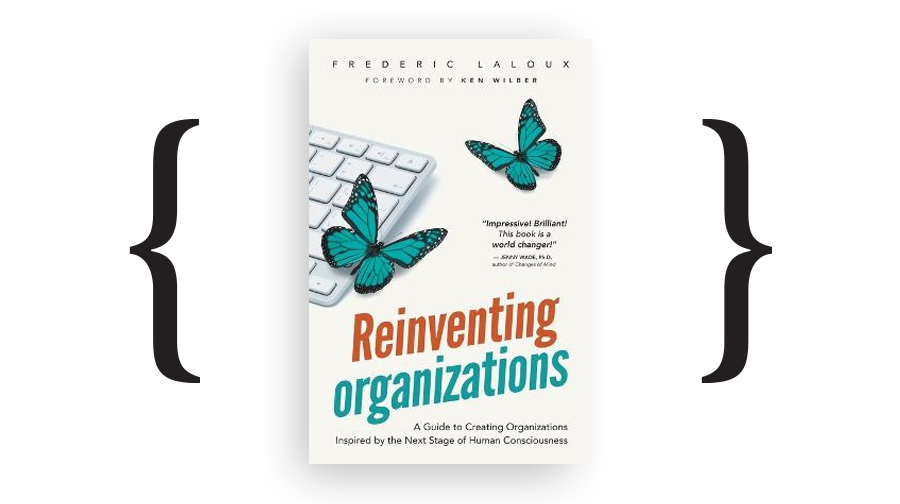
Book Review: Reinventing Organisations
I didn’t simply read Reinventing Organizations when it was published back in 2014 — I devoured it. I pored over it, took it apart, tested its ideas against lived experience and returned to it repeatedly while shaping my own thinking and the development of my Single Organising Idea (SOI®) framework. Laloux’s work acted less as a template than as a provocation. To be completely open, I wanted to better it.
I didn’t. Reinventing Organizations is a work of tremendous insight and foresight. What I gained instead was clarity and direction. Where Laloux explored what a more human, evolutionary organisation could look like, my own work focused on how leaders make that intent real, and how purpose shapes strategy, governance, culture and day-to-day decision-making in practice.
One of the reasons Reinventing Organizations continues to resonate more than a decade after its publication is that the conditions Laloux was responding to have intensified rather than eased. As I noted in my last article, this reality makes 2026 feel less like a milestone and more like an inflection point, as purpose moves from the margins to the mainstream and old business ideas are replaced by ones relevant to today’s world.
What makes Laloux’s contribution distinctive is not simply his critique of traditional hierarchies, but his synthesis. Drawing on evolutionary psychology, systems thinking and real-world case studies, he described a new organisational logic; one oriented around purpose, wholeness and self-management.
Today, Laloux’s influence extends beyond organisations and into the civic and political realm. Fragmentation, institutional mistrust and cultural polarisation are no longer background noise. They are the defining conditions shaping much of our world today. In response, the search underway is not for better rhetoric, but for systems capable of tackling 21st century challenges without collapsing into division.
We can see this dynamic emerging in the Teal movement in Australia. While diverse in form and policy, what unites many of these candidates is not ideology so much as orientation. A rejection of party tribalism in favour of integrity, long-term thinking and a more adult relationship with complexity. In the hands of the Teals, Laloux’s ideas become less about left or right and more about developmental maturity, and the promotion of systems that can hold competing truths without defaulting to zero-sum outcomes.
Similar signals can be observed within New Zealand’s Opportunity Party. Again, the emphasis is subtle but significant: Evidence over rhetoric, long-term outcomes over short-term advantage, and a willingness to challenge entrenched assumptions about how value is created and shared. These traits echo the same evolutionary logic Laloux described in teal organisations seeking to move beyond rigid hierarchies and binary debates.
What is striking is that these societal signals are emerging at the same time as purpose is beginning to be formalised at the level of governance. The development of ISO 37011, the forthcoming international standard on purpose-driven governance, marks an important inflection point. Where Reinventing Organizations helped legitimise a new way of thinking about organisations, ISO 37011 signals the moment when purpose begins to function as a discipline.
Seen together, these threads tell a coherent story. Laloux articulated the why and the what. He explained, with clarity, why existing models were failing and what a more human, evolutionary alternative might look like. Movements such as the Teals and Opportunity reflect the demand side of that shift, and the growing appetite for institutions capable of acting with integrity, coherence and foresight in an increasingly divided world.
Reinventing Organizations is available at leading bookstores and online retailers.