



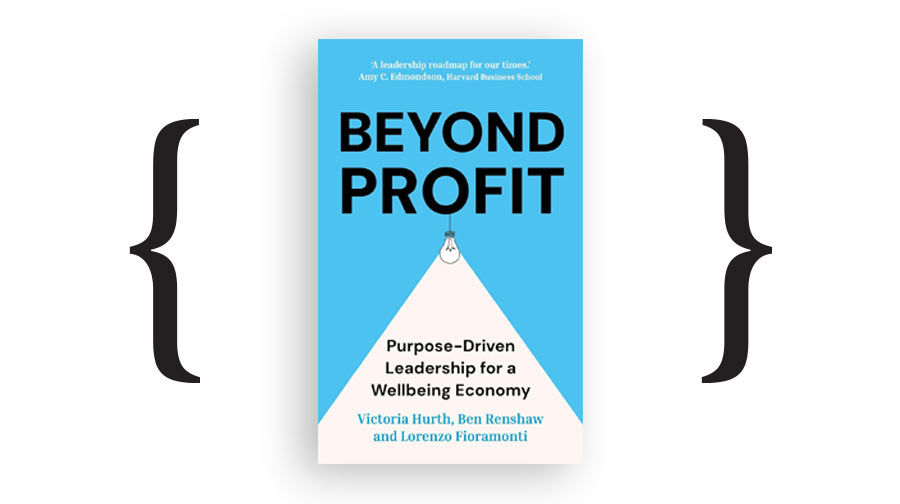
Beyond Profit: How purpose-driven leadership can transform organisations and wellbeing
By Dr Victoria Hurth, Ben Renshaw and Lorenzo Fioramonti
Amazon link
There’s a certain irony in the fact that, at the very moment the world feels increasingly fragmented, the most compelling ideas today are those that urge us to reconnect — to purpose, to people, to nature and to wellbeing. Beyond Profit belongs firmly in that camp.
I have known Dr Victoria Hurth for a number of years. We first met through a think-tank established by Ben Kellard of the Cambridge Institute for Sustainable Leadership. A gathering of practicing consultants and academics united by curiosity and a desire to challenge the status-quo, Victoria’s boundless energy was a driving force of the many debates we had about ‘all matters purpose’ during evening meetings and weekend retreats. It came as no surprise to me then, that she would later channel that energy into something that will genuinely make a difference. Her leading role in the vanguard of the of development of ISO 37011 (the forthcoming international standard that will define what purpose-driven governance looks like), and the publishing of Beyond Profit with Ben Renshaw and Lorenzo Fioramonti are testament to both her thinking and her remarkable determination.
Because of our relationship and the shared objectives that have shaped so many of our conversations over the years, I’ve set aside my usual review style and asked Victoria directly what five ideas she most wants readers to take away. Here’s my take on what she shared with me:
1. Purpose is contribution, not extraction
The first and perhaps the most foundational point is that organisations exist to contribute, not merely extract. Economies are supposed to produce long-term collective wellbeing; yet the way many companies operate achieves the opposite. Self-interest and survival are not innovation strategies. Nor are they adequate lenses for stewarding the scarce resources on which our future depends.
Moving beyond profit is not ideological; it is, in fact, totally rational.
2. A purpose-driven economy requires purpose-driven governance
If contribution is the goal, governance is the engine.
Governance determines:
- What an organisation exists to do
- The boundaries within which it must act
- The accountability mechanisms that keep it honest.
Shifting from business-as-usual to purpose-driven governance is not incremental, it’s transformative. It redefines performance. It shifts incentives. It opens the door to innovation that serves more than the balance sheet. And crucially, it recognises that a better future will not emerge by chance.
3. Leadership as courageous, human service
Leadership is a compassionate, courageous practice of service. The work of creating the conditions in which people can flourish and contribute to something better than the present. Fear, control and narrow financial incentives do not unleash creativity; they actually corrode it. A purpose-driven economy needs leaders who see humanity not as a drag on performance but as its primary asset.
4. The wellbeing economy where all stakeholders flourish is within reach — but only if we modernise governance
A wellbeing economy is not utopian. It is achievable, but only if the technical architecture of governance changes. The upcoming standard ISO 37011 to be published late next year, will provide exactly that blueprint.
5. If not this, then what?
If we do not intentionally redesign governance around purpose, then we are choosing the status quo — choosing extraction, fragmentation and harm.
The question, then, is disarmingly simple:
If not purpose-driven governance, what alternative can credibly deliver long-term wellbeing?
A clear, necessary contribution
Beyond Profit is not another corporate feel-good manual. It is a system-level argument delivered with clarity and moral seriousness. It challenges leaders to rethink not just their organisations but their assumptions about the economy itself.
By bringing together Victoria Hurth’s governance expertise, Ben Renshaw’s leadership insight and Lorenzo Fioramonti’s economic perspective, the book achieves something rare: It bridges disciplines without diluting their depth.
For leaders grappling with the demands of 2026 and beyond — technological disruption, social fragmentation, environmental constraints — this book offers both the intellectual framing and the practical orientation needed to steer in a more purposeful direction.