



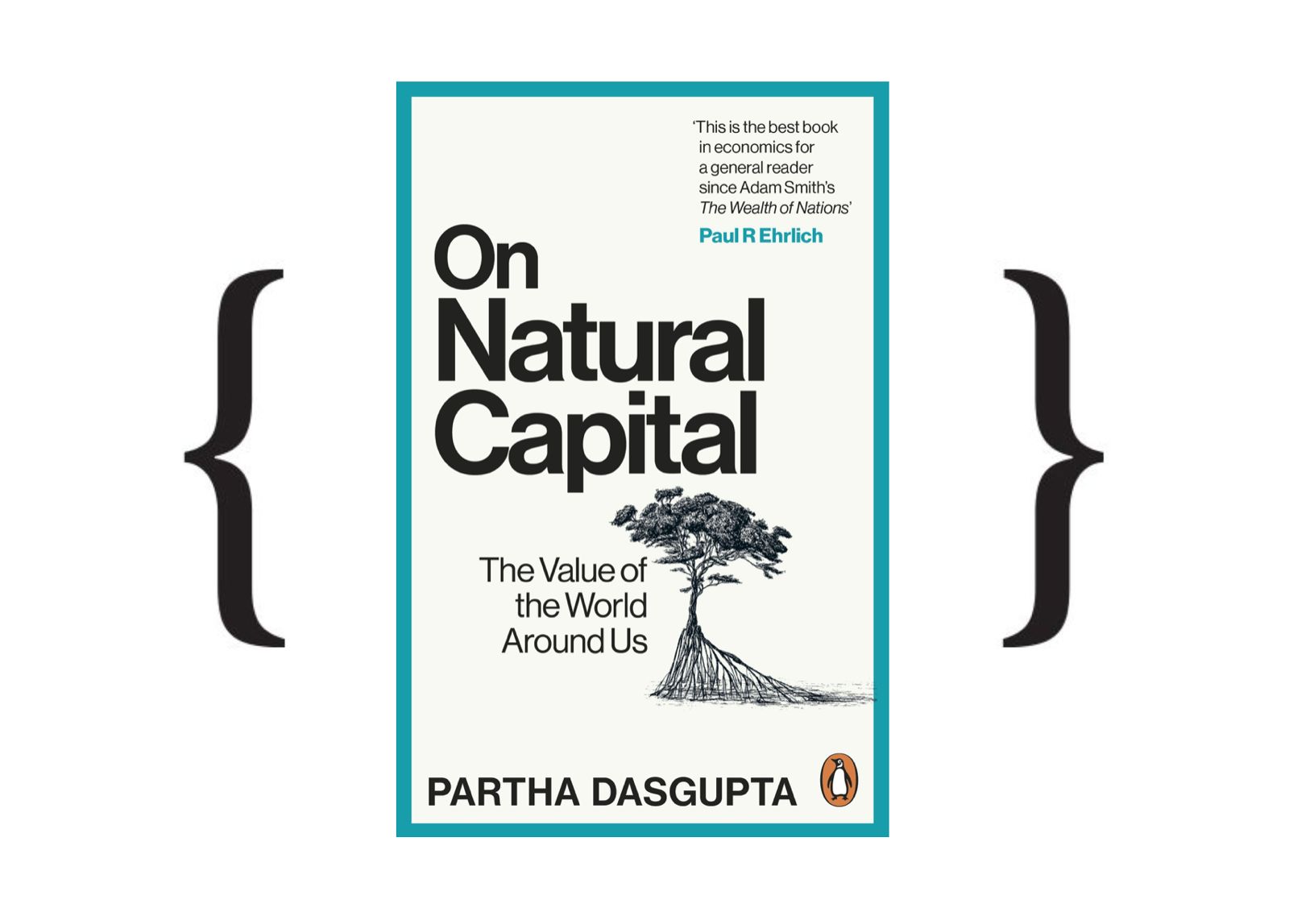
On Natural Capital by Partha Dasgupta
Beyond Rhetoric: Ideas Reshaping the Business of Business
There are some books that change what we think. More rarely, there are books that change what we notice. Partha Dasgupta’s On Natural Capital: The Value of the World Around Us belongs firmly in the latter category, for once read, it becomes difficult to look at the modern economy in quite the same way again.
Dasgupta’s central argument is deceptively simple. Nature is not external to the economy. It is the economy’s foundational asset. Forests, oceans, soils, rivers, biodiversity and stable climatic systems are not decorative backdrops to human progress or optional “ESG considerations.” They are forms of capital upon which all human prosperity ultimately depends. The problem, he argues, is that modern economics largely treats them as free and infinite and, as we are all experiencing, the consequences of that oversight are profound.
Published after Dasgupta’s landmark review for the UK Treasury, the book tackles a subject that could easily have become dry, technical or moralistic. Instead, it is remarkably engaging. At times it carries the sweeping perspective and intellectual accessibility of Yuval Harari’s Sapiens, mixed with the curiosity-driven storytelling of Freakonomics and the narrative clarity of Malcolm Gladwell at his best. Like Kate Raworth’s previously reviewed Doughnut Economics (also hugely accessible), it questions whether the assumptions underpinning modern economic growth remain fit for purpose in a finite world.
What makes Dasgupta especially persuasive is that he never approaches the issue as an activist. He approaches it purely as an economist. That distinction matters because rather than simply arguing that humanity should care more about nature, he demonstrates how economic systems systematically fail to account for its depletion. GDP, for example, comes under sustained scrutiny. A nation can cut down forests, exhaust fisheries, degrade soils and pollute rivers while still recording “growth.” By conventional economic measures, the country may appear richer even as its underlying asset base quietly deteriorates. In accounting terms, humanity has become dangerously skilled at consuming principal while congratulating itself on income.
Dasgupta patiently dismantles the illusion using evidence, statistics, stories and easily accessible calculations. One of the book’s greatest achievements is its ability to explain complex economic concepts without ever becoming inaccessible. Even readers who would normally avoid economics or mathematical modelling will likely find themselves following the logic with ease. That is no small accomplishment.
Importantly, the book never collapses into technocracy. Running throughout it is a deeper exploration of psychology, morality and intergenerational responsibility. Human behaviour, social norms and cultural values matter because economics, ultimately, is an expression of what societies choose to value.
One passage in particular captures the book’s moral centre:
“We imbue our children with values we cherish and teach them the practices we believe are right not merely because we think it is good for them, but also because we desire to see our values and practices survive.”
That idea lingers long after the final page. Natural capital is not simply about conservation. It is about stewardship. About whether one generation sees itself as owner, consumer, custodian or, as Dasgupta puts it, ‘asset managers’ of the systems upon which future generations depend.
There is also something quietly radical about the book’s framing of business and leadership. Increasingly, the organisations likely to endure in the decades ahead may be those capable of understanding that long-term value creation cannot be separated from the health of the ecological and social systems within which they operate. The language of stewardship, once viewed as soft or peripheral, begins to look less idealistic and more economically rational.
In that sense, Dasgupta’s work sits within a growing body of thinking challenging the narrow shareholder primacy that has shaped much of modern capitalism over recent decades. The implication is not anti-growth. Nor is it anti-business. Rather, it is that genuine prosperity depends on understanding the difference between extracting value and sustaining the conditions that make value possible in the first place. That is a subtle but important distinction.
If there is a criticism, it is perhaps that the scale of the challenge can occasionally feel overwhelming. The systems Dasgupta describes are deeply embedded politically, economically and psychologically. Yet the book avoids fatalism. Instead, it leaves the reader with a renewed sense that economics is ultimately a human construct, and therefore capable of being redesigned.
On Natural Capital is an important book because it reframes the environmental decline we are all witnessing not simply as an ecological issue, but as a profound failure of economic logic and moral imagination. It asks readers to reconsider what wealth actually means, what societies choose to measure and, ultimately, what kind of asset managers we are.