



ISO 37011: When Purpose Becomes Governance
ISO 37011: When Purpose Becomes Governance
For years, organisations have been encouraged to define their purpose. ISO 37011 is the first international standard designed to explain exactly what being purpose-driven actually means, and how purpose can move from words into governance, decisions and performance. For businesses in New Zealand and around the world, its emergence creates a considerable opportunity.
Purpose has spent much of the past decade suffering from an excess of enthusiasm and a shortage of discipline. Thousands of organisations have adopted purpose statements. Consultants have developed purpose propositions. Advertising agencies have turned purpose into campaigns. Annual reports have filled with increasingly expansive explanations of why companies exist and the difference they intend to make. Some of this has undoubtedly been worthwhile. But it has also created a fundamental problem. Having a purpose and being driven by one are not the same thing.
That distinction sits at the heart of ISO 37011, Purpose-driven organizations — Guidance, the emerging international standard that has now reached an important stage in its development. In September, the draft entered ISO’s formal enquiry phase, giving national standards bodies and other stakeholders around the world an opportunity to examine and comment on it before it progresses towards publication.
I have had the privilege of contributing to the international expert group involved in its development. For me, its importance lies not simply in the arrival of another ISO document, but in what it represents. Purpose is moving from the language of aspiration towards the discipline of governance. And that matters enormously.
Where ISO 37011 comes from
The story did not begin with ISO 37011. In 2021, ISO published ISO 37000, Governance of organizations — Guidance, the first international benchmark covering the governance of organisations of every type and size. Significantly, purpose sits at the heart of that standard. ISO 37000 defines organisational purpose as an organisation’s meaningful reason to exist and places it at the centre of the responsibilities of those governing an organisation.
That was an important development in itself. It shifted purpose away from marketing and communications and placed it where I have long believed it belongs; inside governance.
The next important step came in Britain with PAS 808:2022, developed by the British Standards Institute (BSI). PAS 808 provided more detailed guidance on purpose-driven organisations, including how purpose should influence decisions and behaviour, and how organisations might assess whether they genuinely operate in accordance with their stated intent. PAS 808 is now evolving onto the international stage through ISO 37011.
The new standard is being developed through ISO/TC 309, the technical committee responsible for governance of organisations. The current draft follows more than 60 international meetings over two years, three working drafts and two committee drafts, involving experts working through the painstaking consensus-building process that sits behind international standards.
That process matters because purpose has desperately needed a common language. Ask ten executives what organisational purpose means and you may still receive ten different answers. For some it is a mission. For others it is a brand promise, a values statement, a social impact programme or simply a more inspiring description of the business strategy. The consequence is predictable. If we cannot agree what purpose means, it becomes almost impossible to agree what being purpose-driven requires. ISO 37011 address that issue.
What the standard actually does
The draft provides guidance on organisational purpose and on the governance of purpose-driven organisations. It is intended for organisations of every type and size, including businesses, public-sector organisations, regulators, voluntary organisations, social enterprises, government bodies and professional associations.
Importantly, it is guidance, not a certification standard. There are no requirements against which an organisation can simply tick boxes and declare itself ISO 37011 compliant. There is no verification framework and no certificate to hang in reception. Its recommendations are expressed as things an organisation should do rather than things it must do. That is important because becoming purpose-driven is not fundamentally a compliance exercise. It is an organisational one.
The standard builds on the three central governance functions established by ISO 37000 — direction, oversight and accountability. It asks governing bodies to consider the purpose their organisation exists to fulfil, ensure that decisions and actions are aligned with it, and hold the organisation accountable for doing so.
At its core is an important proposition. A purpose-driven organisation seeks to align its decisions and actions with the long-term wellbeing of people and the planet.
For some business leaders, that language may initially sound as though commercial performance is being displaced by social ambition, but that interpretation misses the point, and here’s why:
A business that continually loses money will eventually cease to exist. Profitability, productivity, investment, innovation and growth remain essential. Capital still needs to earn an appropriate return. Employees still need to be paid. Customers still need to choose what the organisation sells. Purpose does not remove commercial reality. It simply provides a better way of organising the enterprise within it.
The performance argument
This is where my own interest in ISO 37011 becomes particularly strong. For more than 25 years, my work on Single Organizing Idea (SOI®) has been built around a relatively simple proposition — that organisations perform better when they know clearly what they exist to achieve and organise themselves around delivering it.
Not when purpose sits alongside strategy. Not when it appears as a paragraph on the website. And certainly not when it becomes the responsibility of the communications, sustainability or people team. Purpose has to drive the organisation.
When that happens, it provides a common reference point for decisions. It helps leaders determine where to invest and where not to invest. It guides innovation. It informs the products and services an organisation develops, the customers it serves, the people it recruits, the behaviours it rewards and the measures by which performance is judged.
Importantly it creates alignment. And alignment matters because organisations waste an extraordinary amount of energy through competing priorities, disconnected functions, contradictory incentives and strategies that pull different parts of the enterprise in different directions.
A clear purpose cannot magically remove those tensions. But when it becomes the organising principle around which the organisation is governed and managed, it provides a way of resolving them. Strategy becomes the means through which purpose is pursued. Culture reinforces it. Operations deliver it. Measures tell leaders whether it is being achieved.
Commercial performance and purpose therefore need not sit at opposite ends of a philosophical argument. They are actually mutually reinforcing.
A successful purpose-driven business creates the financial strength necessary to continue investing, employing people, innovating and fulfilling its purpose. In turn, clarity of purpose can create the focus, engagement, trust and strategic coherence from which stronger performance emerges. That creates enduring value for shareholders, employees, customers, suppliers, communities and the wider systems upon which the business ultimately depends.
This is where ISO 37011 makes an important contribution. It gives the international business community a common governance framework around something that has until now been interpreted far too loosely. That makes purpose harder to casually claim, but it also makes it considerably more useful.
Why Aotearoa New Zealand should pay attention
We are unlikely to compete with the largest economies through scale alone. Our advantages have always depended more heavily on ingenuity, relationships, reputation, trust and our ability to create distinctive forms of value.
Purpose-driven governance can strengthen those advantages. For an export business, clarity of purpose can help maintain coherence as the organisation enters different markets and encounters different pressures. For a fast-growing company, it can provide continuity as new people, investors and capabilities arrive. For an established organisation, it can expose areas where legacy practices no longer support what the business is trying to achieve. For boards, it introduces a more searching question than whether the organisation has a purpose statement.
Is the organisation actually being governed by its purpose?
Does purpose influence capital allocation? Strategy? Risk? Executive incentives? Innovation? Measures of success? Decisions about which opportunities to pursue and which to reject?
If the answer is no, the organisation may have declared a purpose, but it is difficult to argue that it is being driven by one. And that distinction could become increasingly important internationally as ISO 37011 creates a shared reference point against which purpose-driven claims can be understood.
For New Zealand, getting ahead of that development represents an opportunity to lead now rather than follow an obligation later. In other words, we can wait until international expectations evolve around us. Or alternatively, we can participate in shaping them and begin applying the thinking now.
From Cambridge to Auckland
Next week, Dr Victoria Hurth will be visiting New Zealand to promote ISO 37011 and discuss what the emerging standard could mean for organisations here. Her visit has a particular personal significance for me, as Victoria and I go back quite a long way.
I first met Dr Victoria Hurth around a decade ago through a purpose-focused think tank convened by Ben Kellard at the University of Cambridge Institute for Sustainability Leadership. Victoria and I were both active, and occasionally rather vocal, participants. We have been discussing, arguing about and advocating for the role of organisational purpose ever since.
Victoria went on to play a leading role in ISO 37000 and PAS 808 and done a truly amazing job as Project Leader for ISO 37011.
Next Tuesday, 27 October, she will be in Auckland for a special British New Zealand Business Association event at AUT, From purpose statements to real decisions: building a wellbeing economy. Victoria will deliver the keynote before joining me and Andrew Baker of Tika Learning for a panel discussion moderated by BNZBA Vice President Dr Victoria Hatton.
The timing could hardly be better. ISO 37011 is currently in its international enquiry period, which runs from 24 September until 17 December, although national consultation deadlines may be earlier. New Zealand participates in ISO through the New Zealand Standards Organisation, giving this country a route into the international standards process rather than simply leaving others to define the framework for us. That makes the conversation next week much more than another discussion about the merits of purpose. It’s an opportunity to consider what purpose looks like when it becomes part of the actual machinery of governance.
Beyond the statement
I have spent much of my career arguing that purpose should not be treated as an addition to the organisation. It should sit at the heart of it and that is ultimately why I believe ISO 37011 matters.
The standard will not tell leaders precisely what their organisation’s purpose should be. Nor will it remove the difficult choices, compromises and tensions involved in running a successful organisation. What it can do is establish a much clearer international understanding of what leaders mean when they claim their organisation is purpose-driven.
That raises the bar. But it also creates an opportunity. Because once purpose moves beyond the statement and begins genuinely influencing governance, strategy, investment, culture, operations and performance, it stops being another piece of corporate language. It becomes useful. And when an organisation is coherently organised around a meaningful purpose, delivering value through everything it does, I believe it becomes capable not only of contributing more to the people and systems around it, but of performing better itself. That is good for business and that is good for all stakeholders too.


The Best Places to Work Have a Purpose
The Best Places to Work Have a Purpose
Why organisational purpose matters to employee experience, and how a shared sense of direction helps create better workplaces, stronger cultures and greater performance.
Pay matters. So do good managers, flexibility, trust and the everyday experience of work. But the strongest workplaces also offer something fundamental: A clear sense of what the organisation is trying to achieve, why it matters and how each person contributes to making it happen.
So what makes somewhere a genuinely good place to work? For an employee, the answer is unlikely to begin with a corporate purpose statement. It will be much more immediate. Am I treated fairly? Do I trust my manager? Is the workload reasonable? Am I listened to? Can I do good work without fighting the organisation around me? Does the organisation keep its promises?
All of these things matter enormously. New Zealand’s Best Places to Work™ 2026 Employee Experience Survey reinforces the point. When employees were asked what mattered most to them at work, 74.6 per cent included people and culture among their three most important factors, compared with 35.4 per cent who selected compensation. Supportive managers, flexibility and being able to be themselves at work also featured strongly.
But buried within that everyday experience is another question that is easy to overlook — do I understand what this organisation is trying to achieve, and can I see how my work contributes to it? That is the meeting point where organisational purpose enters the employee experience.
Not purpose as a slogan. Not an assertion that the organisation exists to make the world a better place. And certainly not another piece of employer branding designed to persuade people that their job is more meaningful than it really is.
Purpose, properly understood, is an organisation’s meaningful reason to exist, grounded in the enduring value it creates through its performance and its contribution to the long-term wellbeing of people and the planet. In a purpose-driven organisation, that understanding becomes the organising principle for strategy, decisions, priorities, behaviour and performance.
From an employee’s perspective, this matters because work rarely happens in isolation. Every day people are asked to make choices, resolve competing priorities, collaborate with others, respond to customers and decide where to put their limited time and attention. The clearer the organising logic of the business, the easier it becomes to understand not simply what needs to be done, but why. That distinction has consequences.
A sizeable body of research has found a strong relationship between experiencing work as meaningful and outcomes including engagement, commitment and job satisfaction. A meta-analysis published in the Journal of Management Studies, covering 44 studies and more than 23,000 people, found particularly strong associations between meaningful work and all three. It also found a relationship with lower intentions to withdraw from an organisation.
Organisational purpose and meaningful work are not the same thing, and we should be wary of pretending that a carefully articulated purpose can somehow make every task inspirational. Few people arrive at work each morning requiring transcendence before opening their inbox. But purpose can create the conditions in which work makes greater sense.
It can provide line of sight between an individual job and a larger organisational endeavour. It can help managers explain decisions rather than merely announce them. It can give teams a common reference point when priorities compete. And it can make autonomy more practical because people have a clearer framework within which to exercise judgement. Most importantly, perhaps, it gives employees something against which to judge the organisation itself.
This is where purpose becomes much more demanding than the purpose statement suggests. Employees experience the gap between words and actions more closely than almost anyone else. They see which behaviours are rewarded. They know whether a stated commitment survives contact with a difficult commercial decision. They experience whether leaders listen, whether customers really matter, whether values disappear when targets are under pressure and whether the organisation behaves consistently when nobody is preparing a presentation about its culture. In that sense, employee experience is one of the toughest tests of whether an organisation is genuinely purpose driven.
A business cannot credibly claim that its purpose guides how it creates enduring value while treating the people expected to deliver that purpose simply as a cost to be managed. Equally, an organisation with a friendly culture, generous benefits and an impressive employee proposition can still leave people confused about where it is going, what really matters and how their work contributes. The two dimensions need each other.
This is also why being purpose driven should not be confused with making work easy. Some of the best workplaces are highly demanding. They expect excellent performance, make difficult decisions and ask a great deal of their people. What distinguishes them is not an absence of pressure, but greater coherence around why the effort matters, what is expected and how success is achieved.
Purpose therefore sits upstream of much of what we describe as employee experience. When it genuinely shapes strategy and behaviour, it can influence how leaders lead, how managers manage, how teams collaborate, what gets measured and rewarded, and how people understand the contribution they are being asked to make.
That connection is one of the reasons Neil Gaught & Associates has entered into partnership with Best Places to Work.
We approach the organisation from different but highly complementary directions. Best Places to Work begins with the lived experience of employees. Its awards process starts with confidential employee feedback before organisations can progress to independent assessment, deliberately testing the difference between what an organisation says about itself and what its people actually experience.
At NG&A, our starting point is the organisation’s core purpose and the work required to make it an organising principle for governance, strategy, culture, operations and performance. Both approaches ultimately come together in how purpose is translated into everyday organisational practice.
That is also why NG&A is sponsoring the Purpose in Action Award at this year’s Best Places to Work Awards. The category recognises organisations working to embed purpose into strategy, decision-making and everyday action, creating outcomes for employees as well as customers, communities and the organisation itself.
Next Thursday, 22 October, the 2026 Best Places to Work Awards will bring together organisations from across Aotearoa New Zealand that are trying to create better experiences for their people.
There will be much to celebrate. But behind the awards sits a more important idea. The best places to work are not created by perks, statements or culture programmes alone. They are created when people can see a connection between what an organisation is there to achieve, the decisions its leaders make, the work they themselves do and the value that work creates. When those things align, purpose stops being something employees are told about and becomes something they experience.

Purpose Inside the Machine
Purpose Inside the Machine
Q3 2026 Summary
Every quarter I look back at what I have written, read and discussed on Neil Gaught On Purpose. It is partly a chance to catch up on anything you may have missed, but it also reveals themes that were not necessarily obvious when each piece was published.
This quarter, one stands out.
Artificial intelligence did not dominate everything I wrote. Far from it. The subjects ranged from Matariki and leadership to organisational change, employee experience, corporate purpose and — surreally — René Magritte. But AI increasingly changes the context in which all those subjects sit.
In The Machine Needs a North Star, I explored what happens when AI begins to change not only how work gets done, but how organisations themselves are organised. As machines become capable of researching, analysing, recommending and increasingly acting, the question of what all that intelligence is ultimately being directed towards becomes much more important. AI can make organisations faster and more capable, but it cannot determine why they exist.
Perhaps appropriately, the quarter began with Matariki and the importance of orientation before action, and ended with the prospect of organisations increasingly populated by intelligent machines. Different worlds, perhaps, but connected by a remarkably similar question: Before we accelerate, do we know where we are going and why?
Here is what I shared during Q3.
Articles
Orientation Before Action: The Wisdom of Matariki
Matariki provided the starting point for a reflection on purpose, stewardship and the value of establishing our bearings before rushing forward.
In a business culture that prizes momentum, Matariki offers a useful reminder that movement and progress are not the same thing. Purpose provides organisations with a point of orientation against which choices about the future can be made.
The Leadership Challenge Hidden in Plain Sight
Prompted by the Oxford–GlobeScan Global Corporate Affairs Survey, I looked at the extraordinary range of pressures now competing for leadership attention.
My argument was that beneath geopolitical, technological, regulatory and social complexity lies a deeper challenge, that being organisational fragmentation. The more complicated the environment becomes, the greater the need for a common organising principle that helps leaders distinguish what matters from what merely demands attention.
This is Not a Purpose
René Magritte’s famous The Treachery of Images provided a surreal way into one of my recurring frustrations with corporate purpose.
A picture of a pipe is not a pipe. And a purpose statement is not a purpose.
Statements matter, but purpose only becomes real when it influences governance, strategy, culture, investment, innovation, behaviour and performance. The challenge is not declaring a purpose. It is becoming organised by one.
The Machine Needs a North Star
The final article of the quarter considered what organisational purpose might mean in an increasingly AI-native world.
AI can optimise against an objective but humans still have to determine which objectives matter. Which is why I firmly believe purpose will become increasingly more important in the age of AI, not less.
Book Reviews
Two very different books featured in my Beyond Rhetoric series this quarter, both concerned, in their own way, with the gap between aspiration and implementation.
Our Iceberg is Melting by John Kotter and Holger Rathgeber
I returned to Kotter and Rathgeber’s deceptively simple fable about a colony of penguins confronting enormous change.
Nearly twenty years after publication, its lessons about urgency, leadership, resistance and collective action remain remarkably relevant. Knowing that change is necessary is one thing. Getting an organisation to move together is quite another.
Higher Ground by Alison Taylor
Alison Taylor offers an intelligent and refreshingly sceptical examination of corporate purpose, ethics, values and responsibility.
I agreed with much of her diagnosis. Where I wanted more was in the how. Understanding why purpose matters, and even defining what it should mean, is only the beginning. The harder task is turning it into the way an organisation actually operates.
Conversations
I also continued my Neil Gaught On Purpose: In Conversation series with two New Zealand leaders approaching purpose and performance from very different perspectives.
In Conversation with Gavin Findlay
As Chief Executive of the New Zealand Food Network, Gavin Findlay works in an organisation with an unmistakably social purpose.
What made our conversation particularly interesting was his emphasis on performance and commercial discipline. Having a worthwhile purpose does not reduce the need to run an organisation well. It makes clarity about what good performance is ultimately for even more important.
In Conversation with Julie Gill
My conversation with Best Places to Work™ Founder and CEO Julie Gill explored employee experience, culture, leadership and the connection between better workplaces and better organisational performance.
One theme stood out: People experience purpose through what an organisation actually does. They notice whether decisions, behaviours and priorities match the words. Purpose becomes credible when it is lived rather than simply communicated.
Into Q4
The final quarter of 2026 promises to be unusually rich territory for purpose.
New Zealand’s general election will dominate the public conversation, bringing questions of leadership, trust, priorities and long-term direction sharply into focus. For NG&A, the opportunity is not to enter party politics, but to examine what organisational purpose can teach us about making choices, maintaining direction and creating value when competing pressures intensify.
October will also put purpose into practice in two very different settings. NG&A is sponsoring the Purpose In Action Spotlight Award at Best Places to Work™, providing an opportunity to recognise organisations demonstrating that purpose can influence culture and performance, rather than simply sit in corporate language.
And the British New Zealand Business Association will host From Purpose Statements to Real Decisions: Building a Wellbeing Economy an event that brings together ISO37011 leading expert Victoria Hurth, Andrew Baker and my good-self for a panel discussion, hosted by Victoria Hatton. With the international standard inching towards publication, this should provide a timely platform for discussing what purpose actually means and what governing an organisation by purpose requires in practice.
It’s going to be a busy Q4!

Neil Gaught On Purpose: In Conversation with Julie Gill
Neil Gaught On Purpose: In Conversation
Neil Gaught On Purpose: In Conversation is a monthly interview series featuring leaders, thinkers and practitioners at the forefront of purpose-driven business.
Each conversation explores how purpose is being applied in practice, across strategy, governance, culture and performance.
At a time of growing complexity and uncertainty, the series brings together diverse perspectives to examine a simple but increasingly urgent question: What does it take to build a business that creates enduring value for both shareholders and society?
Julie Gill is the Founder and CEO of Best Places to Work™, which she helped relaunch in 2023 with an ambition that goes well beyond recognising great employers. Driven by a belief that strong organisations and positive workplace experiences go hand in hand, Julie is building BPTW as a continuous improvement platform that helps organisations listen to their people, understand what shapes their experience and turn that insight into better leadership, culture and performance. Her wider ambition is simple but bold: to help Aotearoa New Zealand become one of the best places in the world to work, “floating all the boats higher” in the process.
NG: Julie, before we talk about Best Places to Work™ (BPTW), I’d like to start with you. What has driven your interest in people, workplaces and organisational culture, and where did the idea that work could, and should, be better first come from for you?
JG: I’ve always been fascinated by people and the difference they can make to an organisation, but equally, the difference an organisation can make to people.
We spend such a significant part of our lives at work, so the workplace experience matters. It affects our confidence, our wellbeing, our families and communities, as well as what we’re able to contribute professionally.
Over the years, I’ve seen organisations with very similar resources and opportunities achieve very different outcomes. Often, the difference comes back to people, leadership and culture.
When people understand why they’re there, know what’s expected of them, feel valued and trusted, and have the right environment around them, they can do extraordinary things.
That’s really where my interest comes from. I don’t see creating a positive workplace experience and creating a strong organisation as two separate things. They go hand in hand.
Because when people love where they work, everything changes. For them, for the organisation and, collectively, for Aotearoa New Zealand.
NG: BPTW has been part of the Aotearoa New Zealand business landscape for two decades and was relaunched in 2023. What did you see happening in the world of work that convinced you the time was right to bring it back?
JG: Best Places to Work has been part of New Zealand for more than 25 years. After a short hiatus, we brought it back three years ago because work had changed enormously, and people’s expectations of work had changed with it.
We’d come through COVID. Flexible and hybrid working had accelerated. Wellbeing and purpose had become a much more serious workplace conversation. And people were asking different questions of their employers.
Not just, “What do you pay me?” but, “Do I belong here? Does my work have meaning? Can I grow here? Does my voice matter?”
At the same time, organisations were trying to understand what all of that meant in practice.
So we brought BPTW back with the same mission: to float all the boats higher and lift the standard of workplace experience across New Zealand.
But we also had an opportunity to build something much broader – a continuous improvement programme built around employee voice, insight, benchmarking, learning and recognition.
Although the Best Places to Work™ Awards are an important part of inspiring leaders and celebrating the exceptional work happening in organisations across Aotearoa New Zealand, our ambition goes further.
Ultimately, we want to inspire New Zealand to be the best place to work in the world!
NG: BPTW talks about its mission as “floating all the boats higher.” I love that phrase. What does it mean to you, and what does it tell us about what you ultimately want BPTW to achieve beyond simply recognising great employers?
JG: I love that phrase because it really captures what we’re trying to do.
Of course we want to recognise and celebrate the best workplaces. We want to tell their stories and showcase the leadership, teams, cultures and innovation within New Zealand organisations.
“Floating all the boats higher” is about lifting the standard of employee experience across Aotearoa New Zealand.
An organisation might hear through its employee feedback that there’s an issue around trust, workload, communication or leadership. We don’t see that as failure. We see it as a signal.
You now know something you didn’t know before, and you have an opportunity to do something about it.
That’s why continuous improvement is so important to us. Success isn’t only seeing the best workplaces continue to perform strongly. It’s seeing organisations listen to their people, understand where to focus, make changes and come back a year later having improved.
If we can help organisations of various sizes right across New Zealand make meaningful improvements year after year, the collective impact can be significant.
That’s what “floating all the boats higher” is all about.
NG: We often talk about a “best place to work” as though we instinctively know what one looks like. From everything you have learned through BPTW, what actually separates the best workplace from an organisation that simply has good benefits, good intentions or a strong employer brand?
JG: For me, the biggest distinction is that an exceptional workplace is something people experience every day. It’s not something an organisation can simply say about itself.
It shows up in the everyday things: how your manager speaks to you, whether you understand what’s expected of you, whether you trust the decisions being made, whether you feel confident speaking up, whether your workload is manageable, whether you understand where the organisation is going and the part you play in getting there.
Those experiences matter.
That’s also why our Employee Experience Survey looks across the nine BPTW Pillars of Workplace Experience, with each question aligned to those pillars.
So we’re not simply measuring how people feel. We’re understanding the conditions and behaviours that shape their experience.
What we see in the best workplaces is consistency. People understand the purpose and direction of the organisation. Leaders communicate and listen. People feel trusted and supported. They feel connected to their teams and have the environment, tools and clarity they need to perform well.
And none of that means everything is perfect.
For me, one of the hallmarks of an exceptional workplace is being willing to listen to your people, understand what the signals are telling you and keep learning and improving.
NG: There is still a tendency in some organisations to regard culture, wellbeing and employee experience as the softer side of business. What have you learned about the relationship between creating a best place to work and harder measures such as performance, productivity, innovation, resilience and retaining good people?
JG: I think separating the “people stuff” from the “business stuff” is increasingly unhelpful.
If people aren’t clear about what they’re trying to achieve, don’t trust their leaders, are consistently overloaded, or don’t feel confident speaking up when something isn’t working, those things will show up in the organisation.
That’s why we think about the connection between experience, behaviour and performance.
Experience shapes behaviour. Behaviour shapes performance. And performance shapes results.
The last few years have brought real pressure for organisations, and that’s when strong foundations, investment in people, and having the right systems and insights matter most.
Employee experience gives leaders valuable information. Where are people performing well? Where is there friction? What might be getting in the way? That makes employee insight useful management information, not simply an annual engagement score.
NG: Purpose has become an increasingly important part of the BPTW approach. What role do you believe a clearly understood organisational purpose plays in creating workplaces where people feel connected, motivated and able to perform at their best?
JG: Purpose can be incredibly powerful, but only when people can see it in the decisions an organisation makes and the way work happens every day.
A beautifully written purpose statement on the wall isn’t enough.
People need to understand: Why are we here? What are we trying to achieve? And how does what I do contribute to that?
When people are clear on purpose, work feels more connected. There’s context around why something matters, people can see the part they play, and decisions become easier because there’s a shared understanding of where you’re trying to go.
For me, purpose becomes particularly interesting when an organisation has to make a difficult decision. Does it influence where you invest? What you prioritise? What you say no to? Who you work with? How leaders behave? What you measure and reward?
That’s where purpose turns into performance.
Through BPTW, we see organisations where employees can draw a very clear line between their everyday work and the difference the organisation is trying to make.
When what an organisation says matters is reflected in what employees actually experience, purpose becomes much more than a statement. It becomes something people can connect to and act on.
NG: BPTW is much more than an annual awards programme and it includes employee insight, certification, learning and access to specialist expertise. How do you see that evolving, and what do you want an organisation’s journey with BPTW to look like?
JG: I want organisations to see BPTW as a workplace improvement partner.
At the heart of the programme is our Employee Experience Survey, because everything starts with listening to your people.
It gives every employee a safe, independent and confidential way to share how work feels, and it gives leaders a clear view of what’s working, where to focus and how their results compare.
Then it’s about what you do with that insight.
For one organisation, that might mean building leadership capability. Another might use Pulse Surveys to understand whether changes are having an impact. Others might access a Masterclass or specialist support, work towards BPTW Certified, or recognise their progress through the Awards.
There isn’t one pathway because organisations are at different stages and have different needs.
What we want to provide is a continuous improvement programme that helps organisations listen, understand, act, measure and improve. Recognition sits alongside that journey, but continuous improvement is at the heart of it.
NG: We have recently begun working together through a partnership between BPTW and NG&A, including around purpose and the emerging ISO 37011 guidance. What opportunity do you see in bringing the workplace and purpose agendas closer together, particularly here in New Zealand?
JG: I think there’s a really interesting opportunity here because purpose and employee experience are deeply connected.
An organisation can have a very clear purpose, but if its people don’t understand it, can’t see how their work contributes to it, or don’t see leaders making decisions consistent with it, there’s a gap between intention and experience.
And purpose needs to do more than make people feel positive about where they work. It should help an organisation make choices, set priorities and be clear about the value it’s trying to create.
That’s what makes the emerging work around ISO 37011 interesting. It brings another level of rigour to how organisations think about purpose and how it translates into governance, strategy and organisational practice.
The opportunity for us is to bring that together with employee voice.
We can look at what an organisation says its purpose is, how that purpose is intended to influence the organisation, and then understand what employees actually experience.
That connection between intention and experience is powerful. It helps turn purpose from something an organisation talks about into something people can see in leadership, decisions and the way work gets done.
NG: Finally, BPTW has an ambition to help make New Zealand one of the world’s best places to work. If we were having this conversation five years from now and you felt that ambition was becoming a reality, what would have changed for employees, organisations and New Zealand as a whole?
JG: I’d want to see improvement at scale.
For employees, we’d want more people to feel that work is a positive part of their lives. That they trust their leaders, understand what they’re contributing to, feel supported to perform at their best, have opportunities to grow and know their voice matters.
For organisations, I’d like employee experience to be treated as seriously as other important business measures.
That doesn’t mean every workplace needs to be perfect. That’s not what BPTW is about.
It’s about listening. Being curious about what your people are telling you. Understanding the signals. Making meaningful changes. Then measuring again and continuing to improve.
And for Aotearoa New Zealand, I’d love the best workplaces to become part of our competitive advantage.
We’re a relatively small country, but I think there’s something very powerful about the way we think about connection here. Connection to people, to place and to the environment around us. Those values can shape the kind of workplaces we create and the kind of leadership we want to be known for.
If we can combine that with workplaces where people are trusted, connected to purpose, encouraged to innovate and enabled to perform at their best, I think New Zealand has an opportunity to lead in its own way.
Not by trying to replicate what the rest of the world is doing, but by building on what is distinctive about Aotearoa New Zealand and showing that strong organisations, positive employee experience and care for people, planet and place can sit alongside each other.
That has an impact far beyond an individual organisation.
It’s good for our people. It strengthens our organisations and our communities. And collectively, it strengthens New Zealand.
That’s ultimately what floating all the boats higher means to me.
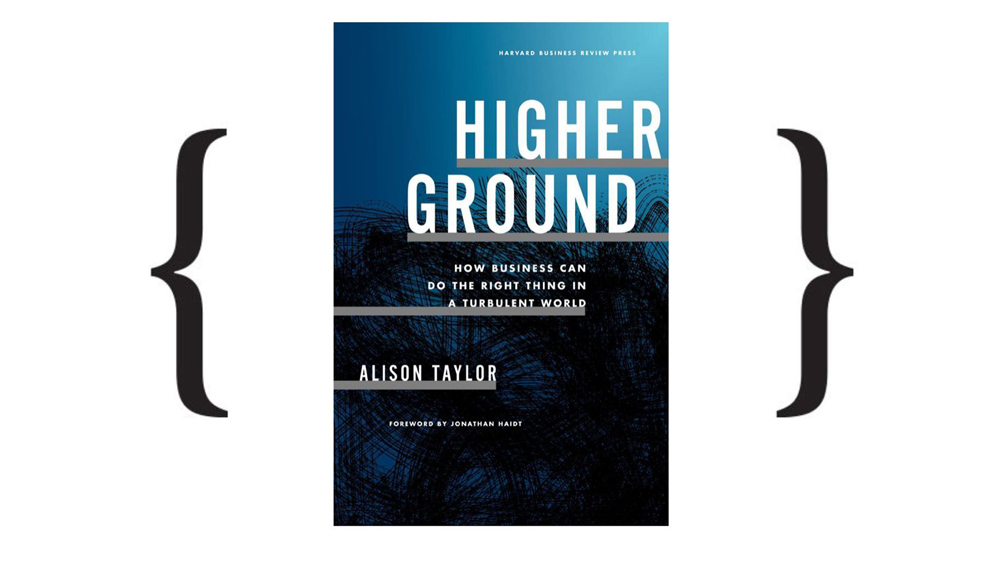
Book Review: Higher Ground by Alison Taylor
Book Review: Higher Ground by Alison Taylor
Alison Taylor’s Higher Ground is an intelligent and persuasive account of why business needs to take ethics, purpose, values and human impact more seriously. It is excellent on the “why” and very good on the “what”. But for a book that explicitly promises to explore what it takes to implement corporate purpose, the practical “how” remains frustratingly unclear.
Listed among the Financial Times best business books of 2024, Higher Ground is a book I recently found myself returning to as part of my Beyond Rhetoric series. Taylor, a clinical professor at NYU Stern School of Business and former executive director of Ethical Systems, sets herself an ambitious task. Namely to explain how businesses should behave in a world in which old certainties around shareholder value, regulation and corporate responsibility are breaking down.
Her diagnosis is strong. Taylor argues that branding, culture, sustainability, risk and ethics can no longer be treated as separate disciplines. In a transparent world, organisations pursuing contradictory agendas through different functions quickly appear incoherent or hypocritical.
Taylor is equally sceptical of interchangeable values statements, superficial ESG programmes and grand claims about making the world a better place. She is particularly good on purpose becoming another form of corporate theatre. If purpose is treated as a performance, she says, it will never drive performance. Quite.
She also understands that principles occasionally have a price. A value that survives only while commercially convenient is not much of a value at all. It echoes an argument I made years ago in discussions with Michael Porter’s Shared Value team at Harvard about the flaws I saw in their ‘win-win’ model. Doing the right thing cannot always depend upon there being a convenient commercial win.
Much of Higher Ground is therefore another welcome antidote to the inflated claims surrounding corporate purpose. The problem comes when Taylor moves from diagnosis to prescription.
Ultimately the book offers a moral framework for responsible business rather than a management framework for purposeful business. So, while Taylor is excellent on the “why” and very good on the “what”, she is much less convincing on the “how”.
In her concluding chapter, “Purpose Starts with Impact”, she wraps up themes explored at length in the book into a set of principles — understand human impact, respect human rights, listen to stakeholders, take culture seriously, avoid hypocrisy and act on commitments.
The principles are sound. But principles are not a system, and so the promise Taylor makes on page nine — “In the conclusion, I’ll explore what it really takes to implement corporate purpose and find a view from a higher ground” — is never quite fulfilled. Instead of a pragmatic framework, Taylor offers her principles and two stories as examples of purpose in practice.
The first story is about American yoghurt company Chobani and its immigrant founder Hamdi Ulukaya. His commitment to refugees, employees and communities is admirable. But an admirable founder is not a methodology. Purpose is not only about creating meaning. It must also create orientation.
The second story is about Jo Alexander, a BP geologist who became disillusioned with the company, left in 2015 and later challenged its leadership publicly over climate change.
It is a story I know well. Firstly, because Lucy Traynor, a London based peer of mine who had led Deloitte UK’s firm-wide purpose strategy, pointed me towards Alexander in a conversation about BP earlier this year. And Secondly, because while I was only ever on the periphery of the BP account during my time at Enterprise IG, then part of WPP and one of the world’s largest branding consultancies, it was difficult not to be caught up in the ambition surrounding Lord John Browne and his “Beyond Petroleum” purpose. Here was the chief executive of one of the world’s largest oil companies acknowledging climate change and talking about reinventing the energy business.
Like Alexander, I believed much of it. And, like Alexander, I subsequently became disillusioned. BP would later feature heavily in my book CORE as an example of the gulf that can open between what an organisation says and what ultimately drives it.
After Alexander challenged BP’s board in 2019, incoming chief executive Bernard Looney sought her out. His new purpose — “reimagining energy for people and our planet” — persuaded her to return as BP’s Purpose Engagement Manager.
For Taylor, it is a powerful example of purpose restoring meaning and commitment. But there is an important postscript. Taylor’s account ends with Alexander’s return to BP. By the time Higher Ground was published in February 2024, however, Alexander had already left the company for a second time, in June 2023, later memorably describing herself as a “serial conscious quitter”. Then, in February 2025, BP announced a fundamental strategic reset, increasing its focus on oil and gas while sharply reducing planned investment in transition businesses.
None of this invalidates Taylor’s example. If anything, it makes it more revealing. It raises precisely the question her book never quite resolves: How does purpose become sufficiently embedded in an organisation to survive changes in leadership, strategy and commercial pressure?
Higher Ground is, at its heart, a book about business ethics, and the moral argument matters enormously. It is intelligent, accessible and refreshingly sceptical of the easy answers surrounding purpose, ESG and stakeholder capitalism. Taylor provides a strong ethical compass and tells business leaders much about the direction in which they ought to travel. What she does not quite provide, despite promising to explore what it really takes to implement corporate purpose, is the organisational route map for getting to higher ground.
Higher Ground is available at leading bookstores and online retailers.

The Machine Needs a North Star
The Machine Needs a North Star
Meta’s faltering attempt to become an “AI-native” company reveals something much bigger than the limitations of today’s artificial intelligence. It raises a fundamental question about what an organisation is for, and why purpose will become more important as machines take on more of the work.
Within the space of a few days last week, two stories emerged about Meta — Mark Zuckerberg’s technology giant and the owner of Facebook, Instagram and WhatsApp — that appeared, at first glance, to have very little to do with one another.
The first dominated the headlines. Meta agreed to pay up to $18 billion over the next decade to settle claims brought by US states alleging that Facebook and Instagram had been designed in ways that harmed and addicted children. Meta admitted no wrongdoing, but the agreement reflects a much wider international reckoning over social media and its impact on young people.
The second story received less attention, but may ultimately prove just as consequential. In a special report Reuters revealed that inside Meta, Zuckerberg and his senior team had been attempting something extraordinarily ambitious. Not simply introducing artificial intelligence into the organisation, but redesigning the entire organisation around it.
Its codename was Project OT (Organization Transformation). The ambition was to make Meta “AI native”. Traditional product teams of ten or twenty people could become pods of three to five “builders”. Specialist roles would blur, management layers would disappear and AI agents would take on increasing amounts of work. Some planning scenarios contemplated reducing the size of individual teams by as much as 60%.
But then things went quickly wrong. Employees rebelled, morale plummeted and plans for a second wave of restructuring were abandoned. More importantly, Meta’s own internal evidence suggested that the promised productivity revolution was proving far more complicated than anticipated. According to Reuters, code changes to Meta’s internal systems increased by 220% year on year, while changes resulting in new or improved features actually reaching users rose by only 36%. Technical and security incidents reportedly increased by 40%.
There is an important lesson buried inside those numbers: More output is not the same thing as more value. And that fact takes us far beyond Meta.
For more than a century, management thinkers have wrestled with the question of how organisations should be structured and what they should exist to achieve. The twentieth-century corporation was largely hierarchical. Authority travelled downwards, information upwards and managers coordinated people occupying clearly defined roles. In business, Milton Friedman’s argument that the responsibility of business was to increase profits provided an equally clear organising logic.
Other models followed. Peter Drucker shifted attention towards customers and knowledge workers. Charles Handy repeatedly challenged conventional assumptions about organisations, hierarchy and the nature of work, anticipating a world in which organisations would become less rigid, careers less linear and knowledge increasingly more important than physical assets. Stakeholder theory widened the responsibilities of business, reflecting a growing recognition that organisations exist within complex networks of relationships rather than in isolation. Agile methodologies challenged rigid planning, while Frédéric Laloux’s book Reinventing Organizations proposed self-management and “evolutionary purpose”.
My own small contribution to this continuing conversation came with my book CORE in 2017, when I introduced the Single Organizing Idea (SOI®) to a wider audience and the idea that organisations perform better when governance, strategy, culture, innovation, operations and performance are aligned around a clear and shared purpose that is both valuable and relevant to all stakeholders.
The important word has always been ‘organising’, however you chose to spell it. Purpose was never intended to be something inspirational sitting above the real business of the organisation. Properly understood, it should help organise it. This is why Meta’s curtailed ‘Organizational Transformation’ experiment matters.
AI is not simply another office technology. The spreadsheet made accountants faster. Email transformed communication. The internet radically reduced the cost of distributing information. AI agents may change something much deeper. The way organisations themselves are organised.
If organisations can deploy hundreds or thousands of digital agents capable of researching, analysing, coding, communicating and undertaking increasingly complex sequences of work, many of the structures we have traditionally used to organise human activity begin to look very different. Teams may become smaller, job descriptions broader, management layers thinner and organisational boundaries more fluid.
Meta may have moved too quickly, but that does not necessarily mean it is wrong about the direction of travel. The harder question is what happens if this becomes normal.
Imagine an organisation of 500 people working alongside 5,000 AI agents, all constantly analysing information, initiating tasks and making decisions. No chief executive could instruct them individually and no operating manual could anticipate every circumstance. If the organisation changes, what organises the organisation?
This is where much of the current discussion about AI begins at the wrong end. We ask what AI can do, which jobs will disappear, how many employees companies will need and how much productivity can be extracted. Those are questions about means. But the more important questions concern ends.
Faster towards what? More efficient at doing what? More productive in whose interests? Better according to whose definition of better?
Artificial intelligence is powerful because it can optimise. Give it an objective and it can increasingly find efficient ways of pursuing it. But optimisation requires orientation. And at this point the other Meta story becomes relevant.
For years Facebook and Instagram became extraordinarily sophisticated at maximising engagement. Their systems learned how to keep people looking, clicking and returning. Whatever one’s position on the litigation, the scale of the settlement illustrates that extraordinary optimisation can produce consequences far beyond the metric being optimised.
Society is now asking whether maximising ever more human attention was always the right objective in the first place. That question cannot be answered by a better algorithm. It is a question of governance and ultimately purpose.
This is why the two Meta stories belong together. One concerns the consequences of technology Meta has already built. The other concerns how Meta intends to organise itself to build the next generation. Both lead to the same question: What is all this extraordinary capability actually for?
AI may reduce the need for hierarchy, but it will not remove the need for coherence. In fact, it will likely increase it. Organisations composed of humans working alongside intelligent agents will require a clear shared understanding of the outcome they exist to create and the principles governing how that outcome should be pursued.
That is precisely what genuine organisational purpose should provide. A Single Organizing Idea becomes an organisational compass, something against which boards can govern, leaders can develop strategy, teams can make decisions and, increasingly, AI systems can be designed and directed.
Not because machines should determine an organisation’s purpose. Quite the reverse. Humans must determine the purpose precisely because machines will increasingly determine how that purpose is pursued.
This is why the emerging ISO 37011 guidance on the governance of organisations by purpose feels so timely and necessary. The central governance challenge of the AI age may not simply be deciding where artificial intelligence can be deployed, but ensuring that extraordinary new capability remains directed towards outcomes worth pursuing.
There is a danger that organisations will see AI primarily as an opportunity to become faster, leaner and cheaper. But a badly oriented organisation does not become a better organisation simply because it becomes more efficient. It simply becomes a badly oriented organisation capable of travelling considerably faster, and the likely consequences of that should worry us all.
Reuters’ account offers an early warning. The future organisation will not simply require better artificial intelligence. It will require better human intention. Because the more powerful the machine becomes, the more important the North Star and the power of purpose.

This is Not a Purpose
This is Not a Purpose
For many years, a reproduction of René Magritte’s The Treachery of Images has hung on the wall of my office. Painted in 1929, it is one of the most recognisable works of twentieth-century art. The painting itself is remarkably simple. Against an otherwise empty background sits an almost perfectly conventional tobacco pipe. Beneath it Magritte has written, in careful script, six words:
Ceci n’est pas une pipe.
(This is not a pipe.)
The first reaction is almost instinctive. Of course it is a pipe. We can see it. Except Magritte was right. It isn’t a pipe. It is a painting of a pipe. You cannot pick it up, fill it with tobacco or smoke it. However convincing the image might be, it remains a representation of something rather than the thing itself.
That distinction is precisely why the painting has followed me from office to office for so many years.
Magritte called the work La Trahison des images (The Treachery of Images). He was interested in the relationship between objects, images and the words we use to describe them. We see an image of a pipe and our mind immediately converts the representation into reality. The picture becomes the thing.
Nearly a century later, I think we have developed a remarkably similar problem with organisational purpose. Over the past decade in particular, businesses around the world have invested enormous amounts of time, energy and money in defining their purpose. Consultants have been hired. Employees interviewed. Workshops held. Boards engaged. Words debated and refined. Eventually, after much deliberation, a sentence emerges intended to capture why the organisation exists and the contribution it seeks to make.
It’s then launched. It appears on the website and in the annual report. It’s incorporated into presentations, corporate communications and, inevitably, the ‘merch’: coffee cups, lanyards, pens, tote bags, USB flash drives and so on. It might even be painted on a wall.
And somewhere along the way, the representation becomes confused with the reality.
A purpose statement is not an organisation’s purpose.
(The words are not the purpose. They merely describe it.)
There is nothing wrong with that. Words matter. I have spent more than two decades helping organisations find the clearest and most compelling articulation of the idea around which they can organise themselves. Done well, a purpose statement can provide extraordinary clarity. It can make something complex understandable and memorable. It can give thousands of people a common language for describing why their organisation exists.
But the statement is still only a representation. A strategy document is not strategy. Values written on a wall are not culture. A sustainability report is not sustainability. An organisational chart is not an organisation. In each case, the words, pictures and diagrams are attempts to describe something that has to exist in the real world. Purpose is no different.
For over two decades I have argued that purpose should operate as a Single Organizing Idea, or SOI®. The choice of the word ‘organizing’ (with a z), has always been deliberate. Purpose has little value if it simply describes an organisation. Its real value lies in its ability to organise one.
If an organisation genuinely understands why it exists, that understanding should have consequences. It should influence the choices a board makes and the strategy an executive team develops. It should affect where capital is allocated, which markets are entered, what products and services are developed, who is recruited and rewarded, which partnerships are pursued and which opportunities are declined.
It should influence what gets measured and, most importantly, it should help when the answer is not obvious. It is in those moments that purpose stops being a statement and starts becoming useful.
Which is something New Zealand’s political parties may wish to reflect on. As TVNZ News reported this week, with elections come election campaigns and the inevitable campaign slogans; a handful of carefully chosen words intended to tell us something about who the parties are, what they stand for and what they intend to do.
Magritte would have enjoyed this year’s batch. Not because any of them are particularly memorable or clever, but because even if they were, that would rather miss the point. A slogan, after all, is no more a government than a purpose statement is an organisation. However appealing the words on the tin, they remain merely a representation of what is supposedly inside. Whether the contents bear much resemblance to the label is something we will only discover by experiencing what actually happens.
Perhaps The Treachery of Images should hang in more boardrooms — and maybe a few campaign offices too.
Ceci n’est pas une pipe. This is not a pipe. And that purpose statement on the wall? That isn’t your purpose either.
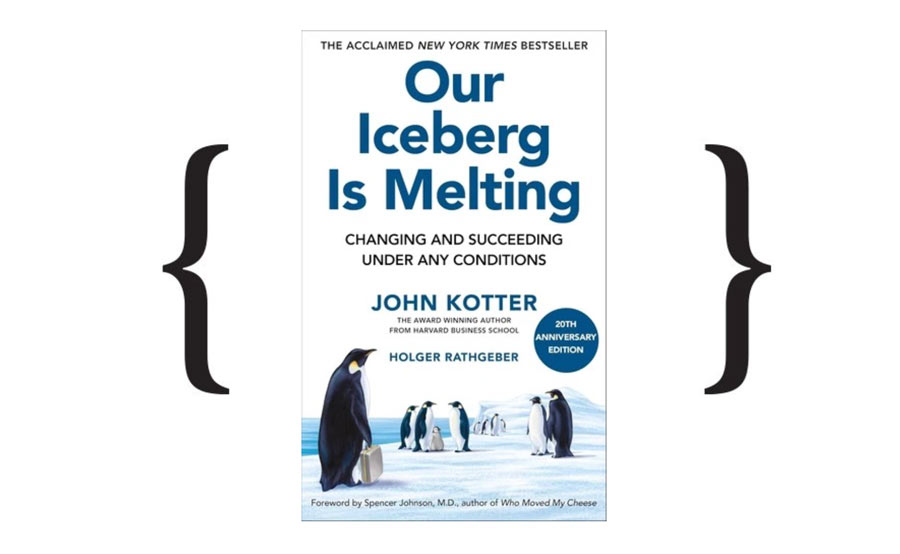
Book Review: Our Iceberg is Melting by John Kotter & Holger Rathgeber
Book Review: Our Iceberg is Melting by John Kotter & Holger Rathgeber
Nearly twenty years ago, Harvard’s John Kotter and Holger Rathgeber published a rather unusual management book about a colony of penguins.
Our Iceberg Is Melting tells the story of Fred, an observant and curious penguin who notices something deeply troubling about the iceberg his colony has occupied for generations. It is melting. Fred does what anyone who has spent time inside an organisation will recognise as the beginning of a difficult process. He gathers evidence, tests his hypothesis and eventually finds an ally in Alice, a strong and pragmatic member of the colony’s leadership team who is prepared to listen and, crucially, to act. Together they begin the difficult task of persuading the colony that something has to change.
Not everyone is convinced. Among the characters Fred encounters is the wonderfully named NoNo, an influential penguin whose particular talent is finding reasons why things should remain exactly as they are. The evidence is questionable, the danger exaggerated, the proposed response too risky. There is plenty of time and, besides, the colony has always lived on this iceberg.
I first read Our Iceberg Is Melting not long after it was published in 2006, at a formative point in my own thinking when I was beginning to develop what would eventually become Single Organizing Idea (SOI®). Nearly twenty years later, I was reminded of it last month when I read an article in The Economist about the demise of one of Earth’s largest icebergs. Iceberg A23a had broken away from its Antarctic home in 1986. There was something strangely grounding about reading the obituary of an iceberg that had existed for so long finally disappearing into the ocean, while Europe and other parts of the world are once again burning through a summer of extreme heat. It immediately brought Fred and his colony back to mind, so I went back and reread Kotter and Rathgeber’s short book.
Our Iceberg Is Melting is essentially a fable built around Kotter’s famous eight-step approach to leading change. One: Create urgency. Two: Assemble the right group. Three: Develop the vision and strategy. Four: Communicate it. Five: Empower people to act. Six: Generate short-term wins. Seven: Keep pushing. And finally, Eight: Embed the new behaviour deeply enough that it becomes part of the culture.
Rereading it exactly twenty years later, I found myself less interested in the mechanics of those eight steps than in the problem that precedes all of them — creating sufficient urgency to act. Before an organisation can change, enough people must believe that remaining where they are is more dangerous than moving somewhere else.
We live in an age in which the evidence for change is everywhere. Across Europe this summer, extreme heat has again brought wildfires, drought and pressure on infrastructure. Similar patterns are visible around the world and, as we have all experienced, New Zealand is hardly insulated from them. Floods, storms, landslips, coastal erosion and the growing cost of protecting communities and infrastructure are increasingly part of our own national conversation.
But climate change is only the most literal example of the melting iceberg around us. Artificial intelligence is transforming industries at extraordinary speed. Geopolitical relationships that appeared stable for decades are being reordered. Trade relationships are changing, populations are ageing, trust in institutions is at an all-time low and entire business models are being challenged. The interesting question is therefore no longer simply whether we can see the cracks. It is what we do once we have.
Last year I wrote about that particularly New Zealand expression, ‘She’ll be right’. At its best, ‘she’ll be right’ captures something admirable about our country and its optimism, resilience, pragmatism and unwillingness to panic unnecessarily. But there is another version. ‘She’ll be right’ can become an excuse for postponement, a belief that somehow things will work themselves out when something else happens, or that action is best deferred until the next election is settled, the summer is over, the new year properly underway or conditions are simply more favourable. There is always another perfectly reasonable reason to wait, and with it the comforting assumption that we have more time than we actually do. In other words, NoNo in a black jersey.
The people who resist change are rarely irrational. Often they are experienced, intelligent and successful. Indeed, their resistance can arise precisely because the existing system has served them well. The iceberg has always been there. The organisation has always made money this way. The country has always muddled through. Why change now?
Why? Because sometimes the conditions that produced yesterday’s success are the very conditions that prevent tomorrow’s.
There is another aspect of the book that struck me particularly strongly on rereading it. The penguins need more than a crisis. They need somewhere to go. Fear can create movement, but it cannot necessarily create direction. Urgency can persuade people to leave an iceberg but it cannot, by itself, tell them what they should move towards. That requires purpose. In other words, urgency answers the question, why must we move now? Purpose answers another, what are we moving towards? The two belong together.
Purpose without urgency can remain little more than aspiration, sitting comfortably on a website or appearing in an annual report without materially changing a single decision. Urgency without purpose presents a different danger. It can create frantic activity, competing priorities and people moving quickly but not necessarily in the same direction. Effective change requires both direction and momentum.
But perhaps the most important lesson in Our Iceberg Is Melting, however, comes at the end. The ultimate success of the penguin colony is not simply that it finds another iceberg. It learns to move.
That distinction feels even more important today than it did in 2006. We continue to talk about ‘managing change’ as though change were an inconvenient interruption between periods of stability. But what if stability is the interruption? Climate, artificial intelligence, geopolitics, demographics, technology and social expectations are not going to settle conveniently into some new permanent configuration.
The leadership challenge is therefore no longer simply how to move an organisation from A to B. It is how to build organisations, institutions and perhaps countries capable of continuing to adapt without losing their sense of who they are and why they exist. That requires shared values, a clear purpose that unites and brings opportunity to all, and a willingness to confront reality and create sufficient urgency to act.
Nearly twenty years after Our Iceberg Is Melting was published, we are surrounded by Freds pointing towards cracks in the ice and NoNos explaining why the cracks are not quite as serious as they appear, why the cost of moving is too great or why we should wait until the picture becomes clearer. Eventually, of course, the picture becomes perfectly clear. By then the choices available to us may be considerably fewer.
Purpose tells us what is worth moving towards. Strategy helps us determine how to get there. But we also need the Alices, the leaders prepared to listen to the Freds, to confront the NoNos and to give people the confidence and courage to begin the journey.
Our Iceberg Is Melting is available at leading bookstores and online retailers.

The Leadership Challenge Hidden in Plain Sight
The Leadership Challenge Hidden in Plain Sight
The latest Oxford–GlobeScan Global Corporate Affairs Survey reveals far more than the changing priorities of one corporate function. It offers a compelling picture of why governance, purpose and organisational alignment have become strategic imperatives in an increasingly uncertain world.
Every year, Oxford University’s Saïd Business School and GlobeScan survey senior Corporate Affairs leaders from around the world to understand the issues shaping their profession. This year’s research draws on the views of almost 300 senior practitioners across 51 countries, representing some of the world’s largest organisations.
The report catalogues an extraordinary list of pressures confronting organisations. Geopolitical instability dominates concerns once again. Artificial intelligence has surged from a relatively minor issue to become the second most significant perceived business risk in just twelve months. Economic uncertainty, regulatory change, cyber threats, climate change and reputational risk all feature prominently.
On the surface, these appear to be separate challenges requiring separate responses. I suspect they are nothing of the sort.
Rather, they are different expressions of a single reality, namely that the world has become so interconnected that political, economic, technological and societal issues can no longer be managed in isolation. Decisions taken in Washington reverberate through supply chains in Asia. Advances in artificial intelligence create opportunities for innovation while simultaneously introducing new risks around misinformation, cyber security and trust. Political polarisation reshapes expectations of business just as quickly as it reshapes government policy.
Complexity itself has become the defining management challenge. That observation becomes even more interesting when viewed alongside another of the report’s findings.
For many years the conversation around Environmental, Social and Governance (ESG) was dominated by climate change and social responsibility. This year’s survey tells a different story. Governance has overtaken both environmental and social issues as the greatest source of reputational risk for organisations. Ethics, accountability, transparency and board oversight are now seen as more significant than environmental performance or social impact.
That should not come as a surprise. In an increasingly unpredictable world, organisations are judged less by whether they face challenges than by how they respond to them. Governance determines the quality of decisions, the speed of adaptation and, ultimately, the level of trust that stakeholders are prepared to place in leadership. In these challenging times good governance has quietly become a competitive advantage.
Yet perhaps the most revealing finding concerns purpose.
Contrary to some popular narratives, organisational purpose has not disappeared. More than four in five organisations surveyed still have a formal corporate purpose in place (even if it is just a slogan). What has changed is the level of executive attention devoted to it. Discussion of purpose within executive teams has declined significantly over the past year, even while respondents overwhelmingly expect societal expectations of purposeful leadership to increase over the next three years. That tension is fascinating.
Boards have understandably become preoccupied with tariffs, inflation, geopolitical instability and artificial intelligence. Immediate risks demand immediate attention.
Stakeholders, however, have not lowered their expectations. Consumers, customers, employees, investors and wider society continue to judge organisations on the quality of their leadership, the values they demonstrate and the contribution they make. If anything, those expectations are becoming more demanding, not less.
The real issue isn’t that purpose has become harder to discuss. It’s that leaders risk becoming distracted by the urgent at precisely the moment when purpose is becoming even more valuable as a means of navigating uncertainty.
Purpose is not a luxury for more settled times. It is precisely what enables organisations to navigate unsettled ones.
The greatest risk is not abandoning purpose altogether. It is allowing it to be crowded out by the urgent. Organisations that lose sight of why they exist risk slowly eroding the trust, relevance and value on which their long-term success depends.
The smartest organisations appear to recognise this. Rather than stepping back from purpose, they are quietly doubling down on it; not as a communications exercise or a branding statement, but as the strategic discipline that brings governance, strategy, culture and stakeholder relationships together around a single, coherent direction.
Reading the report, I was struck by how frequently respondents returned to the same themes. They called for clearer strategy. Better internal alignment. Stronger governance. More integrated operating models. Better measurement. Greater influence at board level. Enhanced stakeholder engagement. Improved organisational capability. Seventy-four per cent believe the Corporate Affairs function itself requires revision to meet the demands of today’s environment.
Those recommendations describe something much bigger than the future of Corporate Affairs. They describe the future of organisational leadership.
For over two decades I have argued that the greatest challenge facing organisations is rarely a lack of purpose. More often, it is a lack of alignment. Strategy competes with culture. Governance sits apart from communications. Sustainability is managed separately from commercial priorities. Every function pursues legitimate objectives, yet too often without a common organising principle. The consequence is fragmentation precisely when coherence is needed most.
The Oxford–GlobeScan report documents the symptoms of that fragmentation with remarkable clarity. It also points, perhaps unintentionally, towards the solution.
The organisations most likely to thrive in the coming decade will not necessarily be those with the largest AI budgets, the most sophisticated communications teams or the most comprehensive ESG reports. They will be those capable of bringing governance, strategy, reputation, stakeholder relationships and organisational purpose together around a single, coherent direction.
That is not simply better Corporate Affairs. It is better leadership. And in a world where uncertainty has become the norm, that may prove to be the greatest competitive advantage of all.
Neil Gaught ON PURPOSE: In Conversation with Gavin Findlay
Neil Gaught On Purpose:
In Conversation with Gavin Findlay
Neil Gaught On Purpose: In Conversation is a monthly interview series featuring leaders, thinkers and practitioners at the forefront of purpose-driven business.
Each conversation goes beyond the rhetoric to explore how purpose is being applied in practice, across strategy, governance, culture and performance.
At a time of growing complexity and uncertainty, the series brings together diverse perspectives to examine a simple but increasingly urgent question: What does it take to build a business that creates enduring value for both shareholders and society?
Purpose is often discussed in boardrooms as though it were a strategy, a marketing statement or a communications exercise. Spend an hour with Gavin Findlay, Chief Executive of the New Zealand Food Network, and it quickly becomes clear that he sees it very differently.
After a career spanning the military, sport and the charitable sector, Gavin believes purpose is ultimately about one thing, and that is creating a positive impact on someone else’s life. That simple philosophy has shaped both his leadership and the organisation he has helped build from the ground up.
In this latest interview in the Neil Gaught ON PURPOSE interview series, we discuss leadership, community, commercial reality and why purpose is far easier to write on a wall than it is to embed into an organisation.
NG: Purpose has become one of the most widely used words in business. What does it actually mean to you?
GF: For me, purpose is about the positive impact you have on someone else’s life.
Years ago I took a group of New Zealanders to South Africa during the Football World Cup. We delivered hundreds of kilograms of football kit into one of Johannesburg’s poorest communities. Seeing the reaction of those children when they received that equipment was unforgettable.
Around the same time I came across something Sir Michael Jones once said: “It’s much better to give than to receive.” That really resonated with me.
Whenever I know we’ve genuinely made a positive difference to someone else’s life, I come away feeling better myself. That’s what purpose means to me. Everyone should have a purpose, whatever form it takes.
NG: The New Zealand Food Network exists to address food insecurity, yet you work closely with businesses. How do you balance social impact with commercial reality?
GF: One of the first conversations I had with our chairman, David Kirk, was about the phrase “not-for-profit.”
I’ve never liked it because every organisation has to generate a surplus. The difference isn’t whether you make money, it’s what you do with it.
We’re a ‘for-profit’ organisation with a clear purpose; a ‘for-profit’ and ‘for-purpose’ organisation if you like. Every surplus we generate goes back into achieving our purpose.
Commercial discipline isn’t the opposite of purpose; it’s exactly what enables purpose to succeed. It’s total nonsense to say that there is a ‘for-purpose’ sector and this is the exclusive domaine of charities. All organisations have to make a profit and almost all of them can be purpose-driven.
NG: Many organisations have purpose statements. Far fewer are genuinely driven by them. What’s the difference?
GF: It’s relatively easy to write a purpose statement. It’s much harder to ensure everyone lives it.
Large organisations naturally create silos. Sales have one set of priorities, operations another, finance another. Unless everyone understands the bigger picture, purpose remains words on a wall.
We’ve been fortunate because we’ve built the New Zealand Food Network from scratch. Everything we do comes back to one simple question: Does this help us get food to where it’s needed most?
That doesn’t remove tension or difficult decisions, but it gives everyone a common direction that we are organised around achieving together.
NG: Partnerships seem to sit at the heart of everything you do. What have you learned about bringing businesses, charities, government and communities together?
GF: The biggest lesson is that every partnership has to create value for both sides.
Too often charities approach organisations with their hand out. I’ve always taken a different approach. Tell your story honestly, understand what matters to the other organisation, and recognise the value they bring as well.
Some companies genuinely believe in what we do. Others become involved because partnering with us also solves a business problem by reducing food waste and disposal costs. Either way, if the outcome is more food reaching families who need it, that’s a partnership worth building.
NG: Many people struggle to understand why organisations like yours are still needed in a developed country.
GF: People often think giving someone food solves the problem. It solves today’s problem. It doesn’t necessarily solve tomorrow’s.
The bigger issue is that we’ve lost something we’ve traditionally relied upon —community.
When I was growing up, neighbours knew each other. If someone lost their job or was struggling, the street often rallied around them. Today many of us don’t even know who lives a few doors away.
At the same time we’ve created a society where housing is dramatically less affordable and more people are living under financial pressure. That’s the reality we’re working in.
Long term we’d love to see more people become food secure rather than continually responding to food insecurity. But until then, organisations like ours have an important role to play.
NG: What advice would you give a CEO who genuinely wants to build a purpose-driven organisation?
GF: First, you have to believe in it yourself. If you don’t genuinely believe in your purpose, nobody else will either.
Second, recognise that you can’t do it alone. Great leaders surround themselves with people who are better than they are in different areas.
Finally, don’t confuse purpose with reinvention. Too many leaders arrive believing they have to create a brand-new purpose. More often the real challenge is asking: How can we fulfil our existing purpose better than we’ve ever done before?
NG: New Zealand has traditionally seen itself as a country that cares. Do you think that’s still true?
GF: Overall, yes. We’ve certainly lost some of our sense of community, but compared with many parts of the world I still believe New Zealanders care deeply about each other.
The challenge is that the gap between those who have and those who don’t continues to widen. As that gap grows, organisations working to support vulnerable communities become even more important.
NG: Finally, if you could leave business leaders with one piece of advice, what would it be?
GF: I’d encourage every leader to ask themselves one simple question: What is enough?
Businesses absolutely need to be profitable. They have to generate returns. But purpose asks what you do with that success.
Could we show a little more empathy? Could we think a little more broadly about the people and communities our organisations affect?
If this conversation encourages even a handful of leaders to ask those questions, then it’s been worthwhile.