



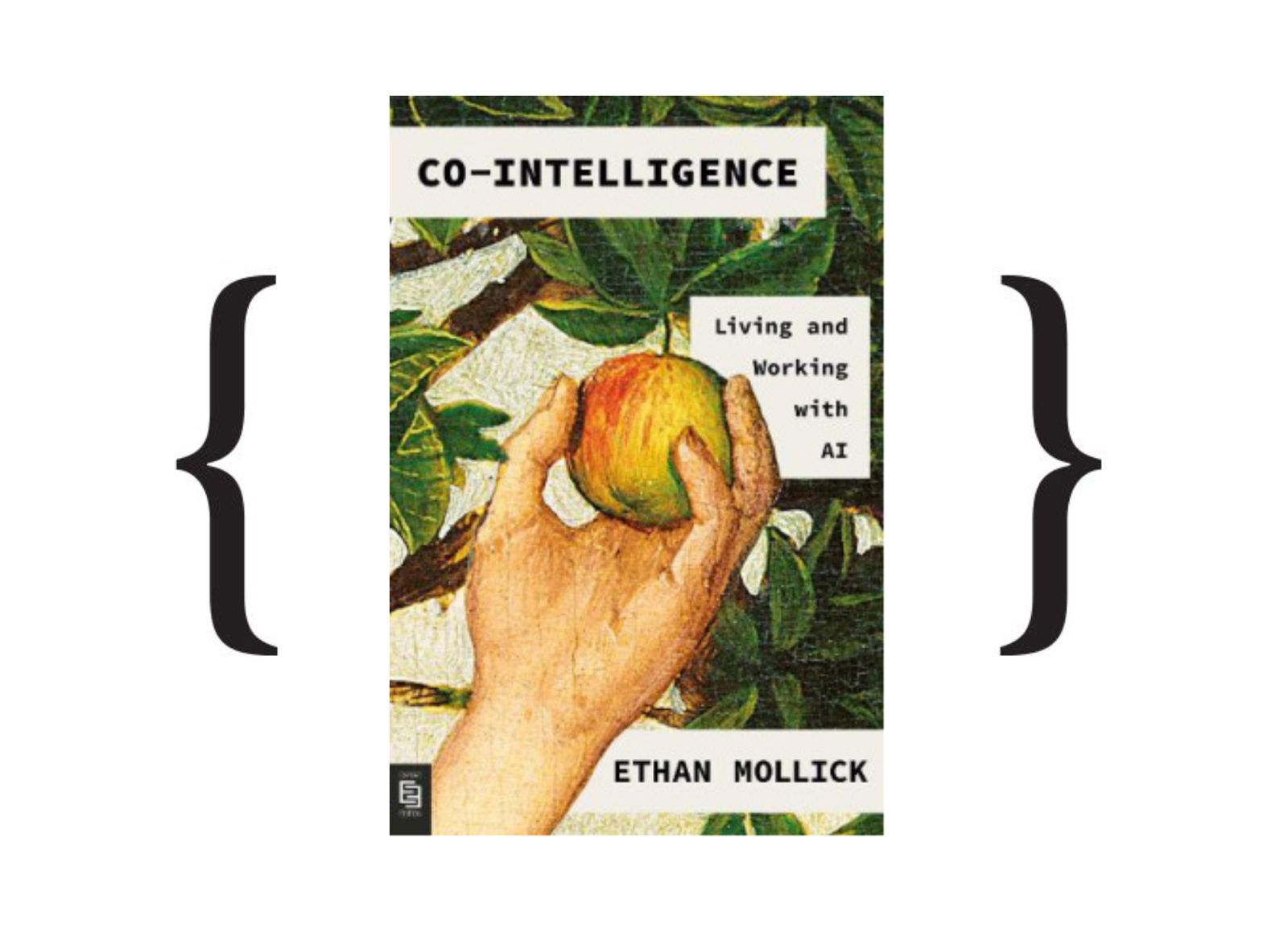
Book Review: Co-Intelligence: Living and Working with AI By Ethan Mollick
Co-Intelligence: Living and Working with AI By Ethan Mollick
Beyond Rhetoric: Books on Ideas Reshaping the Business of Business
Published in 2024, Ethan Mollick’s Co-Intelligence: Living and Working with AI could easily be dismissed as already out of date, such is the pace at which artificial intelligence is evolving. That would be a mistake. While some of its examples inevitably belong to an earlier stage of the AI story, the book’s core arguments have held up remarkably well, which perhaps explains why it continues to lead book-list rankings and remains widely regarded as one of the best books available for those trying to understand what AI means for the future of work.
Mollick’s central thesis is simple. AI is most usefully understood not as a replacement for human intelligence, but as a collaborator. A co-intelligence. Something that can help us think, write, analyse, learn and create. Provided, of course, that we use it with care.
Rather than treating AI as either salvation or threat, Mollick presents it as a practical working reality. He explores how it can act as a tutor, co-writer, critic, researcher and assistant, and he does so in a way that is readable, grounded and refreshingly free of unnecessary theatre and metaphors. This is not a technical manual for engineers, nor a breathless piece of futurism preoccupied with weighing dystopia against utopia. It is a book for ordinary professionals trying to understand how to work intelligently in a changing environment, and that is what makes it useful.
What Mollick conveys well is that AI is not just another software tool. It is beginning to shape the conditions under which knowledge work happens. That means the real question is no longer whether people will use it — we are — but how.
That point resonated with me because it reflects something I have already found in my own work. For years, when framing strategy presentations for clients, I used an introductory slide that signalled that what followed was based on “The truth and informed intuition.” In other words, the insights and recommendations that followed were grounded in researched evidence, human interaction, and then interpreted through experience and judgment. Since first adopting ChatGPT in a meaningful way back in 2022, I changed that slide to read: “The truth, informed intuition and intelligent synthesis.”
In many ways, this is Mollick’s core point. AI can help synthesise information, challenge assumptions, test language and accelerate understanding. Used properly, it can improve the quality and speed of thinking. But this does not remove the need for human insight or, more importantly, responsibility. AI may be impressive, but it is not wise. It can generate plausible answers with alarming fluency, but it cannot reliably distinguish between what is merely convincing and what is actually true.
That matters all the more in an age already shaped by fake news, misinformation and disinformation. This is where Co-Intelligence retains its value despite the rapid changes since it was published. AI is only as useful as the quality of the human relationship around it. It is not a substitute for judgment, discernment or accountability. It is a tool, not a solution.
That distinction is easily lost in current business culture, where there is a growing temptation to mistake speed for substance and output for insight. Copying and pasting is not thinking, and ‘slop in’ absolutely results in ‘slop out’. That reality was underlined when Deloitte Australia became embroiled in controversy after generative AI was used in the production of a government report on welfare compliance that reportedly included fabricated court cases, invented quotes and false references. The issue was not the technology, but the failure of human experience, intuition and oversight.
Mollick’s book is helpful not because it overstates what AI can do, but because it encourages readers to build a more mature relationship with it. Curious, experimental and useful, yes, but also disciplined.
The book’s format and structure make it an easy read and highly accessible. But that should not be mistaken for being lightweight. One of the reasons, I suspect, that it has remained so well regarded is precisely because it lowers the intimidation factor without trivialising the subject. For readers like me, who would not class themselves as ‘techies’, that is no small thing.
If there is a limitation, it is simply that the technology is moving faster than publishing can keep up. Some of the detail has inevitably aged. But the broader insight has not. Humans have, of course, worked with machines for a very long time. What is changing now is not the relationship itself, but the intimacy of it. We are entering a period in which machines are beginning to shape not just what we do, but how we think, write, interpret and create. In that sense, many of us are already functioning as a modest form of cyborg — not in the Dr Who science-fiction sense, mercifully, but in the more literal one; humans whose thinking and capability are increasingly extended by technology. Mollick’s contribution is to make that reality feel less abstract, less hyped, more manageable and maybe a little less scary!
