



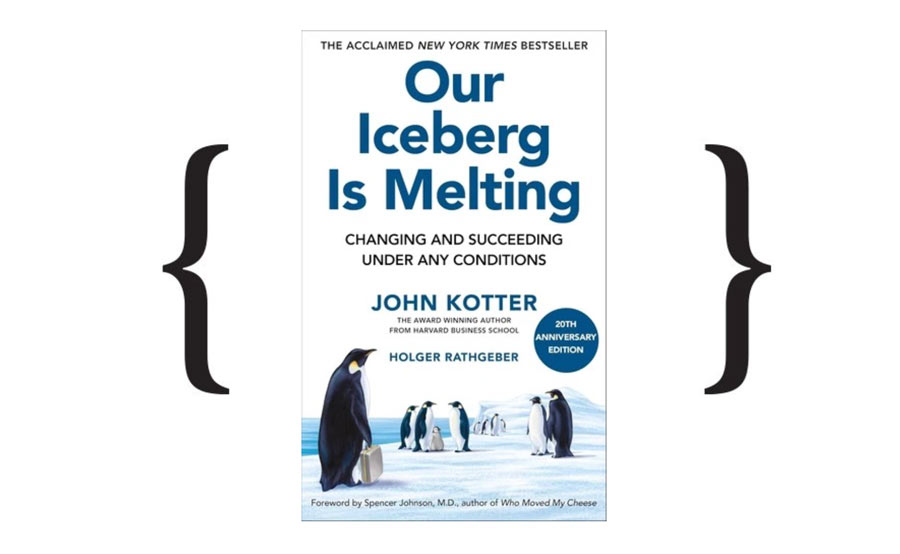
Book Review: Our Iceberg is Melting by John Kotter & Holger Rathgeber
Nearly twenty years ago, Harvard’s John Kotter and Holger Rathgeber published a rather unusual management book about a colony of penguins.
Our Iceberg Is Melting tells the story of Fred, an observant and curious penguin who notices something deeply troubling about the iceberg his colony has occupied for generations. It is melting. Fred does what anyone who has spent time inside an organisation will recognise as the beginning of a difficult process. He gathers evidence, tests his hypothesis and eventually finds an ally in Alice, a strong and pragmatic member of the colony’s leadership team who is prepared to listen and, crucially, to act. Together they begin the difficult task of persuading the colony that something has to change.
Not everyone is convinced. Among the characters Fred encounters is the wonderfully named NoNo, an influential penguin whose particular talent is finding reasons why things should remain exactly as they are. The evidence is questionable, the danger exaggerated, the proposed response too risky. There is plenty of time and, besides, the colony has always lived on this iceberg.
I first read Our Iceberg Is Melting not long after it was published in 2006, at a formative point in my own thinking when I was beginning to develop what would eventually become Single Organizing Idea (SOI®). Nearly twenty years later, I was reminded of it last month when I read an article in The Economist about the demise of one of Earth’s largest icebergs. Iceberg A23a had broken away from its Antarctic home in 1986. There was something strangely grounding about reading the obituary of an iceberg that had existed for so long finally disappearing into the ocean, while Europe and other parts of the world are once again burning through a summer of extreme heat. It immediately brought Fred and his colony back to mind, so I went back and reread Kotter and Rathgeber’s short book.
Our Iceberg Is Melting is essentially a fable built around Kotter’s famous eight-step approach to leading change. One: Create urgency. Two: Assemble the right group. Three: Develop the vision and strategy. Four: Communicate it. Five: Empower people to act. Six: Generate short-term wins. Seven: Keep pushing. And finally, Eight: Embed the new behaviour deeply enough that it becomes part of the culture.
Rereading it exactly twenty years later, I found myself less interested in the mechanics of those eight steps than in the problem that precedes all of them — creating sufficient urgency to act. Before an organisation can change, enough people must believe that remaining where they are is more dangerous than moving somewhere else.
We live in an age in which the evidence for change is everywhere. Across Europe this summer, extreme heat has again brought wildfires, drought and pressure on infrastructure. Similar patterns are visible around the world and, as we have all experienced, New Zealand is hardly insulated from them. Floods, storms, landslips, coastal erosion and the growing cost of protecting communities and infrastructure are increasingly part of our own national conversation.
But climate change is only the most literal example of the melting iceberg around us. Artificial intelligence is transforming industries at extraordinary speed. Geopolitical relationships that appeared stable for decades are being reordered. Trade relationships are changing, populations are ageing, trust in institutions is at an all-time low and entire business models are being challenged. The interesting question is therefore no longer simply whether we can see the cracks. It is what we do once we have.
Last year I wrote about that particularly New Zealand expression, ‘She’ll be right’. At its best, ‘she’ll be right’ captures something admirable about our country and its optimism, resilience, pragmatism and unwillingness to panic unnecessarily. But there is another version. ‘She’ll be right’ can become an excuse for postponement, a belief that somehow things will work themselves out when something else happens, or that action is best deferred until the next election is settled, the summer is over, the new year properly underway or conditions are simply more favourable. There is always another perfectly reasonable reason to wait, and with it the comforting assumption that we have more time than we actually do. In other words, NoNo in a black jersey.
The people who resist change are rarely irrational. Often they are experienced, intelligent and successful. Indeed, their resistance can arise precisely because the existing system has served them well. The iceberg has always been there. The organisation has always made money this way. The country has always muddled through. Why change now?
Why? Because sometimes the conditions that produced yesterday’s success are the very conditions that prevent tomorrow’s.
There is another aspect of the book that struck me particularly strongly on rereading it. The penguins need more than a crisis. They need somewhere to go. Fear can create movement, but it cannot necessarily create direction. Urgency can persuade people to leave an iceberg but it cannot, by itself, tell them what they should move towards. That requires purpose. In other words, urgency answers the question, why must we move now? Purpose answers another, what are we moving towards? The two belong together.
Purpose without urgency can remain little more than aspiration, sitting comfortably on a website or appearing in an annual report without materially changing a single decision. Urgency without purpose presents a different danger. It can create frantic activity, competing priorities and people moving quickly but not necessarily in the same direction. Effective change requires both direction and momentum.
But perhaps the most important lesson in Our Iceberg Is Melting, however, comes at the end. The ultimate success of the penguin colony is not simply that it finds another iceberg. It learns to move.
That distinction feels even more important today than it did in 2006. We continue to talk about ‘managing change’ as though change were an inconvenient interruption between periods of stability. But what if stability is the interruption? Climate, artificial intelligence, geopolitics, demographics, technology and social expectations are not going to settle conveniently into some new permanent configuration.
The leadership challenge is therefore no longer simply how to move an organisation from A to B. It is how to build organisations, institutions and perhaps countries capable of continuing to adapt without losing their sense of who they are and why they exist. That requires shared values, a clear purpose that unites and brings opportunity to all, and a willingness to confront reality and create sufficient urgency to act.
Nearly twenty years after Our Iceberg Is Melting was published, we are surrounded by Freds pointing towards cracks in the ice and NoNos explaining why the cracks are not quite as serious as they appear, why the cost of moving is too great or why we should wait until the picture becomes clearer. Eventually, of course, the picture becomes perfectly clear. By then the choices available to us may be considerably fewer.
Purpose tells us what is worth moving towards. Strategy helps us determine how to get there. But we also need the Alices, the leaders prepared to listen to the Freds, to confront the NoNos and to give people the confidence and courage to begin the journey.
Our Iceberg Is Melting is available at leading bookstores and online retailers.