


This is Not a Purpose
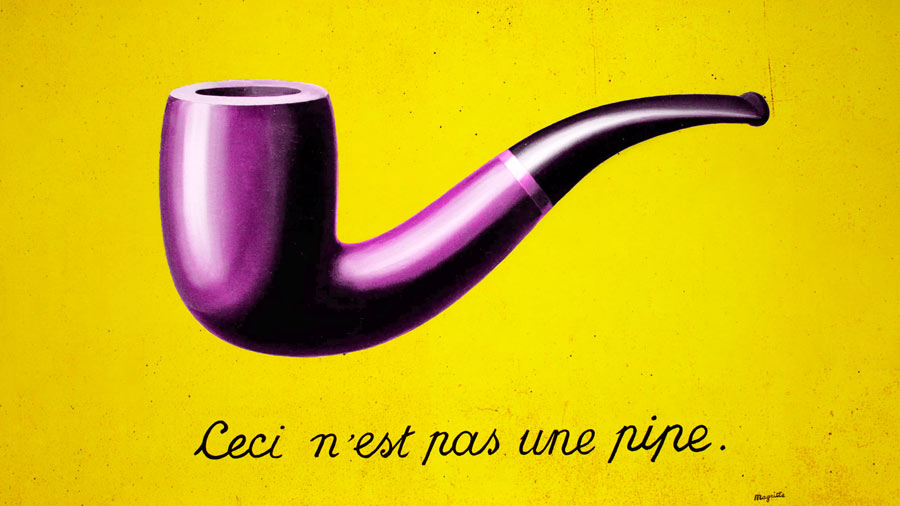
For many years, a reproduction of René Magritte’s The Treachery of Images has hung on the wall of my office. Painted in 1929, it is one of the most recognisable works of twentieth-century art. The painting itself is remarkably simple. Against an otherwise empty background sits an almost perfectly conventional tobacco pipe. Beneath it Magritte has written, in careful script, six words:
Ceci n’est pas une pipe.
(This is not a pipe.)
The first reaction is almost instinctive. Of course it is a pipe. We can see it. Except Magritte was right. It isn’t a pipe. It is a painting of a pipe. You cannot pick it up, fill it with tobacco or smoke it. However convincing the image might be, it remains a representation of something rather than the thing itself.
That distinction is precisely why the painting has followed me from office to office for so many years.
Magritte called the work La Trahison des images (The Treachery of Images). He was interested in the relationship between objects, images and the words we use to describe them. We see an image of a pipe and our mind immediately converts the representation into reality. The picture becomes the thing.
Nearly a century later, I think we have developed a remarkably similar problem with organisational purpose. Over the past decade in particular, businesses around the world have invested enormous amounts of time, energy and money in defining their purpose. Consultants have been hired. Employees interviewed. Workshops held. Boards engaged. Words debated and refined. Eventually, after much deliberation, a sentence emerges intended to capture why the organisation exists and the contribution it seeks to make.
It’s then launched. It appears on the website and in the annual report. It’s incorporated into presentations, corporate communications and, inevitably, the ‘merch’: coffee cups, lanyards, pens, tote bags, USB flash drives and so on. It might even be painted on a wall.
And somewhere along the way, the representation becomes confused with the reality.
A purpose statement is not an organisation’s purpose.
(The words are not the purpose. They merely describe it.)
There is nothing wrong with that. Words matter. I have spent more than two decades helping organisations find the clearest and most compelling articulation of the idea around which they can organise themselves. Done well, a purpose statement can provide extraordinary clarity. It can make something complex understandable and memorable. It can give thousands of people a common language for describing why their organisation exists.
But the statement is still only a representation. A strategy document is not strategy. Values written on a wall are not culture. A sustainability report is not sustainability. An organisational chart is not an organisation. In each case, the words, pictures and diagrams are attempts to describe something that has to exist in the real world. Purpose is no different.
For over two decades I have argued that purpose should operate as a Single Organizing Idea, or SOI®. The choice of the word ‘organizing’ (with a z), has always been deliberate. Purpose has little value if it simply describes an organisation. Its real value lies in its ability to organise one.
If an organisation genuinely understands why it exists, that understanding should have consequences. It should influence the choices a board makes and the strategy an executive team develops. It should affect where capital is allocated, which markets are entered, what products and services are developed, who is recruited and rewarded, which partnerships are pursued and which opportunities are declined.
It should influence what gets measured and, most importantly, it should help when the answer is not obvious. It is in those moments that purpose stops being a statement and starts becoming useful.
Which is something New Zealand’s political parties may wish to reflect on. As TVNZ News reported this week, with elections come election campaigns and the inevitable campaign slogans; a handful of carefully chosen words intended to tell us something about who the parties are, what they stand for and what they intend to do.
Magritte would have enjoyed this year’s batch. Not because any of them are particularly memorable or clever, but because even if they were, that would rather miss the point. A slogan, after all, is no more a government than a purpose statement is an organisation. However appealing the words on the tin, they remain merely a representation of what is supposedly inside. Whether the contents bear much resemblance to the label is something we will only discover by experiencing what actually happens.
Perhaps The Treachery of Images should hang in more boardrooms — and maybe a few campaign offices too.
Ceci n’est pas une pipe. This is not a pipe. And that purpose statement on the wall? That isn’t your purpose either.