


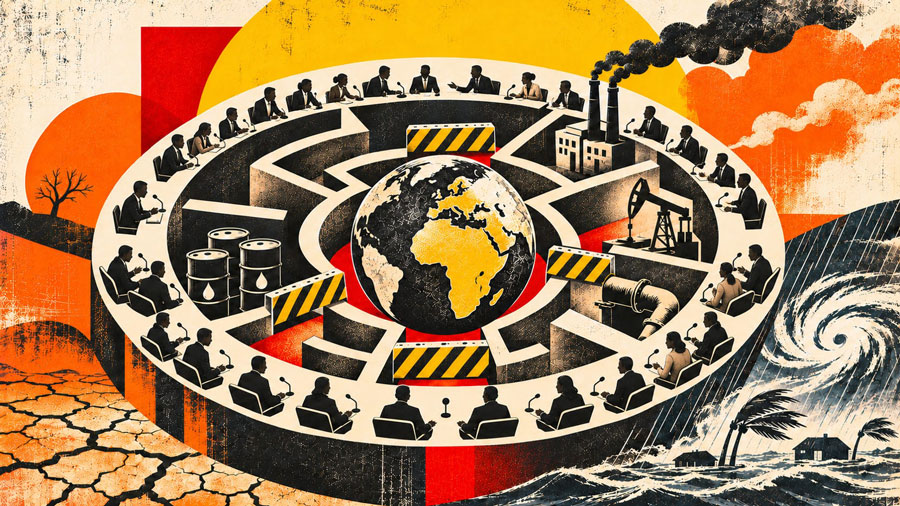
Is COP actually structured to deliver its purpose?
Thirty-four years after the Rio Earth Summit, the world knows what needs to be achieved. But is the system created to tackle climate change capable of delivering it?
COP31 has ended in Antalya without an overarching climate agreement. It would be easy to blame the negotiators or governments that refused to compromise. But after more than three decades of international climate diplomacy, I wonder whether we are asking the wrong question. Rather than asking why another COP has disappointed, shouldn’t we be asking whether COP is actually structured to deliver the purpose for which it was created?
I have attended and spoken at climate gatherings around the world, including delivering a keynote on the fringes of COP26 in Glasgow and speaking on several occasions at London Climate Action Week. One memory from Climate Week in New York in 2018 has stayed with me. At an invitation-only gathering, I heard economist Jeffrey Sachs using some pretty direct language to express his anger at governments’ failure to act with sufficient urgency. Also there was Bertrand Piccard, who had helped fly Solar Impulse 2 around the world using only solar power. What stayed with me, beyond hearing one of the world’s leading economists use language I certainly hadn’t expected, was the extraordinary juxtaposition; on the one hand, striking evidence of what human ingenuity could achieve, and on the other, sheer frustration at what our political systems could not.
The ambition is hardly new. In 1972, economist and environmental thinker Dame Barbara Ward urged humanity to learn “how to walk lightly on the Earth as its other creatures do”. Twenty years later, at the Rio Earth Summit, governments opened the UN Framework Convention on Climate Change for signature. Its ultimate objective was to prevent dangerous human interference with the climate system. The first COP followed in 1995. In Paris in 2015, nations agreed to pursue efforts to hold global warming well below 2°C and pursue efforts to limit it to 1.5°C.
That objective provides a remarkably clear purpose. Yet global emissions remain stubbornly high, temperatures continue to rise, and communities around the world are experiencing the increasingly devastating consequences. We are talking about people dying. On 24 November, the UK Health Security Agency reported that an estimated 5,258 people died from heat-associated causes in England during the summer of 2026. That is a staggering number, particularly when considered against the UK’s Climate Change Committee projection of up to 10,000 heat-related deaths annually across the UK by 2050. The consequences of inaction could hardly be clearer. The science is understood, technological possibilities are expanding, and the economic case for transitioning away from fossil fuels is increasingly compelling. So where does the machinery break down?
First, it is important to understand that COP operates largely by consensus. Unlike a parliament, where a majority can vote to approve a decision, COP generally requires governments to agree on a common position without formal objection. There is an important reason for this. It gives smaller, poorer and more vulnerable nations a voice alongside the world’s largest economic and political powers. But there is a fundamental weakness. The same arrangement that protects vulnerable nations also allows countries whose economies depend upon fossil fuels to obstruct progress. So, even when an overwhelming majority supports stronger action, opposition from a handful of governments can force commitments to be watered down or abandoned. Those governments may themselves face pressure from powerful corporations and industry lobbyists seeking to protect their commercial interests. In effect, countries can use the process to protect their immediate interests at the expense of the very purpose COP exists to achieve.
The European Commission captured this tension following COP31, declaring that “consensus cannot mean the lowest common denominator”. It refused to endorse a proposed agreement that failed to confront fossil fuels, arguing that doing so would undermine meaningful multilateralism. Meanwhile, Panama’s Environment Minister, Juan Carlos Navarro, accused the world of being held hostage by a “petroleum mafia”. His intervention joins a long history of impassioned appeals at successive COPs, from vulnerable island nations to António Guterres’s warnings of a climate catastrophe. Yet the same arguments return year after year. Powerful words, however sincerely delivered, are no substitute for effective governance.
Second, the Paris Agreement asks countries to determine their own emissions targets. Although governments have binding obligations to submit plans and pursue domestic measures, achieving the targets themselves is not legally enforceable internationally. This creates another fundamental weakness. Governments can make commitments on the international stage, only to subordinate them to competing economic and political priorities when they return home. Or as the Trump Administration did, simply withdraw their cooperation altogether. The US’s withdrawal from the Paris Agreement took effect in January this year, a year after the catastrophic California wild fires had claimed the lives of 31 people and destroyed more than 15,000 buildings.
Sadly, despite its 100% Pure mantra New Zealand is not a beacon of hope either. Ranked 22nd in the Climate Change Performance Index in 2007 and 34th in 2024, it has now fallen to 47th. Recent policy changes include weakening methane reduction targets and abandoning plans to price agricultural emissions. In June 2025, Prime Minister Christopher Luxon dismissed concerns raised by 26 international climate scientists, referring to them as “worthies”. A year later, while discussing agricultural production and emissions, he declared that “we’re prioritising growth, it’s not emissions”. Yet in October 2026, he was opening a major new solar farm and championing electrification. Supporting renewable energy is welcome, but it does not remove the need for a coherent climate strategy. The Government argues that protecting agricultural competitiveness is essential to economic prosperity. The wider question is what happens when domestic political and commercial interests take precedence over long-term international commitments.
This brings me to something fundamental about purpose. I have been honoured to play a small part in the international expert group developing ISO 37011, the soon to be published guidance on governing organisations by purpose. The principle underpinning this work is both simple and straightforward: To claim to be purpose-driven an organisation’s purpose must shape direction, oversight and accountability. That means purpose must sit at the core of strategy and, in effect, provide the Single Organising Idea (SOI®) that guides every decision and action taken throughout the organisation. Purpose cannot simply be an aspirational statement that everyone agrees with while continuing to make decisions according to competing short-term interests.
Of course, ISO 37011 is not designed to govern international climate negotiations. But the governance principle is entirely relevant. If COP’s purpose is to prevent dangerous climate change, shouldn’t its structures, decision-making processes and accountability mechanisms be designed above all else to deliver that outcome?
Reforming COP will not be easy. Consensus protects vulnerable nations as well as enabling obstruction, and international agreements depend upon sovereign governments. Nevertheless, stronger accountability, clearer measures of progress and mechanisms that allow willing countries to move forward without being constrained by the least ambitious deserve serious consideration. The objective should not be to abandon multilateralism but to make it effective.
Thirty-four years after Rio, we cannot keep mistaking agreement on a purpose for governance capable of delivering it. COP has helped build a global framework for action, but that framework must be judged by what it achieves, not simply by the declarations it produces.
Purpose is not what we say we intend to achieve. It must determine how we govern, what we decide and how we measure success. Perhaps it is time we applied that principle to COP itself.