



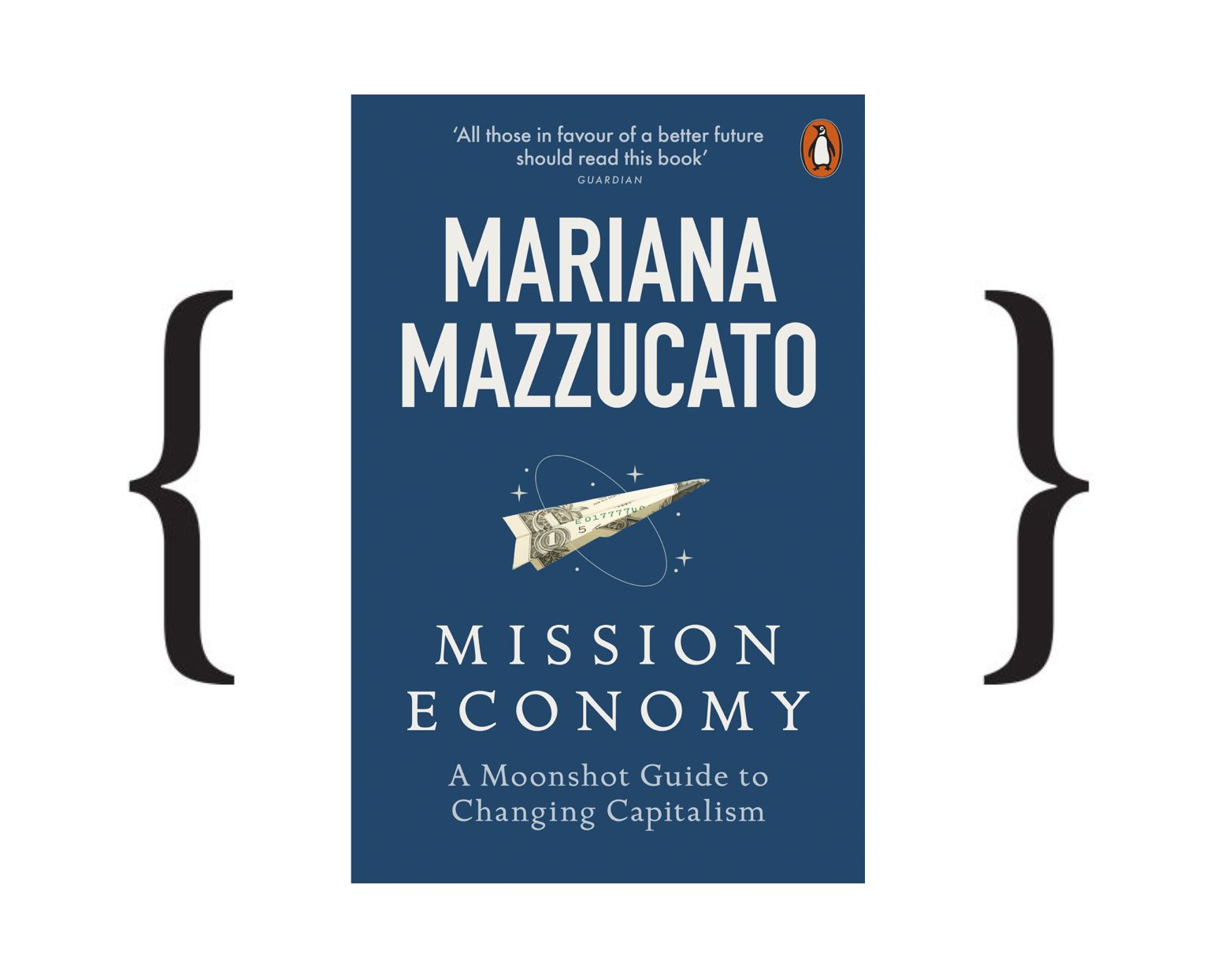
Book Review: Mission EconomyA Moonshot Guide to Changing Capitalism by Mariana Mazzucato
Beyond Rhetoric: Ideas Reshaping the Business of Business
Capitalism, at its simplest, is an economic system defined by private ownership and the pursuit of profit. It is a remarkably durable construct. From Adam Smith’s invisible hand to Milton Friedman’s insistence that the business of business is business, it has evolved, adapted and, at times, been fiercely defended. Yet it has also been persistently challenged, reinterpreted and, more recently, reimagined.
Spurred by an increasing frequency of so-called “black swan” events, this reimagining has gathered pace since the turn of the century. A growing number of commentators, whose work includes Conscious Capitalism, Reimagining Capitalism, Doughnut Economics and Creating Shared Value, have sought to reshape capitalism into something more inclusive, sustainable and ultimately more resilient. Having reviewed several of these, one becomes attuned not only to their ambition, but also to their overlap.
It is into this well-tilled ground that Mission Economy arrives.
Mazzucato’s central thesis is both bold and appealing. Drawing inspiration from the Apollo programme, she argues that the world’s most pressing challenges (captured in the UN’s Sustainable Development Goals SDGs), require a mission-oriented approach. Governments, businesses and institutions, she suggests, should align around clear, ambitious objectives, coordinating effort, resources and investment in pursuit of outcomes that markets alone have struggled to deliver.
Few would dispute the intent. The idea that capitalism needs direction, not just momentum, is increasingly hard to contest. Nor is her assertion that purpose must move from the margins to the core of corporate governance to achieve that.
And yet, for readers familiar with the broader literature, much of this will feel recognisable. The anecdotes are well told but well worn. The oft-cited story of the NASA janitor “helping to put a man on the moon” has circulated in leadership circles for decades. The underlying message that shared purpose can align effort and elevate performance, is important, but not new.
This is less a criticism than a reflection of where the debate now sits. We are no longer short of ideas. The constraint is execution.
Timing matters too. Published during the COVID-19 pandemic, Mission Economy reflects a moment when collective action was not only possible but necessary, and when governments were stepping forward with renewed authority. There was, very briefly, a sense that crisis might catalyse a more coordinated and purposeful form of capitalism.
That moment has since shifted.
Today’s landscape feels more fragmented. Trust in governments and institutions continues to decline, leaving much of the world in what Edelman, a global communications firm best known for its annual Trust Barometer, describes as a state of “pervasive distrust”. The gap between promise and delivery has widened. And dominant pressures including the rising costs of living, financial stress and persistent inequality are fuelling division rather than cohesion. In parts of the world, more assertive forms of leadership are reshaping the role of the state in ways that feel less collaborative and more controlling. A shift that has not gone unnoticed by those wary of leaders who begin to look a little too much like kings.
Against this backdrop, Mazzucato’s claim that capitalism is in crisis remains valid, but incomplete. It is not in crisis for everyone. For a relatively small but highly influential minority, it continues to function exceptionally well. Which raises a more uncomfortable question: If the system delivers for those best placed to shape it, what is the real incentive to change?
There is also the question of what has changed since its publication in 2021, at the height of the pandemic, when the case for coordinated action felt both urgent and achievable. The rapid advance of artificial intelligence (notably absent from the book), is already reshaping not only the future of work, but the trajectory of capitalism itself. If missions are to guide the economy, they will need to contend with technologies that evolve faster than the institutions attempting to direct them.
None of this diminishes Mazzucato’s contribution. Her reputation as a serious and influential thinker is well deserved, and her well-structured and clearly articulated call to organise around ambitious, outcome-driven missions remains both relevant and necessary. But Mission Economy is, in many ways, a product of its time. A snapshot of a moment when alignment felt more necessary and perhaps, given the context, more achievable than it does today’s more divided and complex world.
Which prompts a broader reflection. The grand challenges she highlights have not gone away. If anything, they have intensified. But one is left wondering whether their architects fully anticipated the world as it now is — more contested, less trusting and harder to align.
For business leaders, the implication is straightforward, even if the execution is not. Whether framed as purpose, mission or, in my own work, a Single Organising Idea, the need for a unifying direction remains. But the environment in which that direction must operate is becoming more complex, not less.
Mission Economy, then, is less a roadmap than a reminder. Capitalism may be resilient, but it is not immutable. It can be shaped to deliver more inclusive and sustainable outcomes that enhance the wellbeing of all stakeholders, but only through alignment, accountability and a willingness to confront the structural realities of the systems we have created, and those with a vested interest in maintaining them.
The question is whether, in a more divided and technologically accelerated world, we still have the capacity — or even the inclination — to organise around missions that genuinely serve that wellbeing. It is a question that some, Mazzucato among them, remain determined to answer.
Mission Economy: A Moonshot Guide to Changing Capitalism is available at leading bookstores and online retailers.