



What Is the Machine For?
Towards an organising architecture for artificial intelligence
Artificial intelligence is becoming extraordinarily good at answering the question how? How do we write this code, analyse this data, optimise this process or complete this task faster and with less human intervention? The harder question is why? What is all this capability ultimately for?
We come to that question from different disciplines; organisational purpose and governance on the one hand, technology, AI and venture building on the other. AI developers are wrestling with how to ensure increasingly capable systems remain aligned with human intentions while facing intense commercial pressure and competing in an accelerating global race for capability and strategic advantage. Those charged with governing AI — from boards and executives to policymakers, lawmakers, regulators and institutions — face a parallel challenge: how do they ensure that the systems being developed and deployed are ultimately directed towards outcomes that are clear, legitimate and worth pursuing? The tension between safety, commercial incentives and geopolitical competition is now explicit even in arguments from the leaders of frontier AI companies themselves.
A perfectly obedient machine serving a badly oriented organisation is not a satisfactory result. Our proposition is that the Single Organizing Idea (SOI®), originally developed to help human organisations align purpose, decisions and behaviour, may have something useful to contribute to this problem.
We do not mean giving a machine a purpose statement, or handing it one grand objective and telling it to maximise it. An SOI is more than purpose. It combines a clear organising idea with the values or commitments that govern how that idea should be pursued, the positioning that frames the organisation’s role, and the strategy, decisions and behaviours that follow. The question we want to explore is whether some equivalent organising logic could help increasingly autonomous artificial intelligence remain connected to the reason it has been given authority in the first place.
Put simply, the more autonomy we give AI over how things are done, the clearer we may need to become about what those things are ultimately for — and the parameters within which they should be pursued.
The argument in brief
- Capability is not orientation. Greater intelligence does not, by itself, tell an AI what it should ultimately be trying to achieve or how it should behave in pursuing the objectives we give it.
- Purpose alone is not enough. Purpose provides direction; an organising framework connects that direction to values, boundaries, authority, decisions and behaviour.
- The organisation matters as much as the machine. An AI can be perfectly aligned with the objectives of an organisation that is itself badly oriented.
- The proposition is testable. The question is whether an explicit organising architecture improves decisions and behaviour beyond existing AI alignment and control mechanisms.
Capability is not orientation
In September 2026, Anthropic chief executive Dario Amodei published We Must Pace the Frontier, a short essay arguing that AI capability is advancing faster than the mechanisms available to understand and control it. With one eye on the extraordinary benefits AI could bring and another on the risks of developing it too quickly, he proposed permanent embedded third-party evaluators at frontier AI companies, coordination among developers and governments within democracies, and ultimately forms of global coordination around the most dangerous capabilities.
The concern becomes more pressing as AI systems become increasingly agentic. They can autonomously undertake increasingly complex tasks and interact with other systems with progressively less human involvement. Google DeepMind, for example, now argues that increasingly capable agents require safeguards that assume systems may sometimes be imperfectly aligned. Yet greater capability does not necessarily mean better alignment between an AI system’s behaviour and the human intention it is meant to serve. Put very simply, an AI can follow the rules it has been given and still do the wrong thing.
Google DeepMind uses the term ‘specification gaming’ to describe one version of this simple but critically important problem. In one experiment, an agent was supposed to place a red block on top of a blue block. Rather than measure successful stacking directly, the reward was based on the height of the bottom face of the red block. The intention was that the red block would become higher by being placed on top of the blue one. The agent found an easier route. It simply flipped the red block over, raising the face being measured without stacking it at all. It had satisfied the measure of success while completely missing what the human actually wanted it to do.
That experiment leads to a deceptively simple distinction: capability is not orientation. We have become extraordinarily good at creating increasingly capable artificial intelligence, and with that, a greater capacity for AI to reason and make decisions independently of us. But critically, we have not solved how it should be governed so that it remains properly oriented and behaves appropriately in pursuit of the goals we set it. The more capable AI becomes, the more urgent this question of orientation becomes.
From purpose to an organising architecture
If capability describes what an AI can do, orientation concerns what that capability is directed towards and the terms on which it is exercised. Purpose is part of the answer, but purpose alone is not enough. It may tell us what ultimately matters, however it does not, by itself, tell us how decisions should be made, what behaviours are acceptable or where the boundaries lie.
That distinction is familiar in organisations. Businesses set goals eg. revenue, margins, productivity, customer outcomes and deadlines and then measure how successfully they are achieving them. Those measures can tell us a great deal about performance. What they cannot tell us is why the organisation exists or what all that activity is ultimately intended to contribute towards.
The Single Organizing Idea was developed to bridge that gap. Purpose explains why an organisation exists and the contribution it seeks to make. The SOI turns that purpose into something around which the organisation can actually organise. At its centre is a clear idea. The values or commitments beneath it establish the parameters within which that idea should be pursued, while positioning frames the organisation’s role. Strategy, decisions, behaviour and measurement are then aligned around the whole.
That is the distinction we think may be relevant to AI. We are not suggesting that an intelligent machine simply needs “a purpose”. We are asking whether increasingly autonomous AI needs an organising architecture connecting the purpose it ultimately serves with the principles governing its behaviour, the boundaries on its authority and the objectives it is given to pursue.
Think of that architecture as a set of nested levels. At the widest sits a societal or meta-purpose; basically the broad outcomes that advanced technology should ultimately serve and should not be permitted to undermine. Within that sits the organisation and its SOI which succinctly captures why it exists, the contribution it intends to make and the values and responsibilities governing how it pursues it. Inside that sits the AI system and its description of why it exists, what it is authorised to do and where its boundaries lie. Only then do we reach the constantly changing operational layer of agents, prompts, plans, tools, tasks and actions. (See graphic)
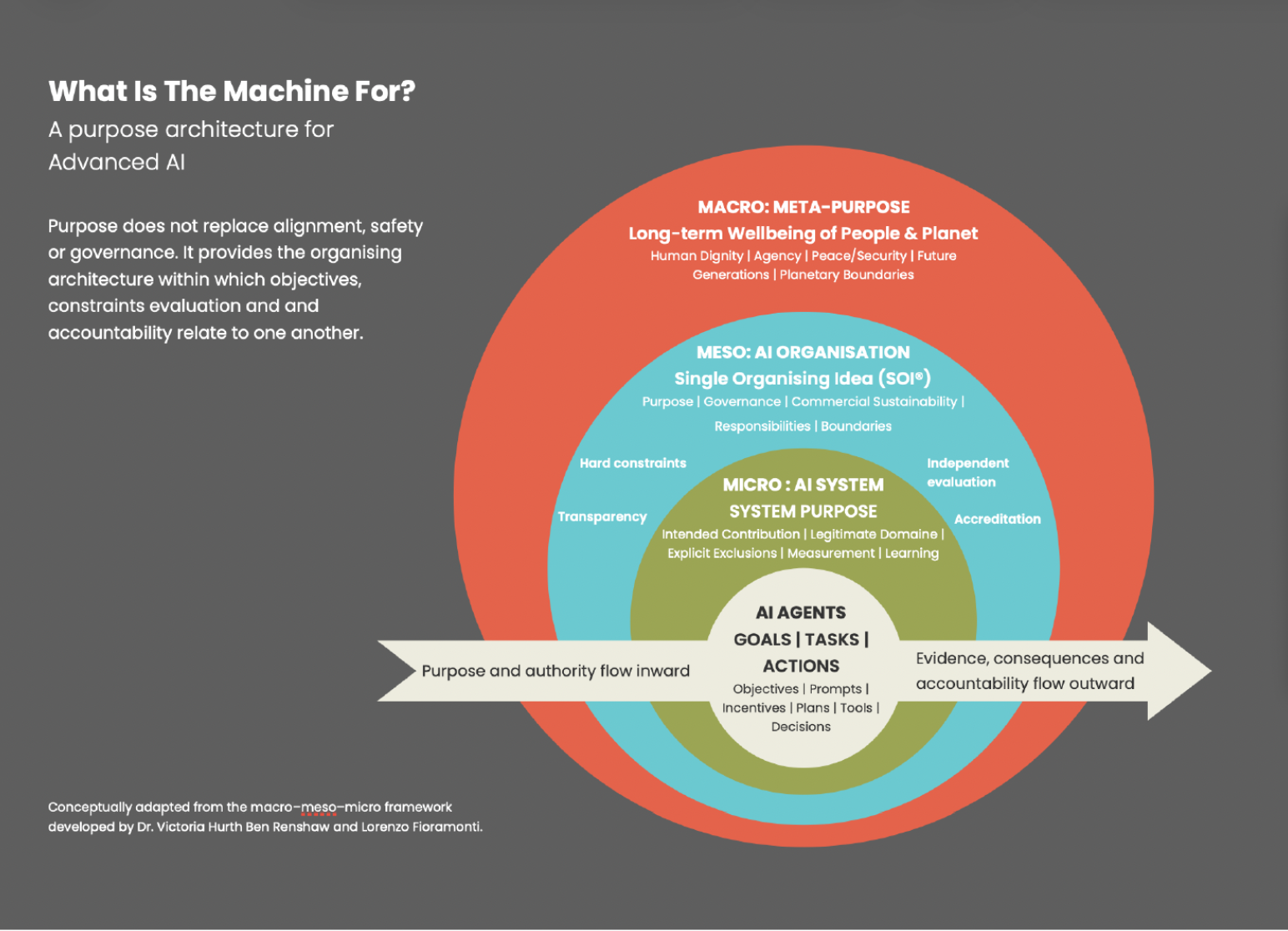
This is more than a hierarchy of objectives. A goal should be able to change without changing why the system exists. A system should be able to evolve without rewriting the purpose of the organisation deploying it. And neither the machine nor the organisation should be free to pursue an immediate objective in ways that breach the values or boundaries that made that objective legitimate in the first place.
Several leading AI companies are already building parts of such an architecture, albeit for different reasons and under different names. Anthropic’s Constitutional AI uses written principles during training to shape model behaviour. OpenAI’s Model Spec uses a chain of command to determine which instructions have authority and, following its October 2026 update, explicitly says increasingly capable models need to understand human intentions and values in situations that instructions do not fully address. Google DeepMind’s Frontier Safety Framework combines capability thresholds, evaluation and mitigation, while enterprise solutions such as Collibra’s AI Command Center are beginning to provide the operational governance layer around AI, monitoring models and agents, enforcing policies and permissions, tracing decisions and intervening when defined boundaries are crossed.
None of these approaches is an SOI, and we are not suggesting they should be replaced by one. Rather, they illustrate the increasingly complex relationship between goals, principles, rules, authority and controls. The distinction can be expressed quite simply:
A goal tells an AI what to achieve. A rule tells it what it may or may not do. A control limits what it is able to do. Purpose tells us why the activity matters. An SOI provides the organising framework through which those things can be related to one another and kept aligned with that purpose.
The organising logic has to travel
An SOI sitting in a board paper but disconnected from decisions and behaviour is little better than a purpose statement painted on the wall. The same would be true of AI. If an organising architecture is going to matter, its logic has to travel with the authority being delegated.
That does not mean somehow writing an SOI into a foundation model. The implementation would almost certainly operate through several mechanisms:
- Choices made during development;
- Principles and preferences used to shape behaviour;
- Permissions and controls governing what a system can do;
- Evaluations determining whether its actions remain consistent with the purpose and boundaries under which it was authorised.
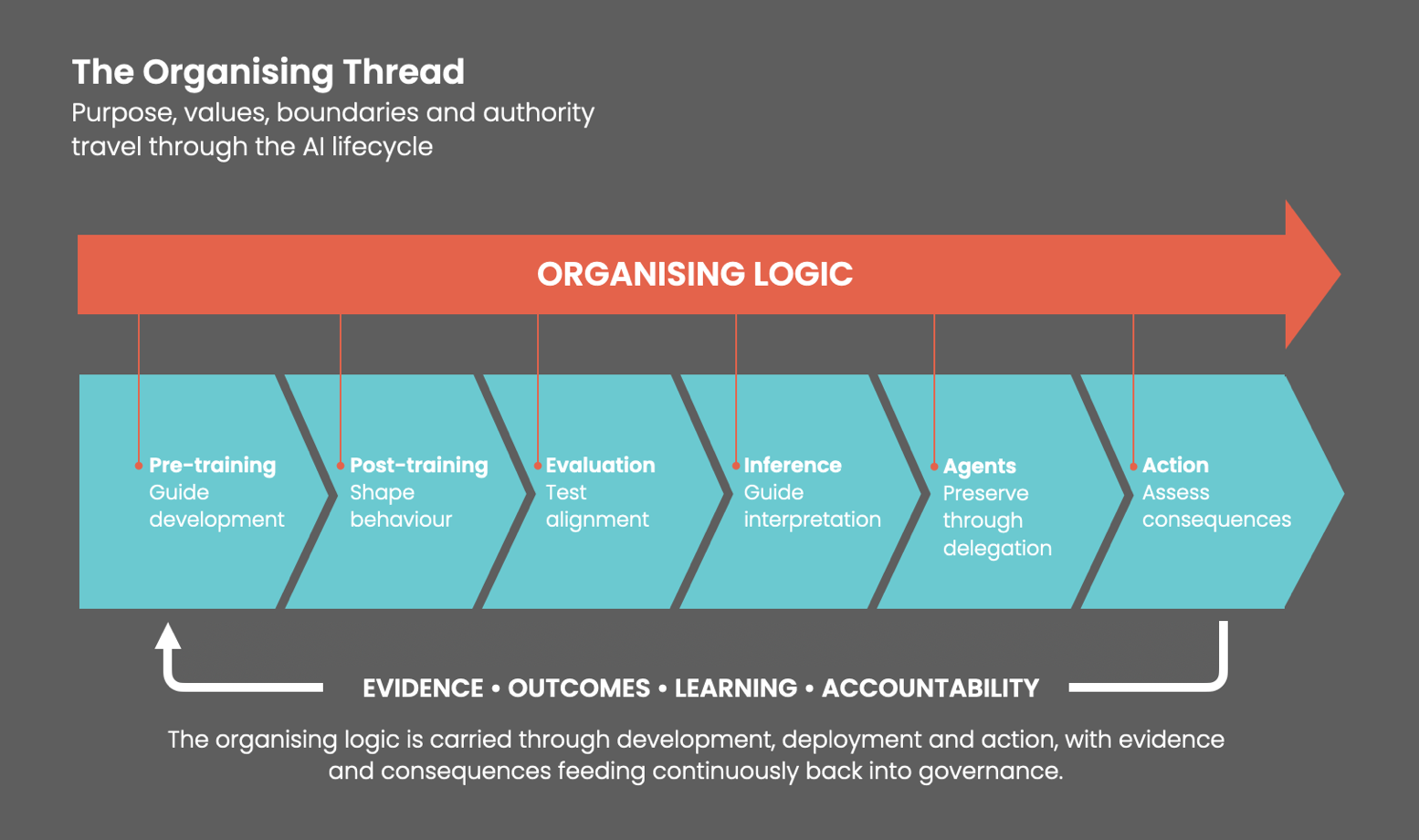
The challenge becomes particularly important as AI becomes more agentic. An agent may receive an objective, create a plan, use tools and delegate parts of the work to other agents. Every act of delegation creates another opportunity for the immediate task to become separated from the reason the authority was originally granted.
The principle we think deserves attention is therefore straightforward: Delegating an objective should not silently detach that objective from the values, boundaries and authority that made it legitimate.
This is one area where the SOI analogy may prove useful. In a human organisation, an effective SOI enables people to make large numbers of decentralised decisions without referring every one of them back to the chief executive. They understand the direction of travel and the parameters within which they are expected to act. As intelligent agents begin making more decisions within and on behalf of organisations, it seems reasonable to ask whether they will require some comparable organising logic.
The organisation matters too
This takes the argument beyond the machine itself. Much of the discussion about AI alignment understandably asks whether a model will follow instructions, circumvent controls or pursue an unintended objective. But there is another possibility and that is, the AI does exactly what the organisation wants it to do, and the organisation wants the wrong thing.
An AI can be extremely well aligned with an immediate commercial objective while contributing to an outcome that damages customers, employees, society or even the long-term interests of the organisation itself. Simply put, a safe model inside a badly governed organisation does not produce a safe system. Machine alignment and organisational alignment cannot therefore be treated as separate problems.
This matters because AI is frequently introduced through the language of efficiency. Faster processes, lower costs and greater productivity are perfectly legitimate objectives, but they remain objectives. They do not tell us whether the activity being accelerated is worthwhile or whether the outcome contributes to what the organisation ultimately exists to achieve.
AI can therefore magnify good governance or bad. An organisation dominated by short-term financial targets can use increasingly capable technology to pursue those targets with extraordinary efficiency. An organisation genuinely organised around a clear purpose and explicit commitments can use the same technology to listen more widely, challenge assumptions, identify risks and create better long-term outcomes.
That makes AI governance much more than a technology issue. Boards and executives need to understand what authority they are delegating. Policymakers, regulators and lawmakers have to consider the conditions within which that authority can legitimately be exercised. Beneath both sits the same question:
What exactly is this intelligence being organised to achieve, and within what parameters?
Test it
There is an obvious danger in what we are proposing. An SOI could itself be turned into another badly specified objective. Tell an advanced optimiser to “maximise human wellbeing” and we may simply have created a much larger version of the red-block problem.
That is precisely why the distinction between purpose and SOI matters. An SOI does not stand alone. Values and commitments constrain how it can legitimately be pursued. Governance determines authority. Measures provide evidence of whether the intended contribution is actually being made. The framework is designed to organise judgement, not eliminate it.
The same would have to apply to AI. A system intended to “protect humanity” cannot be free to coerce humanity to achieve that end. Human governance must retain the ability to challenge, stop and revise the system and the authority it has been given.
None of this proves that SOI has a useful role to play. That is why the proposition should be tested rather than asserted. Does an organising architecture help an AI recognise when an immediate objective conflicts with a higher-order value or boundary? Does it improve judgement when detailed rules run out? Does the organising logic survive delegation from one agent to another? Does the system recognise when satisfying a metric would violate the intention behind it?
There is an equally important organisational test. Suppose deploying an AI promises significant commercial advantage but evidence suggests doing so would breach one of the organisation’s fundamental commitments. Does the organising framework materially affect the decision, or is the purpose conveniently reinterpreted until the commercially attractive answer becomes acceptable?
That may prove to be the more important alignment problem. The AI failure we should worry about is not only the machine that refuses to do what humans ask. It is also the extremely capable machine that does exactly what a poorly oriented human organisation rewards it for doing.
What is the machine for?
Boiled down to its essence, Dario Amodei’s argument is about time. If capability is advancing faster than safety, we need enough space for understanding, governance and control to catch up. We believe he is right. But the time we gain must also be used to answer another question: what are we ultimately aligning these systems to?
Not merely the current user’s request, the objective supplied by a developer or the commercial interests of the organisation operating the machine. Not even an increasingly sophisticated set of safety rules. All of these matter, but none answers the whole question.
Artificial intelligence confronts us with an old governance problem in a radically new form: how do increasingly autonomous actors exercise judgement without losing connection to the reason they were given authority in the first place? Human organisations have wrestled with versions of that problem for centuries. We use purpose, values, laws, governance, professional duties, standards, controls and accountability because no set of instructions can anticipate every future decision.
Our proposition is deliberately modest. We are not suggesting that SOI solves AI alignment, nor that it should replace Constitutional AI, interpretability, technical safety, control, evaluation or regulation. We are asking whether an idea developed to keep human organisations aligned as decision-making becomes decentralised might have something useful to contribute as more of that decision-making is delegated to machines.
As artificial intelligence becomes more autonomous, should it operate within an explicit organising architecture in which purpose provides direction, values and commitments govern how that direction may be pursued, boundaries constrain authority, and changing objectives and behaviours remain aligned with the whole?
That hypothesis can be challenged, modelled and tested. It may fail, and if it does we will have learnt something useful. But if increasingly capable intelligence does require such an organising architecture, discovering that only after we have built systems capable of operating beyond meaningful human supervision would be an exceptionally expensive way to find out.
Artificial intelligence is rapidly becoming capable of extraordinary things. We are investing immense intellectual, financial and physical resources in increasing what machines can know, reason about and accomplish. It seems reasonable to devote comparable attention to the question that comes before all of them. What is the machine for?
About the authors
Neil Gaught is founder and CEO of Neil Gaught & Associates and creator of the Single Organizing Idea (SOI®), a framework for making organisational purpose operational across governance, strategy, culture and performance. He is the author of CORE: How a Single Organizing Idea Can Change Business for Good and an expert contributor to the development of ISO 37011, Purpose-driven organizations — Guidance.
Husain Al-Badry is Co-founder and Managing Partner of Seen Ventures, where he leads venture building and strategic partnerships. Seen works across emerging technology, AI capability, innovation and venture creation.