



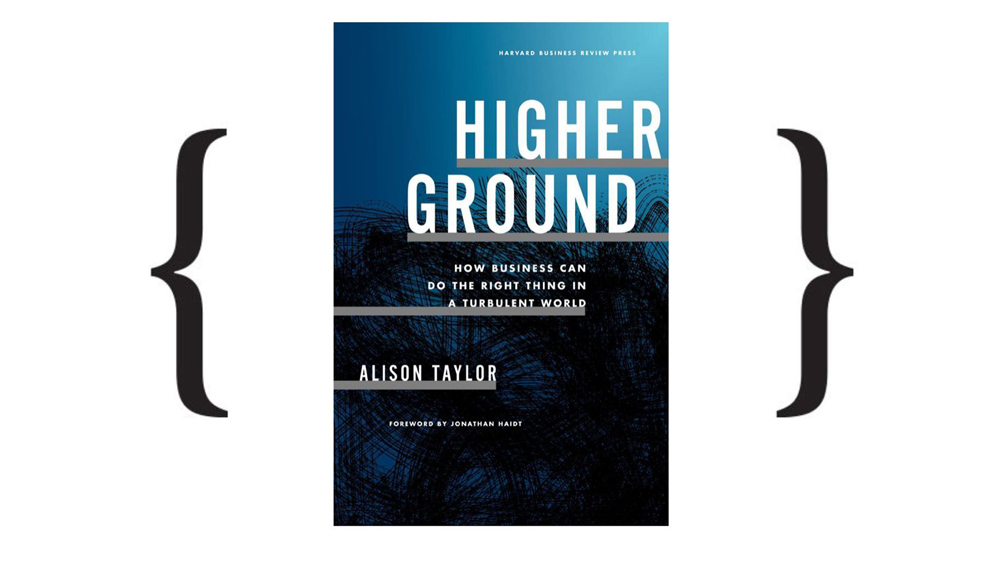
Book Review: Higher Ground by Alison Taylor
Alison Taylor’s Higher Ground is an intelligent and persuasive account of why business needs to take ethics, purpose, values and human impact more seriously. It is excellent on the “why” and very good on the “what”. But for a book that explicitly promises to explore what it takes to implement corporate purpose, the practical “how” remains frustratingly unclear.
Listed among the Financial Times best business books of 2024, Higher Ground is a book I recently found myself returning to as part of my Beyond Rhetoric series. Taylor, a clinical professor at NYU Stern School of Business and former executive director of Ethical Systems, sets herself an ambitious task. Namely to explain how businesses should behave in a world in which old certainties around shareholder value, regulation and corporate responsibility are breaking down.
Her diagnosis is strong. Taylor argues that branding, culture, sustainability, risk and ethics can no longer be treated as separate disciplines. In a transparent world, organisations pursuing contradictory agendas through different functions quickly appear incoherent or hypocritical.
Taylor is equally sceptical of interchangeable values statements, superficial ESG programmes and grand claims about making the world a better place. She is particularly good on purpose becoming another form of corporate theatre. If purpose is treated as a performance, she says, it will never drive performance. Quite.
She also understands that principles occasionally have a price. A value that survives only while commercially convenient is not much of a value at all. It echoes an argument I made years ago in discussions with Michael Porter’s Shared Value team at Harvard about the flaws I saw in their ‘win-win’ model. Doing the right thing cannot always depend upon there being a convenient commercial win.
Much of Higher Ground is therefore another welcome antidote to the inflated claims surrounding corporate purpose. The problem comes when Taylor moves from diagnosis to prescription.
Ultimately the book offers a moral framework for responsible business rather than a management framework for purposeful business. So, while Taylor is excellent on the “why” and very good on the “what”, she is much less convincing on the “how”.
In her concluding chapter, “Purpose Starts with Impact”, she wraps up themes explored at length in the book into a set of principles — understand human impact, respect human rights, listen to stakeholders, take culture seriously, avoid hypocrisy and act on commitments.
The principles are sound. But principles are not a system, and so the promise Taylor makes on page nine — “In the conclusion, I’ll explore what it really takes to implement corporate purpose and find a view from a higher ground” — is never quite fulfilled. Instead of a pragmatic framework, Taylor offers her principles and two stories as examples of purpose in practice.
The first story is about American yoghurt company Chobani and its immigrant founder Hamdi Ulukaya. His commitment to refugees, employees and communities is admirable. But an admirable founder is not a methodology. Purpose is not only about creating meaning. It must also create orientation.
The second story is about Jo Alexander, a BP geologist who became disillusioned with the company, left in 2015 and later challenged its leadership publicly over climate change.
It is a story I know well. Firstly, because Lucy Traynor, a London based peer of mine who had led Deloitte UK’s firm-wide purpose strategy, pointed me towards Alexander in a conversation about BP earlier this year. And Secondly, because while I was only ever on the periphery of the BP account during my time at Enterprise IG, then part of WPP and one of the world’s largest branding consultancies, it was difficult not to be caught up in the ambition surrounding Lord John Browne and his “Beyond Petroleum” purpose. Here was the chief executive of one of the world’s largest oil companies acknowledging climate change and talking about reinventing the energy business.
Like Alexander, I believed much of it. And, like Alexander, I subsequently became disillusioned. BP would later feature heavily in my book CORE as an example of the gulf that can open between what an organisation says and what ultimately drives it.
After Alexander challenged BP’s board in 2019, incoming chief executive Bernard Looney sought her out. His new purpose — “reimagining energy for people and our planet” — persuaded her to return as BP’s Purpose Engagement Manager.
For Taylor, it is a powerful example of purpose restoring meaning and commitment. But there is an important postscript. Taylor’s account ends with Alexander’s return to BP. By the time Higher Ground was published in February 2024, however, Alexander had already left the company for a second time, in June 2023, later memorably describing herself as a “serial conscious quitter”. Then, in February 2025, BP announced a fundamental strategic reset, increasing its focus on oil and gas while sharply reducing planned investment in transition businesses.
None of this invalidates Taylor’s example. If anything, it makes it more revealing. It raises precisely the question her book never quite resolves: How does purpose become sufficiently embedded in an organisation to survive changes in leadership, strategy and commercial pressure?
Higher Ground is, at its heart, a book about business ethics, and the moral argument matters enormously. It is intelligent, accessible and refreshingly sceptical of the easy answers surrounding purpose, ESG and stakeholder capitalism. Taylor provides a strong ethical compass and tells business leaders much about the direction in which they ought to travel. What she does not quite provide, despite promising to explore what it really takes to implement corporate purpose, is the organisational route map for getting to higher ground.
Higher Ground is available at leading bookstores and online retailers.