What is the purpose of government?
What is the purpose of government?
New Zealand’s election raises a question that goes beyond the traditional left-right divide: What is government really for, and how can we ensure it delivers lasting wellbeing and opportunity for all?
As Aotearoa New Zealand prepares to vote and America counts the results of its midterm elections, perhaps the most important political question is not who should govern, but what government is actually for.
This Saturday, 7 November, New Zealanders will elect a government. On the other side of the Pacific, Americans are, as I write, awaiting the outcome of midterm elections that will determine control of the House of Representatives and the Senate. The campaigns are very different, as are the political systems, the personalities are different, yet much of the argument in both countries has a familiar ring. Who will cut taxes? Who will spend more? Who will be tougher on crime, immigration or welfare? Who can be trusted with the economy? Who is up, who is down and who won the debate? These are all important questions, certainly, but they come after a much more fundamental one that we rarely seem to ask. What is government actually for?
It is a question about purpose. For much of my career I have asked organisations to answer essentially the same questions. Why do you exist? What enduring value are you here to generate? For whom? And within what parameters are you prepared to operate in pursuit of it? There is no particular reason why government should be exempt. Indeed, given the extraordinary authority we hand to governments, the resources they command and the consequences of the decisions they make, perhaps we should be demanding greater clarity of purpose from them than from anybody else.
The answer is less controversial than today’s social media driven, divisive style of politics might suggest. The International Public Sector Accounting Standards Board (IPSASB) on which New Zealand is represented, describes the primary function of governments and other public-sector entities as providing services that “enhance or maintain the well-being of citizens and other eligible residents”. Those services include education, policing, welfare, national security and defence. New Zealand’s own Public Service Act is similarly clear. It says the Public Service exists not simply to implement the policies of whichever government happens to be in office, but to support democratic government, deliver high-quality public services, facilitate active citizenship and help government pursue the long-term public interest.
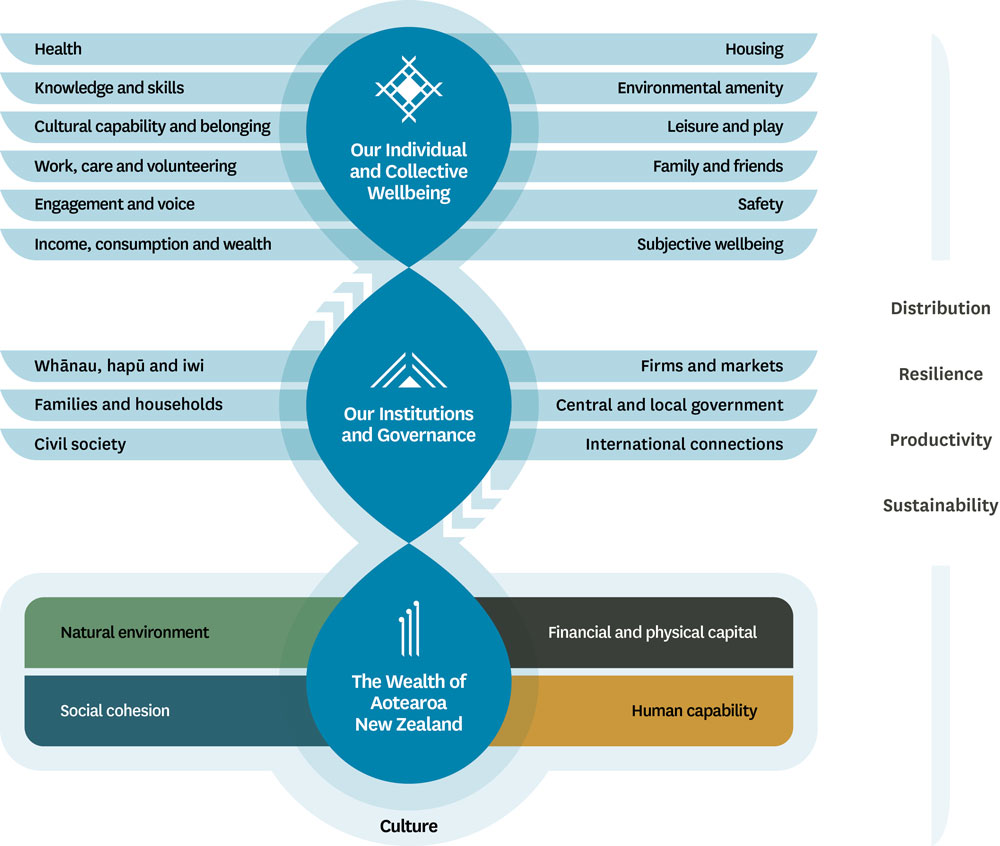
Our Treasury has been thinking in similar terms for years. Its Living Standards Framework explicitly considers individual and collective wellbeing, the role of institutions and governance in facilitating it, and the wealth of New Zealand in terms that extend beyond financial capital to include human capability and the natural environment. So perhaps a reasonable statement of the purpose of government might simply be “to create and sustain the conditions in which people, communities and future generations can flourish”. Not simply some people, but everyone. Not simply today, but over time. And certainly not by consuming the natural and social systems on which tomorrow’s wellbeing depends.
This thinking is very close to the argument Dr Victoria Hurth made here in Auckland last week during her short visit to New Zealand to promote the forthcoming guidance standard on purpose ISO 37011. Her contention is that we have confused the means with the end. We have come to treat financial income, profit and GDP as if they were the things we ultimately care about, rather than instruments that should enable what we actually care about, namely good lives, healthy communities and human flourishing. Hurth describes the overarching goal as “long-term wellbeing for all people and planet”. At the organisational level, purpose-driven organisations make an optimal contribution towards that goal. Government, importantly, is one of those organisations.
In her keynote presentation she described an economy as the greatest tool a government has for achieving its mandate, a mechanism for allocating and transforming resources in ways that maximise collective wellbeing. It is an important distinction because it challenges one of the central assumptions underpinning contemporary political and economic thinking. Rather than asking how we can make the economy grow and assuming that society will benefit as a consequence, we should be asking what kind of society we are trying to create and how the economy can best help us achieve it.
This is not socialism. Nor is it capitalism. It is not fundamentally a question of left or right. As Victoria argued, it sits beneath those ideological divisions. Once we establish that the purpose of an economy is to contribute to collective wellbeing, the debate becomes one about the most effective means of achieving it. Markets, government intervention, public investment, private enterprise, taxation and regulation all have roles to play, but none should be confused with the ultimate objective. An economy is not the purpose of government. It is one of the principal means through which government helps a society flourish.
That does not diminish the importance of economic performance. GDP matters enormously. Productivity matters. Profitable businesses matter. Investment and trade matter. A country that cannot generate wealth will eventually find itself unable to provide the education, healthcare, infrastructure, security and opportunities its people need. But economic growth is not the ultimate objective any more than profit is ultimately the purpose of a company. Both are essential to generating the resources required to achieve something more meaningful.
If GDP rises while large numbers of people cannot afford somewhere decent to live, if productivity grows while natural systems are progressively depleted, or if national wealth increases while children leave school without the capabilities to participate fully in society, then surely we are entitled to ask whether the instrument is delivering against its purpose. This does not mean abandoning markets. Quite the opposite. Hurth’s argument is for a market economy governed towards the outcomes we actually want, rather than assuming that maximising financial activity will somehow produce them automatically. Her phrase for it is a ‘wellbeing economy’. To avoid the unnecessarily politicised attention it has attracted I would suggest simply calling it a ‘purposeful economy’.
This also changes the argument about taxation, which seems to dominate every election campaign. We are encouraged to evaluate competing parties according to whether their policies will leave us with a little more or a little less money in our pockets. Of course taxation matters, as does the responsible management of public finances. Governments should use public money efficiently, waste is indefensible, and a state that spends without discipline is no more purpose-driven than a business that loses money indefinitely. But low taxation cannot sensibly be an end in itself either. Taxes are one of the ways through which we purchase collective capability; hospitals, schools, roads, policing, defence, infrastructure, social protection and the institutions on which a functioning market economy itself depends.
And the demands on that capability are increasing. The Treasury’s 2025 long-term fiscal assessment warns that population ageing will significantly increase the costs of New Zealand Superannuation and publicly funded healthcare over coming decades. Its modelling shows that today’s policy settings cannot simply continue unchanged indefinitely. This does not automatically make the case for higher taxes, nor does it necessarily justify a larger state. What it does make is the case for honest choices about the outcomes we are trying to achieve, what they will cost, how they should be funded and what obligations we have to people who will be living here in 20, 40 or 60 years. We need to determine what government should provide, what markets should provide, what communities and individuals might contribute and, inevitably, what we should stop doing in order to release resources for more important priorities. These are questions of strategy, and strategy only makes sense once we treat purpose not simply as a declared statement of intent but as the fundamental core idea around which everything is aligned, organised and measured against.
It is against this background that I struggle increasingly with the conventional left-right political contest. One government arrives and changes the settings. Another arrives three years later and begins changing them back. Ministers replace one another, programmes are rebadged, institutions reorganised and priorities changed. Then we do it again. It is extraordinarily expensive, and it clearly makes long-term progress on subjects such as infrastructure, education, health, housing, climate resilience and productivity much harder than it needs to be. The political incentives encourage this behaviour. Opposition parties are rewarded for opposing, governments for announcing things, and election campaigns for producing short-term promises capable of being reduced to a headline.
We should not blame politicians alone for this. Most politicians I have met work remarkably hard. Whatever my disagreements with them, choosing public service inevitably brings scrutiny, pressure and personal sacrifice, and that deserves respect. I admire people prepared to give so much of their lives to serving their communities and their country. But politics is also a system, and systems shape behaviour. When politics becomes a career, the danger is that getting elected, remaining elected, becoming a minister or eventually becoming prime minister can gradually become the objective rather than the means to an end. Winning begins to replace serving, and personal political ambition risks taking precedence over the contribution an individual originally set out to make.
The same distortion occurs when lobbying, privileged access and private conversations allow organised interests to exert disproportionate influence over decisions whose consequences are borne by everybody. In a healthy democracy, businesses, unions, community groups and other interests must have opportunities to make their case. Governments need to listen, and consultation is essential to good decision-making. But there is a considerable difference between transparent engagement in the public interest and privileged influence exercised behind closed doors. In the 21st century, with the expectations of transparency that now exist, and the challenges we face, we should surely be capable of creating better systems of accountability.
None of this requires us to believe politicians are corrupt or ill-intentioned. It simply requires us to build governance that makes the purpose the enduring touchstone, establishes the parameters within which decisions are made, makes trade-offs transparent and holds those making them accountable for the results. That is precisely the territory now being addressed by ISO 37011. It applies not only to private organisations but also to public-sector bodies, regulators and central and local government. It asks governing bodies to align direction, decision-making, oversight and accountability with long-term wellbeing for people and nature.
Imagine applying that discipline seriously to government. Instead of judging ministers simply by whether they delivered the policies they promised, we could judge them by the contribution those policies actually made to the purpose of government. Were people’s lives improved? Was opportunity expanded? Were the country’s capabilities strengthened? Did the decisions protect or diminish the interests of future generations? And were those outcomes achieved within clearly understood and publicly accountable parameters?
There is another reason why this matters, and that is trust. The OECD’s latest survey found that 47% of New Zealanders reported high or moderately high trust in central government in 2025, above the OECD average of 40%. But trust in political parties was just 36%. For a country that has traditionally regarded institutional trust as one of its strengths, that ought to concern us. A clearly articulated national purpose would not magically restore trust, but it could give us something against which governments could be judged beyond partisan allegiance and the electoral cycle. It would establish a common reference point against which competing strategies and their results could be evaluated.
It would also force us to think much more seriously about our national values. If purpose describes the enduring value we want to generate, values are the parameters within which we commit to pursuing it. What are New Zealand’s? Fairness, trust, ingenuity, courage, stewardship, partnership and respect for future generations all come to mind, but these are not decisions that should be made by a political party or written by a consultancy. They belong to New Zealanders. We are a country with a distinctive identity, widely associated with trust, fairness, innovation, resourcefulness and an extraordinary natural environment. Surely there is an opportunity to turn those characteristics into something more deliberate than a national reputation.
Once established, a shared purpose and set of values could provide remarkable continuity. Governments would still disagree, sometimes vigorously, about taxation, spending, regulation, the role of the state and the mechanisms through which opportunities should be created. Those debates are both legitimate and necessary in a democracy. But different political philosophies could be competing to demonstrate how best to achieve a commonly understood national objective, rather than continually redefining what success itself is supposed to mean. We could maintain the benefits of political competition while reducing some of the destructive consequences of constantly changing direction.
Of course, purpose on its own achieves nothing. It requires leadership capable of representing it, explaining it, building coalitions around it and encouraging people, businesses, communities and institutions to contribute towards it. That sort of leadership feels increasingly rare. Around the world we are living through geopolitical conflict, cultural division, technological disruption and declining faith in institutions. The temptation for political leaders is to exploit those divisions because division can be electorally useful. Purpose-driven leadership demands almost the opposite. It requires the ability to unite people who disagree about the means around something bigger than themselves, and the courage to take decisions whose benefits may not become apparent until long after the next election.
This is where a leader’s character becomes as important as their political abilities. A compelling purpose requires someone who genuinely believes in it, can communicate it convincingly and has the humility to recognise that achieving it depends on the contributions of many others. A prime minister cannot personally deliver the wellbeing of a nation any more than a chief executive can single-handedly deliver an organisation’s purpose. But both can create the conditions, establish the direction and inspire the collective endeavour that makes progress possible. Leadership, at its best, is not about occupying the most important position. It is about enabling others to achieve something important together.
Which brings me, inevitably, to Saturday’s election and my own political preference. I have never believed purpose requires everybody to agree. Politics will always involve competing interests and legitimate differences over how resources should be allocated. Nor am I suggesting that any political party has discovered all the answers. But I do believe clarity about what you are trying to achieve matters, and it is one reason I chose to help and support Qiulae Wong and her Opportunity party.
Its published vision is for a New Zealand in which individuals, society and the environment “thrive together”. Its stated purpose is to enact policies that give “every Kiwi equal opportunity to pursue their potential” in socially, economically and environmentally sustainable ways. Its principles include following evidence over left-right ideologies and prioritising long-term outcomes over short-lived wins. I may not agree with every policy it proposes, and I do not need to. What appeals to me is the organising idea itself. Opportunity for all is immediately understandable and it provides a potentially powerful basis for evaluating the decisions a government makes.
Opportunity to learn, to work, to create, to build a business, to own a home, to participate and to live a healthy and meaningful life. Crucially, it is an idea that should extend beyond those fortunate enough to have started life with opportunity already on their side. It says what it does on the tin. That strikes me as a rather better starting point for political decision-making than asking which collection of short-term promises might leave a few more dollars in my bank account next year. It is also a purpose around which people from different political traditions could potentially unite, even while disagreeing about the best way of delivering it.
I am not suggesting that Opportunity, or any other political party, could simply adopt a purpose statement and thereby solve the challenges confronting New Zealand. As I have argued for years in the context of business, purpose is only useful when it becomes the organising principle through which governance, strategy, investment, operations, culture and performance are aligned. Declaring a purpose is the beginning of the work, not its completion. The same would be true of a government, and perhaps even more so given the complexity of the systems and competing interests involved.
But imagine what might change if, instead of starting every election campaign with a shopping list of policies, we began by asking those seeking to govern us to explain the enduring value they believe government exists to create. We could then ask how their policies would contribute to it, what principles and parameters would guide their decisions, how progress would be measured and how they would be held accountable when they fell short. Rather than treating every election as a contest between disconnected promises, we would be inviting political parties to present competing strategies for achieving a meaningful and shared national ambition.
As we prepare to cast our votes, perhaps it is worth remembering that the ultimate purpose of government is not especially complicated. It is to create the conditions in which all of us, and those who come after us, have the opportunity to flourish.
That strikes me as something worth voting for and organising a country around.
For transparency, I have provided some voluntary strategic and practical support to Qiulae Wong and Opportunity, entirely unpaid. The views expressed in this article are my own.