


This is Not a Purpose
This is Not a Purpose
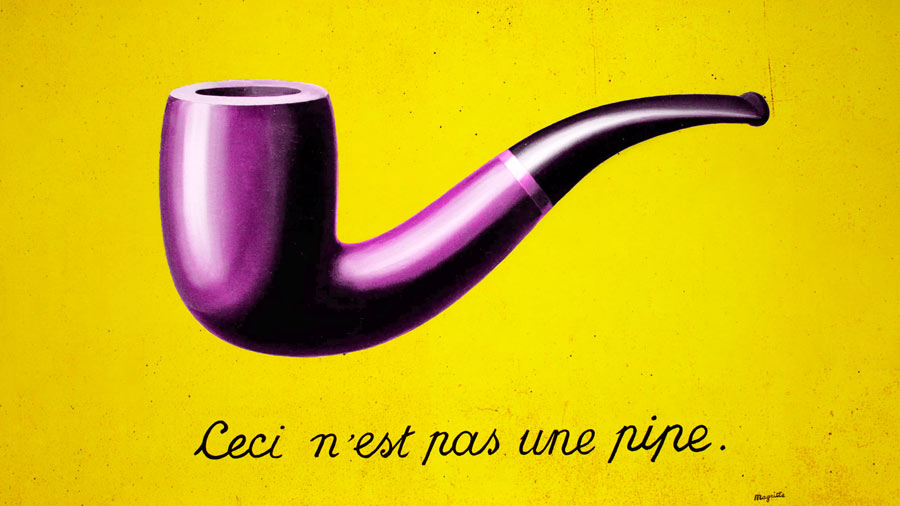
For many years, a reproduction of René Magritte’s The Treachery of Images has hung on the wall of my office. Painted in 1929, it is one of the most recognisable works of twentieth-century art. The painting itself is remarkably simple. Against an otherwise empty background sits an almost perfectly conventional tobacco pipe. Beneath it Magritte has written, in careful script, six words:
Ceci n’est pas une pipe.
(This is not a pipe.)
The first reaction is almost instinctive. Of course it is a pipe. We can see it. Except Magritte was right. It isn’t a pipe. It is a painting of a pipe. You cannot pick it up, fill it with tobacco or smoke it. However convincing the image might be, it remains a representation of something rather than the thing itself.
That distinction is precisely why the painting has followed me from office to office for so many years.
Magritte called the work La Trahison des images (The Treachery of Images). He was interested in the relationship between objects, images and the words we use to describe them. We see an image of a pipe and our mind immediately converts the representation into reality. The picture becomes the thing.
Nearly a century later, I think we have developed a remarkably similar problem with organisational purpose. Over the past decade in particular, businesses around the world have invested enormous amounts of time, energy and money in defining their purpose. Consultants have been hired. Employees interviewed. Workshops held. Boards engaged. Words debated and refined. Eventually, after much deliberation, a sentence emerges intended to capture why the organisation exists and the contribution it seeks to make.
It’s then launched. It appears on the website and in the annual report. It’s incorporated into presentations, corporate communications and, inevitably, the ‘merch’: coffee cups, lanyards, pens, tote bags, USB flash drives and so on. It might even be painted on a wall.
And somewhere along the way, the representation becomes confused with the reality.
A purpose statement is not an organisation’s purpose.
(The words are not the purpose. They merely describe it.)
There is nothing wrong with that. Words matter. I have spent more than two decades helping organisations find the clearest and most compelling articulation of the idea around which they can organise themselves. Done well, a purpose statement can provide extraordinary clarity. It can make something complex understandable and memorable. It can give thousands of people a common language for describing why their organisation exists.
But the statement is still only a representation. A strategy document is not strategy. Values written on a wall are not culture. A sustainability report is not sustainability. An organisational chart is not an organisation. In each case, the words, pictures and diagrams are attempts to describe something that has to exist in the real world. Purpose is no different.
For over two decades I have argued that purpose should operate as a Single Organizing Idea, or SOI®. The choice of the word ‘organizing’ (with a z), has always been deliberate. Purpose has little value if it simply describes an organisation. Its real value lies in its ability to organise one.
If an organisation genuinely understands why it exists, that understanding should have consequences. It should influence the choices a board makes and the strategy an executive team develops. It should affect where capital is allocated, which markets are entered, what products and services are developed, who is recruited and rewarded, which partnerships are pursued and which opportunities are declined.
It should influence what gets measured and, most importantly, it should help when the answer is not obvious. It is in those moments that purpose stops being a statement and starts becoming useful.
Which is something New Zealand’s political parties may wish to reflect on. As TVNZ News reported this week, with elections come election campaigns and the inevitable campaign slogans; a handful of carefully chosen words intended to tell us something about who the parties are, what they stand for and what they intend to do.
Magritte would have enjoyed this year’s batch. Not because any of them are particularly memorable or clever, but because even if they were, that would rather miss the point. A slogan, after all, is no more a government than a purpose statement is an organisation. However appealing the words on the tin, they remain merely a representation of what is supposedly inside. Whether the contents bear much resemblance to the label is something we will only discover by experiencing what actually happens.
Perhaps The Treachery of Images should hang in more boardrooms — and maybe a few campaign offices too.
Ceci n’est pas une pipe. This is not a pipe. And that purpose statement on the wall? That isn’t your purpose either.

Book Review: Our Iceberg is Melting by John Kotter & Holger Rathgeber
Book Review: Our Iceberg is Melting by John Kotter & Holger Rathgeber
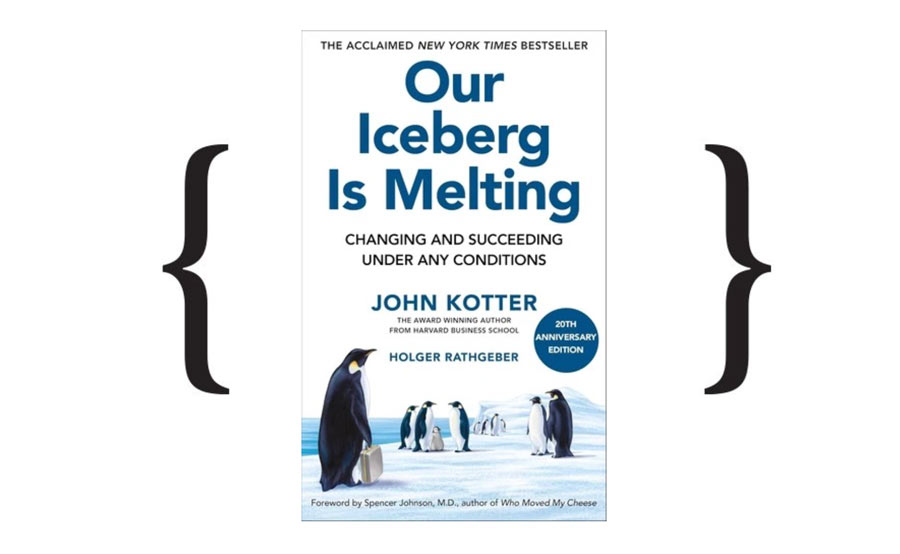
Nearly twenty years ago, Harvard’s John Kotter and Holger Rathgeber published a rather unusual management book about a colony of penguins.
Our Iceberg Is Melting tells the story of Fred, an observant and curious penguin who notices something deeply troubling about the iceberg his colony has occupied for generations. It is melting. Fred does what anyone who has spent time inside an organisation will recognise as the beginning of a difficult process. He gathers evidence, tests his hypothesis and eventually finds an ally in Alice, a strong and pragmatic member of the colony’s leadership team who is prepared to listen and, crucially, to act. Together they begin the difficult task of persuading the colony that something has to change.
Not everyone is convinced. Among the characters Fred encounters is the wonderfully named NoNo, an influential penguin whose particular talent is finding reasons why things should remain exactly as they are. The evidence is questionable, the danger exaggerated, the proposed response too risky. There is plenty of time and, besides, the colony has always lived on this iceberg.
I first read Our Iceberg Is Melting not long after it was published in 2006, at a formative point in my own thinking when I was beginning to develop what would eventually become Single Organizing Idea (SOI®). Nearly twenty years later, I was reminded of it last month when I read an article in The Economist about the demise of one of Earth’s largest icebergs. Iceberg A23a had broken away from its Antarctic home in 1986. There was something strangely grounding about reading the obituary of an iceberg that had existed for so long finally disappearing into the ocean, while Europe and other parts of the world are once again burning through a summer of extreme heat. It immediately brought Fred and his colony back to mind, so I went back and reread Kotter and Rathgeber’s short book.
Our Iceberg Is Melting is essentially a fable built around Kotter’s famous eight-step approach to leading change. One: Create urgency. Two: Assemble the right group. Three: Develop the vision and strategy. Four: Communicate it. Five: Empower people to act. Six: Generate short-term wins. Seven: Keep pushing. And finally, Eight: Embed the new behaviour deeply enough that it becomes part of the culture.
Rereading it exactly twenty years later, I found myself less interested in the mechanics of those eight steps than in the problem that precedes all of them — creating sufficient urgency to act. Before an organisation can change, enough people must believe that remaining where they are is more dangerous than moving somewhere else.
We live in an age in which the evidence for change is everywhere. Across Europe this summer, extreme heat has again brought wildfires, drought and pressure on infrastructure. Similar patterns are visible around the world and, as we have all experienced, New Zealand is hardly insulated from them. Floods, storms, landslips, coastal erosion and the growing cost of protecting communities and infrastructure are increasingly part of our own national conversation.
But climate change is only the most literal example of the melting iceberg around us. Artificial intelligence is transforming industries at extraordinary speed. Geopolitical relationships that appeared stable for decades are being reordered. Trade relationships are changing, populations are ageing, trust in institutions is at an all-time low and entire business models are being challenged. The interesting question is therefore no longer simply whether we can see the cracks. It is what we do once we have.
Last year I wrote about that particularly New Zealand expression, ‘She’ll be right’. At its best, ‘she’ll be right’ captures something admirable about our country and its optimism, resilience, pragmatism and unwillingness to panic unnecessarily. But there is another version. ‘She’ll be right’ can become an excuse for postponement, a belief that somehow things will work themselves out when something else happens, or that action is best deferred until the next election is settled, the summer is over, the new year properly underway or conditions are simply more favourable. There is always another perfectly reasonable reason to wait, and with it the comforting assumption that we have more time than we actually do. In other words, NoNo in a black jersey.
The people who resist change are rarely irrational. Often they are experienced, intelligent and successful. Indeed, their resistance can arise precisely because the existing system has served them well. The iceberg has always been there. The organisation has always made money this way. The country has always muddled through. Why change now?
Why? Because sometimes the conditions that produced yesterday’s success are the very conditions that prevent tomorrow’s.
There is another aspect of the book that struck me particularly strongly on rereading it. The penguins need more than a crisis. They need somewhere to go. Fear can create movement, but it cannot necessarily create direction. Urgency can persuade people to leave an iceberg but it cannot, by itself, tell them what they should move towards. That requires purpose. In other words, urgency answers the question, why must we move now? Purpose answers another, what are we moving towards? The two belong together.
Purpose without urgency can remain little more than aspiration, sitting comfortably on a website or appearing in an annual report without materially changing a single decision. Urgency without purpose presents a different danger. It can create frantic activity, competing priorities and people moving quickly but not necessarily in the same direction. Effective change requires both direction and momentum.
But perhaps the most important lesson in Our Iceberg Is Melting, however, comes at the end. The ultimate success of the penguin colony is not simply that it finds another iceberg. It learns to move.
That distinction feels even more important today than it did in 2006. We continue to talk about ‘managing change’ as though change were an inconvenient interruption between periods of stability. But what if stability is the interruption? Climate, artificial intelligence, geopolitics, demographics, technology and social expectations are not going to settle conveniently into some new permanent configuration.
The leadership challenge is therefore no longer simply how to move an organisation from A to B. It is how to build organisations, institutions and perhaps countries capable of continuing to adapt without losing their sense of who they are and why they exist. That requires shared values, a clear purpose that unites and brings opportunity to all, and a willingness to confront reality and create sufficient urgency to act.
Nearly twenty years after Our Iceberg Is Melting was published, we are surrounded by Freds pointing towards cracks in the ice and NoNos explaining why the cracks are not quite as serious as they appear, why the cost of moving is too great or why we should wait until the picture becomes clearer. Eventually, of course, the picture becomes perfectly clear. By then the choices available to us may be considerably fewer.
Purpose tells us what is worth moving towards. Strategy helps us determine how to get there. But we also need the Alices, the leaders prepared to listen to the Freds, to confront the NoNos and to give people the confidence and courage to begin the journey.
Our Iceberg Is Melting is available at leading bookstores and online retailers.
The Leadership Challenge Hidden in Plain Sight
The Leadership Challenge Hidden in Plain Sight
The latest Oxford–GlobeScan Global Corporate Affairs Survey reveals far more than the changing priorities of one corporate function. It offers a compelling picture of why governance, purpose and organisational alignment have become strategic imperatives in an increasingly uncertain world.
Every year, Oxford University’s Saïd Business School and GlobeScan survey senior Corporate Affairs leaders from around the world to understand the issues shaping their profession. This year’s research draws on the views of almost 300 senior practitioners across 51 countries, representing some of the world’s largest organisations.
The report catalogues an extraordinary list of pressures confronting organisations. Geopolitical instability dominates concerns once again. Artificial intelligence has surged from a relatively minor issue to become the second most significant perceived business risk in just twelve months. Economic uncertainty, regulatory change, cyber threats, climate change and reputational risk all feature prominently.
On the surface, these appear to be separate challenges requiring separate responses. I suspect they are nothing of the sort.
Rather, they are different expressions of a single reality, namely that the world has become so interconnected that political, economic, technological and societal issues can no longer be managed in isolation. Decisions taken in Washington reverberate through supply chains in Asia. Advances in artificial intelligence create opportunities for innovation while simultaneously introducing new risks around misinformation, cyber security and trust. Political polarisation reshapes expectations of business just as quickly as it reshapes government policy.
Complexity itself has become the defining management challenge. That observation becomes even more interesting when viewed alongside another of the report’s findings.
For many years the conversation around Environmental, Social and Governance (ESG) was dominated by climate change and social responsibility. This year’s survey tells a different story. Governance has overtaken both environmental and social issues as the greatest source of reputational risk for organisations. Ethics, accountability, transparency and board oversight are now seen as more significant than environmental performance or social impact.
That should not come as a surprise. In an increasingly unpredictable world, organisations are judged less by whether they face challenges than by how they respond to them. Governance determines the quality of decisions, the speed of adaptation and, ultimately, the level of trust that stakeholders are prepared to place in leadership. In these challenging times good governance has quietly become a competitive advantage.
Yet perhaps the most revealing finding concerns purpose.
Contrary to some popular narratives, organisational purpose has not disappeared. More than four in five organisations surveyed still have a formal corporate purpose in place (even if it is just a slogan). What has changed is the level of executive attention devoted to it. Discussion of purpose within executive teams has declined significantly over the past year, even while respondents overwhelmingly expect societal expectations of purposeful leadership to increase over the next three years. That tension is fascinating.
Boards have understandably become preoccupied with tariffs, inflation, geopolitical instability and artificial intelligence. Immediate risks demand immediate attention.
Stakeholders, however, have not lowered their expectations. Consumers, customers, employees, investors and wider society continue to judge organisations on the quality of their leadership, the values they demonstrate and the contribution they make. If anything, those expectations are becoming more demanding, not less.
The real issue isn’t that purpose has become harder to discuss. It’s that leaders risk becoming distracted by the urgent at precisely the moment when purpose is becoming even more valuable as a means of navigating uncertainty.
Purpose is not a luxury for more settled times. It is precisely what enables organisations to navigate unsettled ones.
The greatest risk is not abandoning purpose altogether. It is allowing it to be crowded out by the urgent. Organisations that lose sight of why they exist risk slowly eroding the trust, relevance and value on which their long-term success depends.
The smartest organisations appear to recognise this. Rather than stepping back from purpose, they are quietly doubling down on it; not as a communications exercise or a branding statement, but as the strategic discipline that brings governance, strategy, culture and stakeholder relationships together around a single, coherent direction.
Reading the report, I was struck by how frequently respondents returned to the same themes. They called for clearer strategy. Better internal alignment. Stronger governance. More integrated operating models. Better measurement. Greater influence at board level. Enhanced stakeholder engagement. Improved organisational capability. Seventy-four per cent believe the Corporate Affairs function itself requires revision to meet the demands of today’s environment.
Those recommendations describe something much bigger than the future of Corporate Affairs. They describe the future of organisational leadership.
For over two decades I have argued that the greatest challenge facing organisations is rarely a lack of purpose. More often, it is a lack of alignment. Strategy competes with culture. Governance sits apart from communications. Sustainability is managed separately from commercial priorities. Every function pursues legitimate objectives, yet too often without a common organising principle. The consequence is fragmentation precisely when coherence is needed most.
The Oxford–GlobeScan report documents the symptoms of that fragmentation with remarkable clarity. It also points, perhaps unintentionally, towards the solution.
The organisations most likely to thrive in the coming decade will not necessarily be those with the largest AI budgets, the most sophisticated communications teams or the most comprehensive ESG reports. They will be those capable of bringing governance, strategy, reputation, stakeholder relationships and organisational purpose together around a single, coherent direction.
That is not simply better Corporate Affairs. It is better leadership. And in a world where uncertainty has become the norm, that may prove to be the greatest competitive advantage of all.