



Here comes the shift: How purpose is bridging the divide: Part 1
Part One: Here comes the shift: How purpose is bridging the divide
As 2025 comes to a close, I’m noticing something rare in a year marked by noise and division — alignment. Not perfect alignment, the world is far too messy for that, but a quiet, unmistakable coalescence around the idea that unity through shared purpose is no longer fringe, optional or idealistic. It is emerging instead as a realistic antidote to the destruction that division wreaks. Purpose, as a driver of future prosperity and human wellbeing, has crossed a threshold. The innovators have broken down the barriers, the early adopters have done their job and we are now unmistakably in early-majority territory.
And when the early majority moves, markets move.
This shift isn’t ideological. It’s structural and it’s being driven by five converging forces:
- Geopolitics, which have made fragility impossible to ignore.
- Socio-economics, where inequality and insecurity are reshaping beliefs and behaviours.
- Demographics, with younger workers, acutely aware of the world they’re inheriting, increasingly unwilling to collude with business-as-usual.
- The environment, where climate change, biodiversity loss and resource constraints are forcing ever more urgent thinking around risk, resilience and responsibility.=
- Technology, particularly AI, which is forcing organisations to define what makes them meaningfully human.
Together they form an irresistible tide. You can, of course, sit on the shore like King Canute and command the waves to stop rolling in. But, just like the waves, markets will continue to do what markets do and reward those who meet the needs, values and preferences of customers, employees and investors.
This is why the 2025 narrative coming from the business-as-usual ‘Canute Brigade’, that ESG or sustainability has somehow gone away, is so misplaced. ESG hasn’t gone away. The only thing that has changed is the language. And frankly, thank goodness for that, because we are finally talking about how purpose drives performance, catalyses innovation and creates long-term value, rather than being sidelined by deny–delay–distract tacticians with their ‘woke caricatures and ‘dig-baby-dig’ calls to invest in industries in decline, while, the world’s richest and arguably most successful businessman pointed out, “severely damaging industries of the future.”
Mr Musk isn’t wrong to identify the tension. Many nations, including Aotearoa New Zealand, still find themselves caught between two instincts:
- Dig, baby, dig — invest in what we know, even as it declines.
- Bet on the future — back the industries, capabilities and governance models that will define the next 10–20 years.
These are not abstract forces grinding away in the background. They are choices made by people, in rooms, around tables, weighing up risk, reward and reputation. Which is why the question of who sits at those tables and how they think about their role matters now.
In a recent interview, Barack Obama said something that captures the spirit of this moment. He reflected on sitting in rooms with “folks with fancy titles,” only to discover they were not superhuman after all. Some brilliant, some not, some admirable, some deeply questionable. In his words:
“Once you sit at these tables…you talk to them and you go…oh, they ain’t all that.”
That sentiment is at the heart of why purpose is spreading. People are finally realising that the work of building better organisations, and better societies, isn’t reserved for the anointed few. It belongs to all of us.
Qiulae Wong, The Opportunities Party’s recently anointed leader, summed up her CitizenVoice policy in strikingly human terms: Connect as people first rather than hiding behind screens, give those most affected by decisions a genuine role in shaping them and remember that community, not radical individualism, is ultimately what makes societies work.
What interests me is what this signals about expectations of governance from the point of view of a relatively young political party entering an arena dominated by traditional organisations, with traditional ideas for a traditionally minded ‘voting constituency’. This is not challenger-brand veneer. It is a pragmatic and thoughtful reaction to the status quo and a model of governance that reflects what society is increasingly demanding from all our organisations — participation, transparency, fairness and long-term thinking.
Part Two will explore what this means for leadership in 2026. The courage to choose the future over the past, the discipline to align governance with purpose and the role of ISO 37011 in separating those who are merely talking about change from those who are prepared to contribute and lead it.

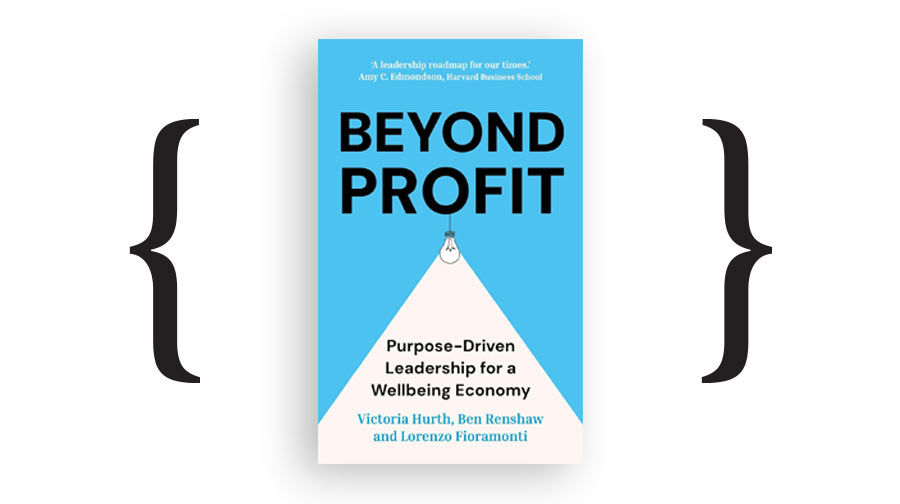
Book Review: Beyond Profit: How purpose-driven leadership can transform organisations and wellbeing
Beyond Profit: How purpose-driven leadership can transform organisations and wellbeing
By Dr Victoria Hurth, Ben Renshaw and Lorenzo Fioramonti
Amazon link
There’s a certain irony in the fact that, at the very moment the world feels increasingly fragmented, the most compelling ideas today are those that urge us to reconnect — to purpose, to people, to nature and to wellbeing. Beyond Profit belongs firmly in that camp.
I have known Dr Victoria Hurth for a number of years. We first met through a think-tank established by Ben Kellard of the Cambridge Institute for Sustainable Leadership. A gathering of practicing consultants and academics united by curiosity and a desire to challenge the status-quo, Victoria’s boundless energy was a driving force of the many debates we had about ‘all matters purpose’ during evening meetings and weekend retreats. It came as no surprise to me then, that she would later channel that energy into something that will genuinely make a difference. Her leading role in the vanguard of the of development of ISO 37011 (the forthcoming international standard that will define what purpose-driven governance looks like), and the publishing of Beyond Profit with Ben Renshaw and Lorenzo Fioramonti are testament to both her thinking and her remarkable determination.
Because of our relationship and the shared objectives that have shaped so many of our conversations over the years, I’ve set aside my usual review style and asked Victoria directly what five ideas she most wants readers to take away. Here’s my take on what she shared with me:
1. Purpose is contribution, not extraction
The first and perhaps the most foundational point is that organisations exist to contribute, not merely extract. Economies are supposed to produce long-term collective wellbeing; yet the way many companies operate achieves the opposite. Self-interest and survival are not innovation strategies. Nor are they adequate lenses for stewarding the scarce resources on which our future depends.
Moving beyond profit is not ideological; it is, in fact, totally rational.
2. A purpose-driven economy requires purpose-driven governance
If contribution is the goal, governance is the engine.
Governance determines:
- What an organisation exists to do
- The boundaries within which it must act
- The accountability mechanisms that keep it honest.
Shifting from business-as-usual to purpose-driven governance is not incremental, it’s transformative. It redefines performance. It shifts incentives. It opens the door to innovation that serves more than the balance sheet. And crucially, it recognises that a better future will not emerge by chance.
3. Leadership as courageous, human service
Leadership is a compassionate, courageous practice of service. The work of creating the conditions in which people can flourish and contribute to something better than the present. Fear, control and narrow financial incentives do not unleash creativity; they actually corrode it. A purpose-driven economy needs leaders who see humanity not as a drag on performance but as its primary asset.
4. The wellbeing economy where all stakeholders flourish is within reach — but only if we modernise governance
A wellbeing economy is not utopian. It is achievable, but only if the technical architecture of governance changes. The upcoming standard ISO 37011 to be published late next year, will provide exactly that blueprint.
5. If not this, then what?
If we do not intentionally redesign governance around purpose, then we are choosing the status quo — choosing extraction, fragmentation and harm.
The question, then, is disarmingly simple:
If not purpose-driven governance, what alternative can credibly deliver long-term wellbeing?
A clear, necessary contribution
Beyond Profit is not another corporate feel-good manual. It is a system-level argument delivered with clarity and moral seriousness. It challenges leaders to rethink not just their organisations but their assumptions about the economy itself.
By bringing together Victoria Hurth’s governance expertise, Ben Renshaw’s leadership insight and Lorenzo Fioramonti’s economic perspective, the book achieves something rare: It bridges disciplines without diluting their depth.
For leaders grappling with the demands of 2026 and beyond — technological disruption, social fragmentation, environmental constraints — this book offers both the intellectual framing and the practical orientation needed to steer in a more purposeful direction.

Beyond flat-packs: What IKEA’s arrival means for purpose-driven governance
IKEA shows that you can scale globally, serve meatballs and still lead with integrity.
First published in Chapter Zero New Zealand – 18 Nov 2025
In December, IKEA will finally open its first New Zealand store in Auckland. I’m old enough to remember the opening of IKEA’s first UK store in 1987 – but I don’t recall it generating quite this level of excitement. For many, IKEA’s arrival promises affordable Scandinavian design and meatballs. For me, it represents something deeper – the arrival of a company that has demonstrated over decades what can be achieved by challenging the status quo, leading with values and being single-mindedly purpose-driven.
Behind the blue-and-yellow logo stands Ingka Group, the largest IKEA franchisee and the operator of nearly all IKEA stores worldwide. While the IKEA trademark and concept are owned by Inter IKEA Systems B.V., Ingka Group is responsible for global retail operations, investment activities and the company’s world-leading approach to business governance. It’s a governance model that focuses people and sustainability around a widely understood core purpose and combines it with distributed accountability – and it works.
Ingka Group has shown that commercial success and positive societal impact are not opposing forces; its integration lies at the very heart of IKEA’s success. Its stated purpose – to create a better everyday life for the many people – is not a slogan but an organising idea. It shapes everything from how products are designed and priced to how materials are sourced, employees are treated, stores are powered and decisions are made in the boardroom.
Happily, Ingka is prepared to share and foster greater understanding of its success and the potential of being purpose-driven. First published in 2017, Ingka Group released its latest People & Planet Consumer Insights & Trends Report – a global study conducted with Canadian research partner GlobeScan – in October this year. Together their work tracks and captures the pulse of public expectations of business around the world. New Zealand directors should pay attention to the numbers. They might also pause to ask a simple question – why does a company that sells furniture publish such a report?
Despite the divisions fuelled by short-termist populist politicians, the squeeze of rising costs and the chaos of click-bait misinformation, something essential endures: people still care about one another, they fear for the climate, they dislike injustice and they long for a future – and a world – that is fair for everyone.
- 64% worry about climate change and almost half feel personally affected.
- 82% want companies to pay living wages and 36% say they boycott brands that fail to treat workers fairly.
- Seven in 10 consumers want clearer communication from businesses about the environmental and social impact of their products.
- Younger generations are leading, pioneering circular habits such as buying second-hand, renting and repairing.
This is not a consumer-trends report – it’s a governance signal and a wake-up call for boards. New Zealand stands at its own inflection point. Productivity is slipping, inequality is widening and, like elsewhere in the Western world, trust in both business and government is eroding. Yet there is also a deep-seated belief among Kiwis that we can, and should, do better – that values matter and that what unites us is far greater and more powerful than what divides us.
IKEA’s success offers three key lessons in the power of purpose as an organising idea – one that unites an entire enterprise, delivers measurable outcomes and drives long-term sustainable success:
- Make purpose the organising idea
Purpose only delivers when it sits at the heart of strategy and operations – not as an add-on or aspiration. From flat-pack logistics to renewable energy and circular design, IKEA has built its entire system around one clear idea. Everything else flows from that core purpose. - Align purpose with real-world value
The Ingka/GlobeScan report shows that saving money remains the top motivator for sustainable behaviour. IKEA’s genius lies in linking purpose with affordability – proving that what’s good for people and planet can also be good for profit. Boards that align purpose with everyday value creation turn ideals into enduring commercial success. - Govern for the long term
IKEA’s purpose endures because its governance model demands it. Ingka Group’s structure – a foundation with a long-term ownership mandate – protects purpose from short-term pressures and political fashion. Boards that design governance around purpose, not quarterly results, create the conditions for consistency, innovation and trust.
When the doors open in December, IKEA will undoubtedly attract large crowds eager to experience its mix of design, efficiency and Scandinavian charm. But the bigger story is what those crowds are recognising and rewarding through spending their hard-earned cash. Simply put, that is an approach to business superbly executed every day at scale, across the world by a company that has embedded purpose into the core of its governance, operations and culture – and prospered as a result.

Why do companies greenwash?
Why do companies greenwash?
Z Energy’s recent apology for misleading environmental claims poses a question: Why do companies keep greenwashing?
In 2022, Ampol owned Z Energy told New Zealanders it was “in the business of getting out of the petrol business.” It sounded like a radical step for the country’s biggest fuel importer — a bold signal that the company was changing course.
Three years later, after a costly legal dispute with Consumer NZ and environmental groups, Z Energy has admitted the truth: Its much-promoted biofuels plant wasn’t operating, its carbon-reduction claims excluded the emissions from the fuel it sells, and its messaging went “beyond aspirational.”
To its credit, the company has apologised. But the questions remain: Why do smart, well-resourced businesses keep saying one thing and doing another?
Z Energy is not an isolated case. Around the world, major brands have been caught in the same web. In the same sector, a quarter of a century ago, I saw firsthand the results of going “beyond reality” while working for the WPP branding agency that came up with BP’s now-infamous “Beyond Petroleum” rebrand. It’s a landmark example I’ve written and spoken about often over the years — a powerful core purpose and potential single organising idea that could have changed everything at BP and across the entire sector — if only Lord Browne, then CEO, had delivered on it.
Volkswagen’s “Clean Diesel” campaign promised low-emission performance but concealed deliberate manipulation of emissions tests is another case in point. H&M, Nestlé, Shell, HSBC, Kmart and others have all faced scrutiny for sustainability claims that overstated progress or obscured uncomfortable facts.
So why do they do it? Here are some reasons:
- To protect reputation – appearing progressive buys time and goodwill.
- To meet stakeholder pressure – investors, customers and employees expect and are much more vocal about, their expectations of business.
- To retain market relevance – being seen as sustainable, rather than being sustainable, has ironically become a survival strategy.
- To disguise inertia – rhetoric fills the gap where innovation and progress aren’t actually happening.
- To simplify complexity – clever marketing and creative advertising can tell a more compelling and engaging story than reality allows.
- Because of fragmented governance – the left hand (marketing) doesn’t know what the right hand (operations) is doing.
- Because leadership confuses communication with commitment – they believe saying it is the same as doing it.
- Because the system still rewards short-term profit – quarterly earnings trump long-term purpose.
- Because they lack a strategy for the future – senior leaders see change as risky and managing efficiencies as progress, missing out on the innovation that comes from grasping the future and contributing to it in ways that create new ideas, new value and sustained relevance for all stakeholders.
- Because they really don’t understand the power and potential of purpose — as a single organising idea that drives progress from the heart of business.
Most companies don’t set out to deceive. They simply haven’t re-engineered their businesses to deliver what their slogans promise. The result is an obvious credibility gap between what they say and what they do.
The hidden cost of that gap
The Z Energy case highlights the price of that gap.
The company spent hundreds of thousands of dollars in legal fees and lost months of leadership focus defending its own words. Far more damaging, though, is the erosion of trust.
Z’s chief executive, Lindis Jones, has walked a fine line between contrition and justification. He apologised “to the extent we caused any confusion,” but defended the campaign as “aspirational and provocative,” arguing it reflected the company’s intent to transition over time. It was, in effect, an apology for misunderstanding — not misrepresentation.
That distinction matters. Because when leaders stop short of full accountability, they signal that the problem is perception, not practice. The risk is that it entrenches the very behaviour the apology was meant to resolve.
When customers and communities discover that big environmental statements aren’t backed by real action, cynicism grows. The next time a company makes a genuine commitment, the public shrugs.
The collateral damage is borne by everyone — including the businesses trying to do the right thing.
The alternative: Walking the talk
There is another path, and we can see it in companies that have truly embedded purpose — organisations like Patagonia, Interface, Unilever and IKEA.
These businesses don’t just talk about sustainability; they integrate it into how they’re governed, how they invest and how they measure performance. They demonstrate that when purpose is treated strategically as a governance framework, not a slogan, it produces measurable benefits:
- Stronger stakeholder trust
- Greater innovation and resilience
- Higher employee engagement and retention
- Improved long-term performance
- Positive social and environmental impact
The irony is that if most companies actually did what their marketing departments claim, they would perform better — commercially as well as ethically.
The real issue is a failure of vision
Companies don’t greenwash because they’re evil. They greenwash because they lack a vision of the future.
Fixated on managing the status quo through lobbying politicians to protect short-term results, they are closed-minded to the possibilities of tomorrow — to the power and potential of new ideas to transform their businesses and ensure their long-term success.
Businesses such as Z Energy are emperors without clothes. They have jumped on the purpose bandwagon. They are not driven to make a positive difference to people and planet — but they are comfortable talking about it.
And that’s a great shame — and a lost opportunity. Because given their resources and influence, with a little courage these leading companies could do so much more than peddle purpose statements — they could live by them.
And that would benefit them and all of us as well.

The purposeful path to future prosperity
New Zealand stands at an inflection point. Once celebrated globally for its integrity, ingenuity and natural beauty, it now faces a complex set of 21st-century challenges: Productivity decline, widening inequality, talent shortages, environmental degradation and an erosion of trust in business and government alike. Yet within these challenges lies an extraordinary opportunity — to rediscover what makes Aotearoa different and to show the world how a small, values-driven nation can lead through purpose.
The power of purpose
Around the world, purpose has moved from rhetoric to results. Future focused companies that embed purpose at the core of governance and strategy consistently outperform their peers in growth, innovation and resilience. Purpose-driven organisations attract and retain talent more effectively, inspire loyalty among customers and earn the trust of investors and communities. When purpose becomes a measurable driver of decision-making — as formalised in the emerging ISO 37011 international standard on purpose-driven governance — it unlocks a flywheel of value creation that benefits both business and society.
In a world defined by disruption — from AI and climate transition to demographic and societal shifts — purpose has emerged as both a moral compass and a rational strategy for long-term success. It offers business leaders a clear alternative to short-termism, helping organisations navigate complexity with confidence, integrity and impact.
Why this matters to New Zealand
Few nations are better placed than New Zealand to lead in this space. Purpose resonates deeply with Kiwi values — fairness, community, stewardship, ingenuity
and manaakitanga — a way of being, grounded in respect, generosity and care. These are not abstract ideals; they are the foundations of a uniquely New Zealand approach to enterprise — one that strengthens our integrity and balances commercial success with collective wellbeing.
It was here, in Aotearoa, that the idea of a Single Organizing Idea (SOI®) — a practical method for embedding purpose at the heart of business strategy — first took root. The framework was conceived and inspired by what New Zealand stood for in my heart and mind: A place where integrity, creativity and care for people and planet could coexist naturally in business. Those same values still make this the ideal place to show the world how purpose can be made practical — not as a slogan, but as a system that unites people, drives productivity, generates new ideas, streamlines decision making and strengthens New Zealand’s reputation as a forward-thinking, purpose-led economy.
And yet, for all this natural alignment, purpose is very poorly understood by most New Zealand business leaders. The irony is that while our culture instinctively reflects purpose — fairness, ingenuity, community and care — our businesses rarely do. Too often purpose is dismissed as ‘fluff’ by poorly informed champions of the status quo, reduced to marketing language by advertising and brand agencies, or confined to the domain of sustainability teams by misguided leadership. In reality, purpose is a dynamic governance and performance driver that delivers competitive advantage in multiple ways — it is literally the missing link between values and value creation.
The economic case
When purpose is properly understood and implemented, it becomes the most powerful form of value creation there is. It aligns culture with performance, turns trust into capital and converts a Single Organising Idea into measurable results.
Global research shows that purpose-driven companies deliver up to 42% higher financial performance and 30% greater innovation output than competitors. A Harvard Business Review meta-analysis found that firms with a clear sense of purpose report stronger employee engagement and outperform the stock market by as much as 5–7% annually over the long term. Likewise, The Financial Times has reported that companies integrating purpose into governance and strategy demonstrate greater resilience during economic downturns and recover faster than peers.
For New Zealand — where small and medium-sized enterprises make up 97% of all businesses — this represents a significant and largely untapped lever for growth.
If we can help Kiwi businesses systematically identify, define and embed their purpose, we can unlock more than productivity gains. We can build stronger brands, attract talent and investment, increase export value and create an economy that competes on both integrity and ingenuity — one that’s genuinely future-fit.
By making purpose central to New Zealand’s business identity, we can help ensure that the next chapter of Aotearoa’s success story is one the world looks to for inspiration — and that, in itself, creates lasting value.

Book Review: The Evolving Doughnut: A Model for a Thriving Future
The Evolving Doughnut: A Model for a Thriving Future
When I read Kate Raworth’s Doughnut Economics back in 2017, it felt like a revolution in how we might think about progress. The designer inside me loved it instantly — a model that made economics both meaningful and beautiful. It reminded me of Edward R. Tufte’s The Visual Display of Quantitative Information, a book I’ve always admired for showing how great graphic design can reveal truth rather than decorate it. Raworth’s simple, elegant doughnut did exactly that — balancing human well-being within the planet’s ecological limits, cutting through the ongoing noise of GDP obsession and offering something rare: A picture of an economy designed to serve life, not the other way around.
Eight years on, the model has evolved again. In The Evolving Doughnut (2025), Raworth and Andrew Fanning transform the idea from a static snapshot into a living system — an annual monitor of global social and ecological health. It’s an extraordinary synthesis of science, data and moral clarity. It reminds us that the challenge isn’t simply to grow; it’s to grow up.
At its heart, the doughnut remains disarmingly simple:
- The inner ring defines the social foundation — the minimum conditions for every person to live with dignity.
- The outer ring defines the ecological ceiling — the planetary boundaries we must not exceed. Between them lies the safe and just space for humanity.
In this new iteration, every indicator tells a story. Some good — global access to electricity has risen, literacy has improved. Others, less so — carbon emissions, biodiversity loss and chemical pollution have all worsened dramatically. The visualisation now includes time-series data from 2000 to 2022, showing the deep imbalance between social progress and ecological overshoot. It’s both sobering and motivating.
What I find most powerful, however, is how Raworth acknowledges that the doughnut is not a Western invention but part of a long lineage of indigenous wisdom. She references Māori, Andean, Taoist and Buddhist traditions that see well-being as balance, not accumulation.
“In Māori culture,” she writes, “the concept of well-being combines spiritual, ecological, kinship and economic well-being, interwoven as interdependent dimensions.”
That idea could not be more relevant to Aotearoa today. It aligns beautifully with the essence of purpose — and with the forthcoming ISO 37011 standard on purpose-driven governance, which will guide organisations worldwide to embed the well-being of all stakeholders into decision-making and performance. Together, they redefine success not by scale or shareholder return, but by how well an organisation balances economic growth and positive social impact with environmental protection and renewal — contributing to the interdependent well-being of people, planet, and community.
Raworth’s evolving doughnut gives us a map. Purpose gives us the compass. Together, they point to a future where business is not about extracting value from the world, but creating value within its limits.

Why purpose-driven business isn’t risky business
Why purpose-driven business isn’t risky business
If there is one thing business leaders can agree on today, it is that risk is everywhere. Geopolitical shocks, climate disruption, artificial intelligence, shifting social norms — the pace and complexity of change is relentless. In such conditions, the instinct to tighten control and wait for calmer waters is understandable. But it is also perilous. In a world defined by uncertainty, standing still is often the riskiest move of all.
History proves the point. Kodak invented the digital camera but was fixated on protecting its film cash-cow. Blockbuster optimised its stores and late fees while streaming surged. Bookstore chain Borders outsourced online sales to Amazon and lost its customers. Toys ‘R’ Us was too debt-burdened to invest in omnichannel. Nokia clung to legacy software as the smartphone era dawned. Different sectors, same error: These companies didn’t fail because they took bold bets on the future — they failed because they did the opposite. In their inward-looking complacency, they mistook efficiency for strategy and risk aversion for prudence. The result was premature — and entirely avoidable — demise.
The risk of not acting
Here in New Zealand, as economist Cameron Bagrie recently observed in the New Zealand Herald (28 September 2025), too many boards are going/have gone down the same road. Citing the OECD’s 2022 Economic Survey of New Zealand, he pulled no punches in reminding readers that “Management boards in New Zealand’s firms are often more focused on preserving existing value and regulatory compliance than on growth strategies that involve productivity-enhancing investments and international expansion.”
Relying on old-school thinking, New Zealand’s boardrooms remain preoccupied with preservation over progress and efficiency over strategy. They’ve convinced themselves that waiting is wisdom — that the safest move is no move at all. Which, in plain speak, is inertia.
Yet the world outside their boardrooms is anything but inert. It is shifting — technologically, socially, demographically and geopolitically — at speed. Business governance is shifting too. Yesterday’s ‘business-as-usual’ model is being dismantled in real time by future-focused companies that understand risk and opportunity are now two sides of the same coin. Fossil-fuel firms are being overtaken by purpose-driven clean-tech innovators. Artificial intelligence is redrawing industries and redefining value creation. Conscious consumers are demanding transparency and authenticity. Increasing numbers of workers are gravitating towards employers that share their values and have a purpose beyond just making profit. Investors are pricing sustainability and resilience, not just returns.
Purpose as the antidote to risk and uncertainty
In this environment of constant change, evolving, grasping the future and pivoting towards being purpose-driven is anything but risky — it is the opposite. It is a golden opportunity:
- To embed a unifying and future-focused governance framework — a Single Organising Idea (SOI®) — that anchors decision-making and aligns the business behind a shared purpose.
- To shift the focus from protecting the status quo to channelling effort and resources into tangible outcomes that deliver both financial and social value.
- To empower boards and leaders with a north star that reduces ambiguity, sharpens decision-making and builds the confidence to act.
- To attract talent, partners and investors who are increasingly drawn to organisations with clarity of purpose and the courage to lead through change.
Because when a business knows who it is, why it exists and how it creates value for others, risk and uncertainty cease to be threats — they become sources of advantage.
White Paper: Humanising Business: Why Trust, Relationships and Purpose Are the Next Strategic Advantage
Humanising Business: Why Trust, Relationships and Purpose Are the Next Strategic Advantage
By Kavita Khanna and Neil Gaught

The Māori Queen’s quiet leadership and grounded purpose
The Māori Queen’s quiet leadership and grounded purpose
Last week, at just 28 years old, Te Arikinui Kuīni Ngā Wai hono i te Pō delivered a speech that resonated like a heartbeat — steady, human, deeply rooted. Crowned only a year ago, she already carries a timeless authority. With a BA and MA in tikanga and reo Māori from the University of Waikato, she blends profound cultural knowledge with modern leadership at a level rarely seen in someone so young.
Her presence in that speech wasn’t just regal — it was real. Attendees commented on her humility, dignity and heartfelt emotion, saying she spoke not from a script, but from the core of her being. Many of the young there saw in her a reflection of themselves; elders were moved to tears by the pride carried in her words.
In her address, she urged her people to redefine what it means to be Māori — not as a posture of resistance but through everyday cultural living: Language, history, care for whenua and enduring unity. That quiet authority, grounded in a clear sense of purpose, isn’t loud — it’s deeply compelling.
“Being Māori is not defined by having an enemy or a challenge to overcome. Being Māori is speaking our language. It is taking care of the environment. It is reading and learning about our history. It is the choice to be called by our Māori name. There are many ways to manifest being Māori, not just in times of protest.”
Her fusion of youthful grace, cultural fluency and leadership is magnetic. Watching her speak — and then reading her words — immediately recalled the deep sense of humanity I felt a month ago when the New Zealand Story Group released its highly evocative video promoting pakihi Māori (Māori business) to international trade audiences. At the time, I wrote in a LinkedIn post:
“This isn’t branding. It’s not spin. It’s a values-led view that puts wellbeing — of people, land and legacy — at the heart of what it means to prosper.”
Similarly, the Queen’s leadership qualities aren’t about optics or rhetoric. She embodies kaitiakitanga — care for people, place, and future — through simple, everyday leadership decisions. In a world where leadership often mistakes noise for strength, she shows us that true courage can be calm, real power grounded in purpose and that resonant leadership begins with respect, not spectacle.
When leadership unifies clear purpose with authentic presence, the result is transformative.
